

Among the samples collected by the Chang'e 5 probe, researchers found a "transparent prismatic crystal" about the width of a hair, which is actually an "unidentified lunar mineral" called ULM-1, according to a study published on July 16 in the journal Nature Astronomy.
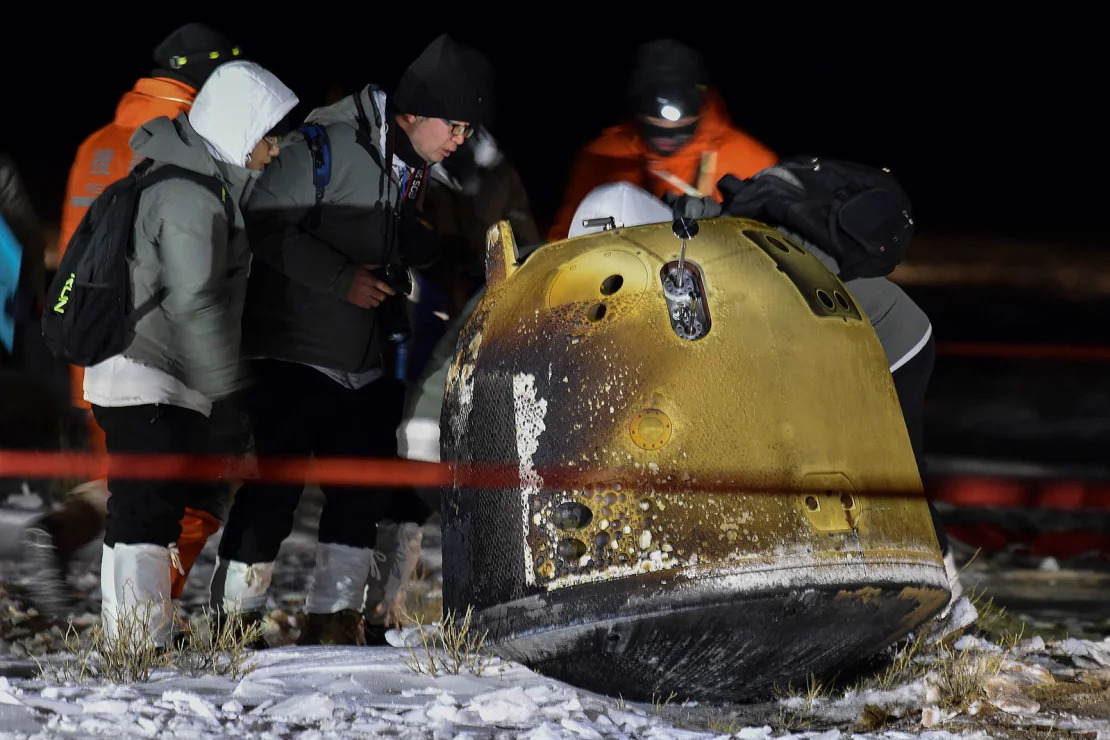
Crew members inspect the Chang'e 5 probe after its successful landing in northern China in December 2020. Photo: Xinhua News Agency
According to the study, the ULM-1 crystal (with the chemical formula (NH4)MgCl3·6H2O) is composed of approximately 41% water, along with a small amount of ammonia which helps keep the H2O molecules stable despite the extreme temperature changes on the Moon.
Scientists say this type of water could be a "potential resource for life on the Moon".
The discovery of water on the Moon is not new. Previously, NASA and Indian spacecraft have detected what they believe to be water on the lunar surface. Last year, Chinese scientists also found water trapped in scattered glass particles on the Moon.
But scientists say this latest discovery marks the first time water has been found in molecular form (H2O) in physical samples. Importantly, it was taken from a part of the Moon where they previously thought water could not exist in that form.
"The discovery of hydrated minerals at the Chang'e 5 landing site is exciting and will help us better understand the vapor-rock reaction in the lunar crust and on the lunar surface," said scientist David A. Kring of the Lunar and Planetary Institute in Texas, who was not involved in the study.
According to planetary geologist Yuqi Qian at the University of Hong Kong, who was not involved in the study, there are three types of water that could exist on the Moon: water molecules (H2O); ice; and a molecular compound called hydroxyl, a close chemical relative.
The samples collected by the Chang'e 5 probe came from a mid-latitude section of the Moon, at 43.1 degrees latitude – an area that is typically "unstable for molecular water," Qian said. The ammonia found in the samples acts as a stabilizer for water molecules, he explained.
The Moon's poles are difficult to navigate due to their rocky terrain, making them challenging locations for water extraction. Furthermore, molecular water, which is "unstable in other parts of the Moon," evaporates at lower latitudes where temperatures can exceed 100 degrees Celsius, Qian said. This new research will change that.
"I think this new discovery has a lot of potential; we could extract molecular water directly from the soil on the Moon. This is a novel mechanism for stabilizing molecular water on the lunar surface," Qian said.
Hoai Phuong (according to CNN)
Source: https://www.congluan.vn/phat-hien-nuoc-trong-mau-dat-mat-trang-cua-trung-quoc-post306563.html




















































































Comment (0)