

(NLĐO) - Scientists have just discovered something incredibly deadly in the world once sweetly known as the "cotton candy planet".
According to Science Alert, a research team led by astrophysicist Lisa Nortmann from the University of Göttingen (Germany) has just discovered raging winds, more intense than any world previously known to humankind, on a planet called WASP-127b.
These winds in this far-off world reach speeds of up to 33,000 km/h. For comparison, the highest wind speed ever recorded on Earth was 407 km/h, measured at Barrow Island, Australia, in 1996.
A Category 17 storm on the extended Beaufort wind scale used by Vietnam has wind speeds of 202-220 km/hour.
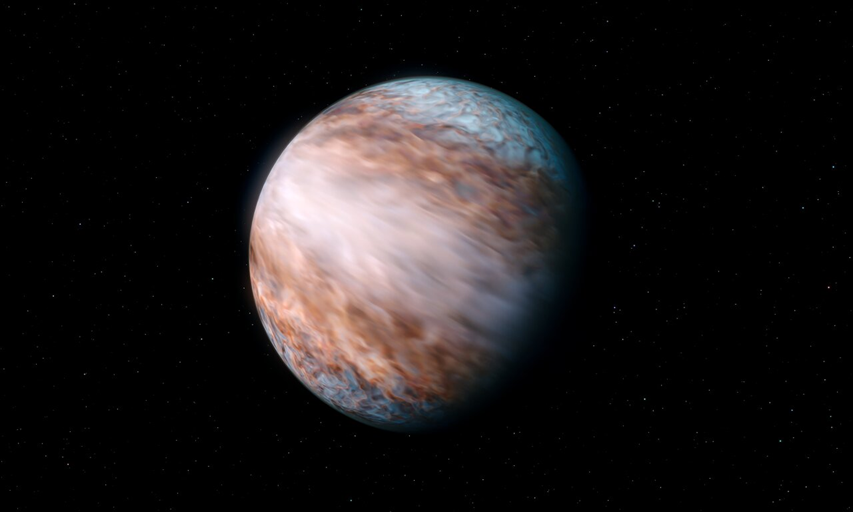
The hot and furious planet WASP-127b - Graphic image: ESO
Writing in the scientific journal Astronomy & Astrophysics , the researchers said they analyzed the light spectrum reflected from the planet WASP-127b, discovering two contrasting peaks in the water and carbon dioxide signals.
"Part of this planet's atmosphere is moving toward us at high speed while another part is moving away from us at the same speed," Dr. Nortmann explained.
This signal indicates the presence of a supersonic jet stream moving around the planet's equator.
"Fast is an understatement. At an astonishing speed of 7.5 to 7.9 kilometers per second, they far surpass any storm or jet stream known to science," the authors stated.
WASP-127b has long attracted scientific attention due to its unusual bulging shape, which has earned it sweet nicknames such as "cotton candy planet" or "cloud planet".
In fact, it's a "hot Jupiter," a type of large gas planet similar to Jupiter, but scorching hot because it orbits so close to its parent star.
WASP-127b is estimated to be slightly larger than Jupiter, but its mass is only 16% of Jupiter's.
It orbits the star WASP-127 in just 4.2 days, located 520 light-years from Earth, and is tidally locked with it.
Tidal locking is a phenomenon where a celestial body is bound by the gravitational pull of a larger body, causing it to always face only one side towards that larger body, similar to the Moon being tidally locked with the Earth.
In the case of WASP-127b, this condition gives the planet two contrasting hemispheres: one side is always daytime, the other is always nighttime.
The daytime side of the planet has a "scorching" temperature: around 1,000 degrees Celsius. Coupled with the aforementioned terrible winds, we certainly have no hope of finding life there.
Source: https://nld.com.vn/phat-hien-rung-ron-noi-hanh-tinh-gio-va-lua-196250124082805027.htm


![[Photo] General Secretary and President To Lam presides over a meeting with the Central Organizing Committee.](https://vphoto.vietnam.vn/thumb/1200x675/vietnam/resource/IMAGE/2026/06/03/1780482764658_a1-bnd-4741-3342-jpg.webp)

![[Photo] First session of the 14th Congress of the Vietnam Trade Union](https://vphoto.vietnam.vn/thumb/1200x675/vietnam/resource/IMAGE/2026/06/03/1780465947883_ndo_br_img-3852-jpg.webp)
![[Photo] Secretary of the National Assembly Party Committee, Chairman of the National Assembly presides over the meeting of the Standing Committee and Executive Committee of the National Assembly Party Committee.](https://vphoto.vietnam.vn/thumb/1200x675/vietnam/resource/IMAGE/2026/06/03/1780480353201_ndo_br_bnd-2585-jpg.webp)





















































![[Video] Sunset at Lap An Lagoon – Where the sun sets over the fishing nets](https://vphoto.vietnam.vn/thumb/1200x675/vietnam/resource/IMAGE/2026/05/31/1780192137701_beach-landscape-sea-water-nature-grass-745871-pxhere-com.jpeg)










































Comment (0)