

Kinhtedothi - Strengthening the financial health and competitiveness of state-owned enterprises in general, and Vietnam Airlines Corporation in particular, is necessary to leverage advantages, overcome limitations, and seize development opportunities...
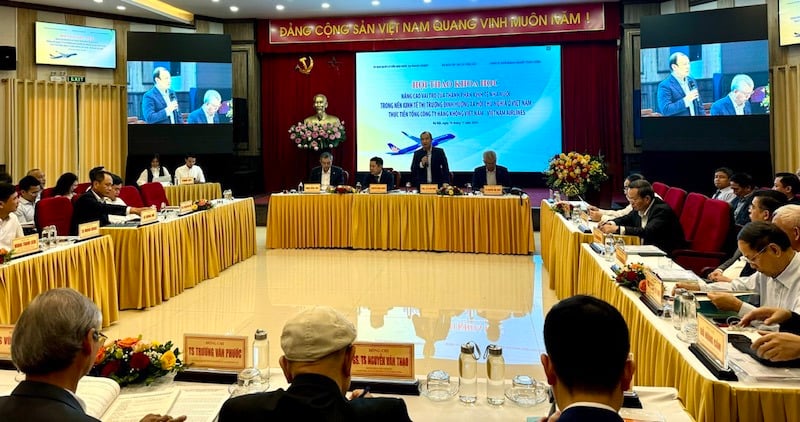
This was the general opinion of experts at the seminar "Enhancing the Role of the State-Owned Economic Sector in the Socialist-Oriented Market Economy in Vietnam - From the Practice of Vietnam Airlines Corporation" organized by the Communist Magazine, the State Capital Management Committee at Enterprises, and the Party Committee of the Central Enterprise Bloc on the morning of November 10th.
Negative equity, accumulated losses
Associate Professor, Dr. Vu Van Phuc - Vice Chairman of the Science Council of the Central Party Agencies, stated that the Party's viewpoint on the position and role of State-owned enterprises (SOEs) is very clear. They hold a key position, are an important material force of the State economy, and serve as a tool to support the State in regulating the economy, stabilizing the macroeconomy, and promoting economic development. SOEs play a dominant and leading role in important and essential sectors of the economy, and in many critical infrastructure areas such as telecommunications, information technology, transportation, and finance and banking.
According to the Government's report to the National Assembly (2024), as of the end of 2023, the country had 671 state-owned enterprises (SOEs), including 6 economic groups, 53 state-owned corporations, and 19 limited liability companies operating under the parent-subsidiary model. While accounting for just over 10% of the total number, these groups, corporations, and parent-subsidiary companies play a crucial economic role, holding 92% of total assets, 90% of total equity, 93% of total revenue, and 85% of total contributions to the state budget from SOEs nationwide. The total assets and total equity of the SOE sector reached VND 3,899,447 billion and VND 1,838,707 billion respectively. However, the numerous political and social responsibilities they must shoulder may negatively impact the economic efficiency of SOEs.
Vietnam Airlines (VNA) currently has total assets of nearly 58,000 billion VND and a fleet of over 100 aircraft, playing a crucial role in air transport. With over 30 years of experience in the aviation sector, VNA possesses many competitive advantages and development potential. As a 4-star national airline, it is striving to become a leading 5-star international airline in Asia…
In the first nine months of 2024, VNA's revenue reached VND 82,000 billion (a 17.4% increase compared to the same period last year). Net profit reached nearly VND 6,000 billion, a significant improvement compared to the net loss of VND 3,740 billion in the first nine months of 2023. The gross profit margin also improved significantly, reaching 11.9% compared to 6.1% in the same period last year. Despite returning to profitability, VNA still incurred accumulated losses of VND 35,225 billion, resulting in negative equity of VND 11,086 billion.
According to VNA Chairman Dang Ngoc Hoa, the severe consequences of the Covid-19 pandemic, coupled with the overall economic difficulties, have created significant challenges for VNA. Currently, the parent company's equity remains negative, accumulated losses are still high, and the corporation's financial situation is still unbalanced, with large amounts of due and overdue debts. The situation is further complicated by geopolitical tensions, with airlines facing numerous disadvantages including high fuel costs, fleet upgrades, aircraft leasing, purchasing, and maintenance, personnel shortages, exchange rate fluctuations, and airport service fees. Therefore, the support and cooperation of the State are crucial for the company's future growth.
Institutions and cash flow: Enhancing the efficiency of state-owned enterprises.
Chairman of the Board of Directors of VNA, Dang Ngoc Hoa, stated that the company has developed a comprehensive restructuring plan to overcome difficulties and build a future, and requested that the plan be quickly approved. The main components include increasing equity capital by 22,000 billion VND through issuance to existing shareholders, policies on environmental protection taxes and landing and takeoff fees, etc. The company also requested ensuring infrastructure and assigning VNA to participate in the Long Thanh International Airport project, and importantly, developing aircraft maintenance and repair services.
Global experts estimate that from 2003 to 2018, for every 1% increase in GDP, the aviation industry grew by 1.28% to 2.03%. Over the past 20 years, for every 1% increase in Vietnam's GDP, the aviation industry has grown by approximately 1% to 1.5%. The importance of aviation to the economy is immense. Aviation is a particularly crucial industry, the lifeblood of the nation. Not only does it play a vital role in economic development, but it also holds significant importance for national security, military affairs, and sovereignty. Therefore, it is necessary to continue implementing solutions to overcome difficulties and innovate, improving operational efficiency to overcome the crisis, recover quickly, and achieve sustainable development.
However, the restructuring process of the national airline is facing some obstacles and shortcomings due to inconsistent legal mechanisms and policies. “In the law on capital management for state-owned enterprises, the State only provides capital for the security and defense sectors. That is an institutional bottleneck. If the State provides more capital, it will face difficulties. But if enterprises increase their charter capital and issue more shares to the public, the Securities Law stipulates that loss-making enterprises are not allowed to issue shares to the public,” shared Mr. Truong Van Phuoc, former Acting Chairman of the National Financial Supervision Committee.
Therefore, the State needs to focus on reviewing and improving the institutional framework and legal regulations in the fields of aviation and tourism, as well as legal regulations on the operation of enterprises, the stock market, and investment, especially for enterprises in which the State holds a controlling stake, to ensure flexibility, consistency, and suitability to practical realities, serving as a basis for handling unforeseen events.
Dr. Truong Van Phuoc proposed immediate approval of the VNA restructuring plan and amendments to the securities law in the following direction: "Even if a company is losing money, from an investor's perspective, if that company has potential, investors can still buy newly issued shares and bear the responsibility for their own decisions. Capital should be concentrated through institutional mechanisms to achieve the fastest possible capital increase for VNA."
National Assembly Deputy Trinh Xuan An believes that state-owned enterprises (SOEs) have three pillars: finance, human resources, and science and technology (S&T). If these are effectively utilized, they will be highly efficient. He proposed combining both short-term and long-term solutions. In the long term, the law amendment process should include criteria allowing core SOEs and enterprises with national brands to retain 100% of their profits, and piloting special mechanisms (capital, human resources, S&T). In the short term, an immediate solution is to establish a fund for leading SOEs to refinance their operations.
Former Vice Chairman of the National Assembly, Phung Quoc Hien, supports a long-term perspective. He believes a thorough review and assessment of the relevant legal documents is necessary. This review and timely amendment will create a breakthrough, establishing a favorable mechanism and policies for state-owned enterprises in general, and Vietnam Airlines in particular, to develop sustainably and balance political and economic objectives. In addition, VNA must also implement its own solutions, restructure, and overcome difficulties. This includes developing a rational business plan, reorganizing production activities, ensuring safety, changing the flight network, improving productivity, restructuring loans and debts with suppliers, and applying science and technology.
Source: https://kinhtedothi.vn/phat-develop-the-aviation-in-the-new-context.html






















![[Photo] Reception to welcome General Secretary and President To Lam and his wife on their State visit to the Philippines](https://vphoto.vietnam.vn/thumb/1200x675/vietnam/resource/IMAGE/2026/06/01/1780295488620_vna-potal-chieu-dai-chao-mung-tong-bi-thu-chu-tich-nuoc-to-lam-va-phu-nhan-tham-cap-nha-nuoc-toi-philippines-8798060-7855-jpg.webp)



















































Comment (0)