

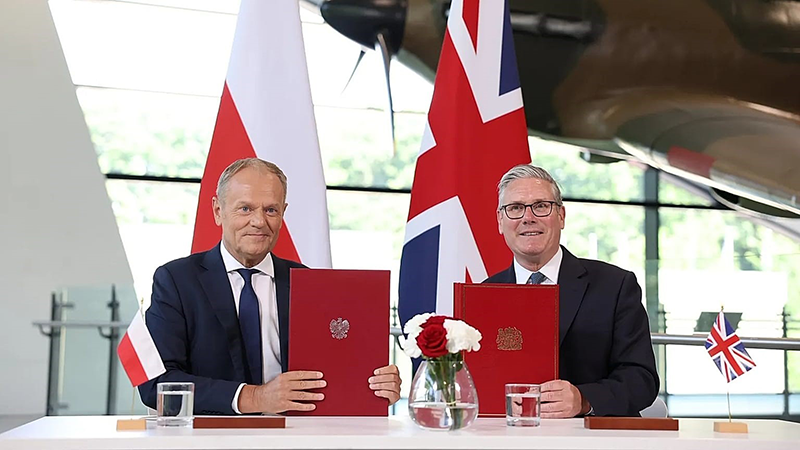
British Prime Minister Starmer (right) and his Polish counterpart Donald Tusk sign a security and defense cooperation agreement on May 27 in London. Photo: Donald Tusk/X
Prior to Poland, Britain had signed similar treaties with France, Germany, and Norway. Poland itself has signed treaties with France and Sweden and is preparing to sign another with Germany. Many more bilateral treaties are likely to be signed in the near future.
These numerous bilateral agreements are becoming one of the defining features of European defense in a short period of time. These treaties are highly practical, covering areas such as missiles, drones, cybersecurity, intelligence sharing, border security, and military interoperability.
This trend towards bilateral cooperation increasingly resembles European security doctrine in the new era – an era of strategic instability, where governments no longer assume that old security guarantees, alliances, and institutions will automatically be maintained.
More specifically, Europe wants security against the potential threat from Russia while it is increasingly uncertain about the long-term reliability of the United States within the North Atlantic Treaty Organization (NATO). As a result, the continent is building what it calls a “lineup” of bilateral security guarantees outside of NATO and the European Union (EU).
NATO remains the cornerstone. The EU still plays a crucial role through its funding policies, regulations, sanctions, and shared defense industry programs. However, the most dynamic aspects of these two multi-member organizations are increasingly bilateral, as a divided EU cannot act quickly enough and NATO is dependent on a highly unpredictable United States. Governments within the EU and NATO are forming smaller groups because they operate more rapidly.
Indeed, these treaties accomplish what larger institutions often struggle to do. They provide political guarantees, link defense industries, and foster a habit of military cooperation. They allow nations to combine specific strengths with specific weaknesses.
For Britain, signing a security treaty with EU members is the most viable path for London to regain and maintain influence in the Old Continent after Brexit. Prime Minister Keir Starmer wants Britain to strengthen its ties with the EU, but not through economic means, but rather through defense capabilities – where London still possesses significant intelligence capabilities, nuclear deterrence, expeditionary military experience, an advanced defense industry, and diplomatic influence in debates about European security.
DUC TRUNG
Source: https://baocantho.com.vn/chau-au-xay-dung-an-ninh-ben-ngoai-the-che-a205778.html
![[Photo] Ba Lang An Lighthouse - the "eye of the sea" amidst the "rock museum" of Quang Ngai province.](https://vphoto.vietnam.vn/thumb/1200x675/vietnam/resource/IMAGE/2026/05/29/1780038698840_anh-man-hinh-2026-05-29-luc-14-10-42.png)



![[Image] Pleasant weather helps students enter the 10th grade entrance exam with confidence.](https://vphoto.vietnam.vn/thumb/1200x675/vietnam/resource/IMAGE/2026/05/29/1780034401612_ngay-1-thi-lop-10-minh-duy-8-5009-jpg.webp)


















































































Comment (0)