

In global higher education , rankings are often seen as a shorthand for measuring quality. But their true value lies not in the ranking number itself, but in the mindset, mechanisms, and capabilities that created that number.
From that perspective, the fact that Phenikaa University – a member of the Phenikaa Group – has maintained its leading position in Vietnam on the Nature Index for six consecutive years is not just a remarkable achievement. It is also a case worth analyzing; not simply because of the ranking, but because stability in science rarely comes from luck. It is usually the result of a deliberate approach to building long-term research capacity.
This is particularly noteworthy when considering the nature of the Nature Index.
Unlike many measurement systems based on the number of publications, the Nature Index reflects the actual contribution to high-quality scientific research published in leading journals worldwide . In other words, this index not only recognizes presence in science, but also reflects the level of participation in the knowledge creation process.
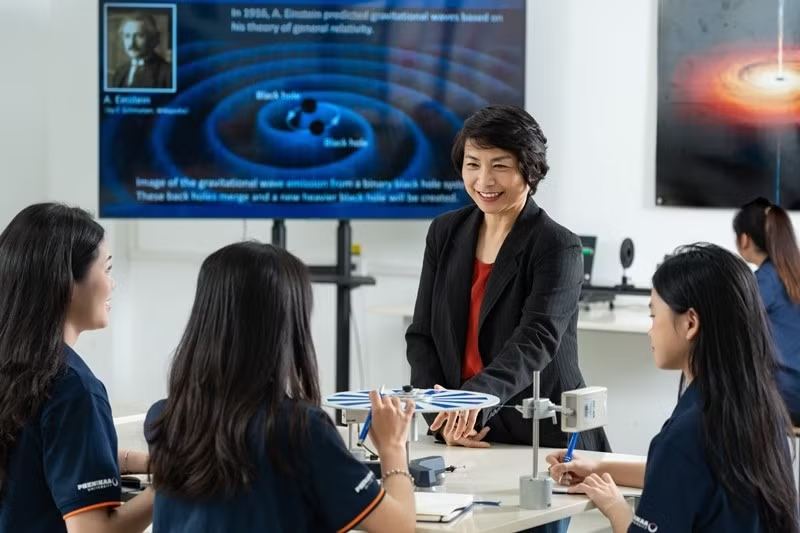
Therefore, maintaining a leading position for many consecutive years cannot come solely from short-term results. It requires a research ecosystem stable enough to pursue long-term questions, which is the very nature of science.
Here, an important distinction needs to be clearly understood: rankings can be improved in the short term, but scientific competence can only be built in the long term.
These two goals are often conflated. But when the system begins to optimize for measurable metrics instead of investing in the conditions that generate knowledge, measurement itself gradually becomes an end in itself. This is not a problem unique to Vietnam. Many higher education systems around the world are also facing the pressure to balance immediately measurable results with the process of building a sustainable scientific foundation.
However, in the context of Vietnam, where the research ecosystem is still in a transitional phase between scaling up and improving quality, this issue becomes even more thought-provoking.
Pressure to produce high output can generate impressive numbers in the short term. But impactful work, especially in basic science, requires different conditions: time, patience, academic freedom, and a willingness to invest in questions that may not yield immediate results.
From that perspective, Phenikaa's case suggests a noteworthy approach.
Instead of focusing on immediate results, the university's research development strategy focuses on building foundational conditions: minimizing administrative barriers, empowering scientists with greater autonomy, and embracing the long cycles of basic research. This isn't the quickest way to create media presence, but it may be a more suitable path if the goal is the quality and sustainability of science.
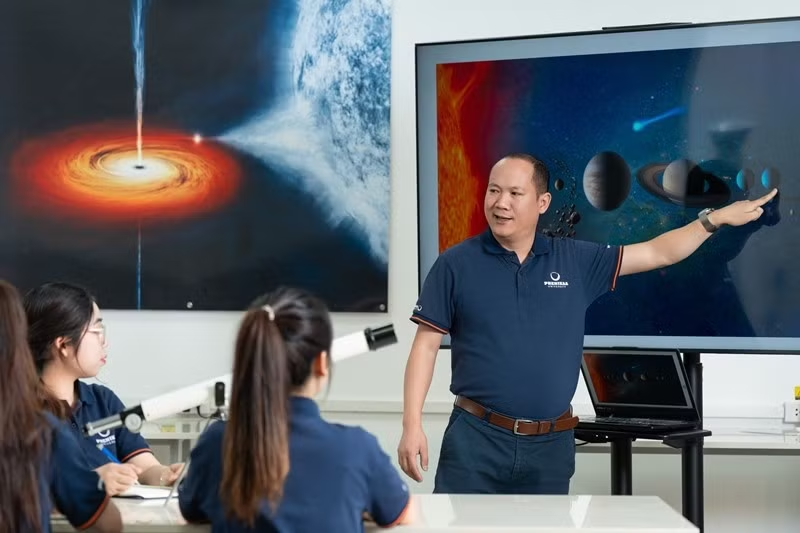
The role of the Phenikaa Institute for Advanced Studies (PIAS) is a prime example. With a significant contribution to the total Share score (an indicator reflecting the author's contribution to each publication), PIAS demonstrates the effectiveness of a focused research model and reflects a more important shift: from participating in international collaborations to gradually shaping research directions.
Several publications featuring significant contributions from the Institute's scientists demonstrate that competence lies not only in "participation," but also in the ability to formulate research questions and lead academic direction.
In science, the right to ask important questions is just as important as the ability to answer them.
This shift has implications that extend beyond the scope of a single organization. For developing scientific systems, the challenge is not simply increasing the number of publications, but progressively elevating their position within the global knowledge value chain: from participants to leaders.
At the policy level, this leads to a larger question: are organizations pursuing rankings, or are they building scientific capacity?
This question is not intended to negate the role of measurement tools, including the Nature Index. A good index, if designed and used correctly, remains an important tool for strategic guidance. But the problem lies in this: when any ranking becomes an end in itself rather than a consequence of a long-term strategy, it begins to skew the system's priorities.
From that perspective, Phenikaa's continued position on the Nature Index is not simply an outcome. It reflects the existence of a scientific environment capable of operating effectively in the long term, where talent is nurtured, and organizational structures are designed to suit the specifics of research activities.

For Vietnam, the significance of such cases lies not in comparing rankings, but in the direction they suggest. If the goal is deeper participation in global science, the focus of the system cannot be limited to output indicators, but must shift to building the conditions for science to truly flourish.
Phenikaa's six-year journey on the Nature Index can therefore be seen as an ongoing experiment.
Its greatest value lies not in its leading position, but in the question it raises: are we willing to invest in things that don't produce immediate results, but will determine our scientific capabilities in the long term?
And in science, perhaps the answer to that question, more than any ranking, is the ultimate measure of a system's vision and capabilities.
The achievements recorded in scientific research activities at Phenikaa University are also a proud accomplishment of the Phenikaa Group, clearly demonstrating the spirit of "Innovation - Creation - Sustainability" throughout the Group's development strategy. At Phenikaa, "Innovation" is the core source that nourishes all thinking and actions, the glue that tightly connects the seamless value chain from training, research and development, application to production and business, creating practical, groundbreaking and effective values, contributing to improving the quality of life and unlocking new potential for society.
Source: https://giaoducthoidai.vn/phenikaa-va-cau-chuyen-vuot-khoi-cuoc-dua-thu-hang-post778127.html
![[Image] Hanoi's urban life under the challenge of a "scorching hot" environment](https://vphoto.vietnam.vn/thumb/1200x675/vietnam/resource/IMAGE/2026/05/25/1779706979265_nang-nong-t5-2026-minh-duy-7-4636-jpg.webp)































































Comment (0)