

A solid foundation of knowledge is needed to enhance critical thinking skills.
+ In recent years, the Middle East has been a hotbed of political instability and military conflict... When an event occurs, there are many conflicting reports. How can reporters obtain the most up-to-date, complete, and accurate information quickly, sir?
- Fake news has become a global problem. In regions with much conflict, suspicion, and mistrust, such as the Middle East, the problem of fake news is even more pronounced. In many cases, fake news doesn't simply originate from a few individuals; it's a well-planned information war waged by various parties with ulterior motives… But we see this as both a challenge and an opportunity for our correspondents to prove their worth.
The age of the internet and social media has made the world increasingly interconnected. Stories from distant lands are now quickly accessible to Vietnamese people. But what resident correspondents can excel at is providing viewers and readers with insightful perspectives and insights into the underlying nature of events in their assigned regions. In many cases, resident correspondents abroad need to act as a "filter," helping audiences gain accurate and truthful understanding of global issues.
In my opinion, the more a foreign correspondent immerses themselves in the local life, the deeper their understanding of events in that country will be, and the more discerning they will be of "fake news traps." For example, recent stories about the Israel-Hamas conflict or the Iran-Israel tensions. There are conspiracy theories or figures that sound sensational at first glance. But if you put them in a broader context, and try to connect them with other factors you already know, you'll see the absurdity.
Therefore, I believe that journalists need to build a solid foundation of knowledge to enhance their critical thinking skills. In addition, in each place we travel to, I try to build a network of friends. This network has helped me a great deal in providing diverse perspectives and hearing different viewpoints on an issue.
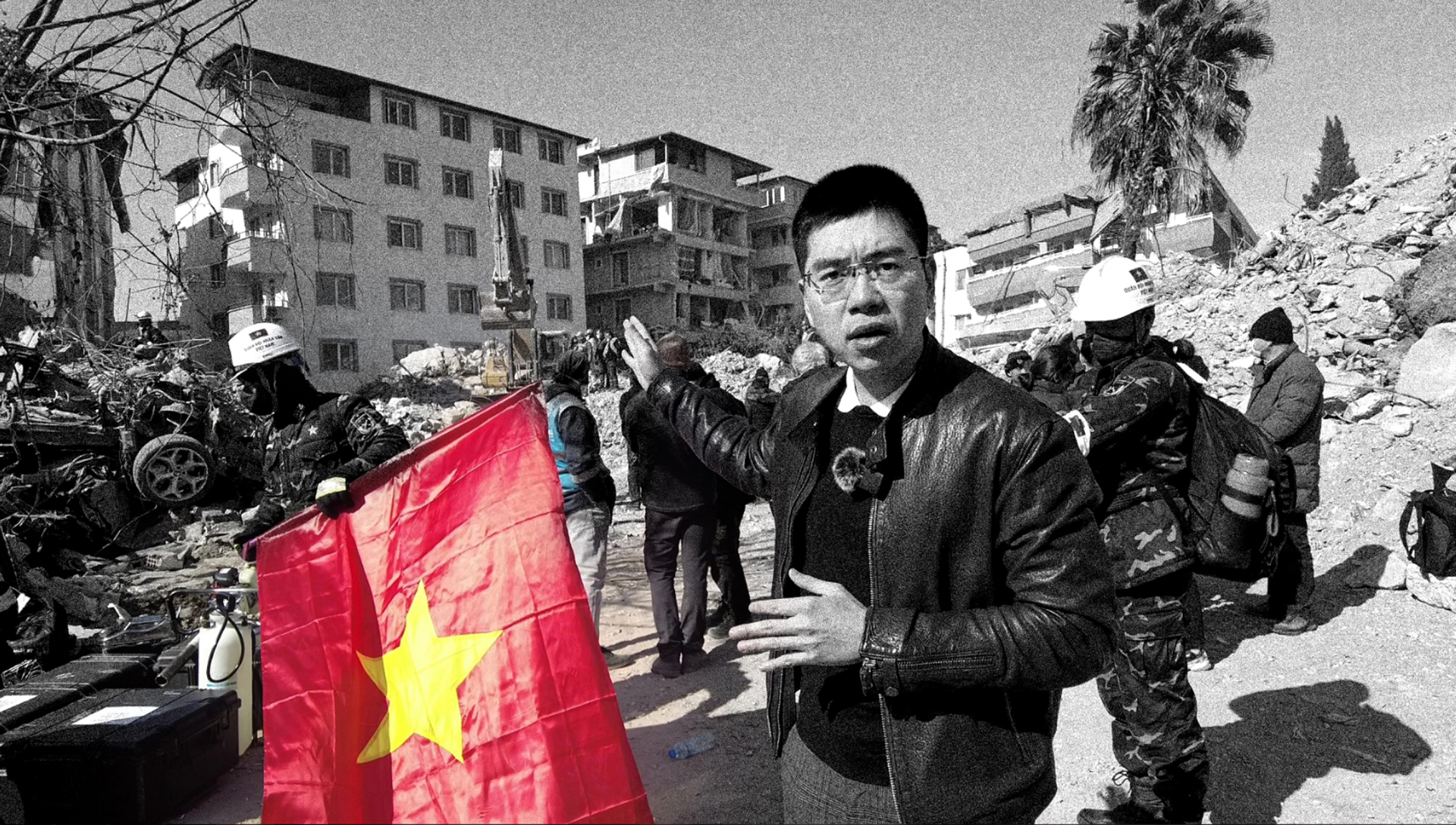
Vietnamese journalist Anh Phuong was present at the earthquake epicenter in Türkiye, a reporting trip that left her with many emotions. Photo: Provided by the interviewee.
Compared to other forms of journalism, television absolutely requires images and videos . You've been to conflict zones, disaster areas, earthquake zones, etc. So, how is safety ensured during your work, Mr. Journalist?
- I've been asking this question to colleagues from major media outlets like CNN (USA) and DW (Germany) since the early days of my assignment. The Middle East is a land of risks and unpredictable changes; what principles can we follow to ensure our safety and avoid dangers while working there?
And they honestly advised us not to look at what they do on TV and then recklessly rush into the hotspots to report... Every day, viewers see reporters from CNN, Al Jazeera, or RT... present in almost every hotspot in the world, from the Gaza Strip to Ukraine... But behind that is not simply the love of the profession or the professionalism of the reporters. Above all, there are also enormous costs involved.
In many cases, to appear at hotspots, major media outlets have to hire private security companies to survey the terrain before reporters arrive. They also have to hire a local team to guide them, advise on suitable areas for reporting, camera placement, and areas where they can and cannot venture... Of course, elements of luck are still unavoidable.
Previously, I worked in the West Bank (Palestine), surrounded by gunfire and tear gas grenades; it looked very dangerous. But in reality, I had been guided there by colleagues and local people beforehand. In many cases, the military was aware of the presence of the press in the area. And the level of risk from bombs and bullets in those conflicts was acceptable. Reporters should reflect the news, not become the news themselves – this is a motto for us reporters when going into conflict hotspots. There is an unchangeable principle, not only for us but for any reporter working in conflict zones: no news is more important than life.
More importantly, the content should be engaging and authentic.
+ At many times, the application of information technology and data transmission in journalism is extremely important. So, how do you and your colleagues utilize modern journalistic technology to quickly disseminate information from hotspots, sir?
Having traveled to many different countries, I've noticed that Vietnam's current journalistic and television capabilities are not much different from those of many other countries around the world. To report live from the scene, VTV's resident reporters often use a device called a Streambox, which, when attached to a camera, can transmit images from anywhere for broadcast. In reality, we ourselves are quite flexible in using our equipment; we don't always use a large camera, sometimes just a phone to film footage or conduct interviews.
I think that sometimes, a dazzling, sharp image isn't necessarily an advantage. What's more important is engaging and authentic content. That carries more weight in winning over the audience. There are expensive details where the image quality isn't perfectly smooth, but the audience can still easily understand and accept them.
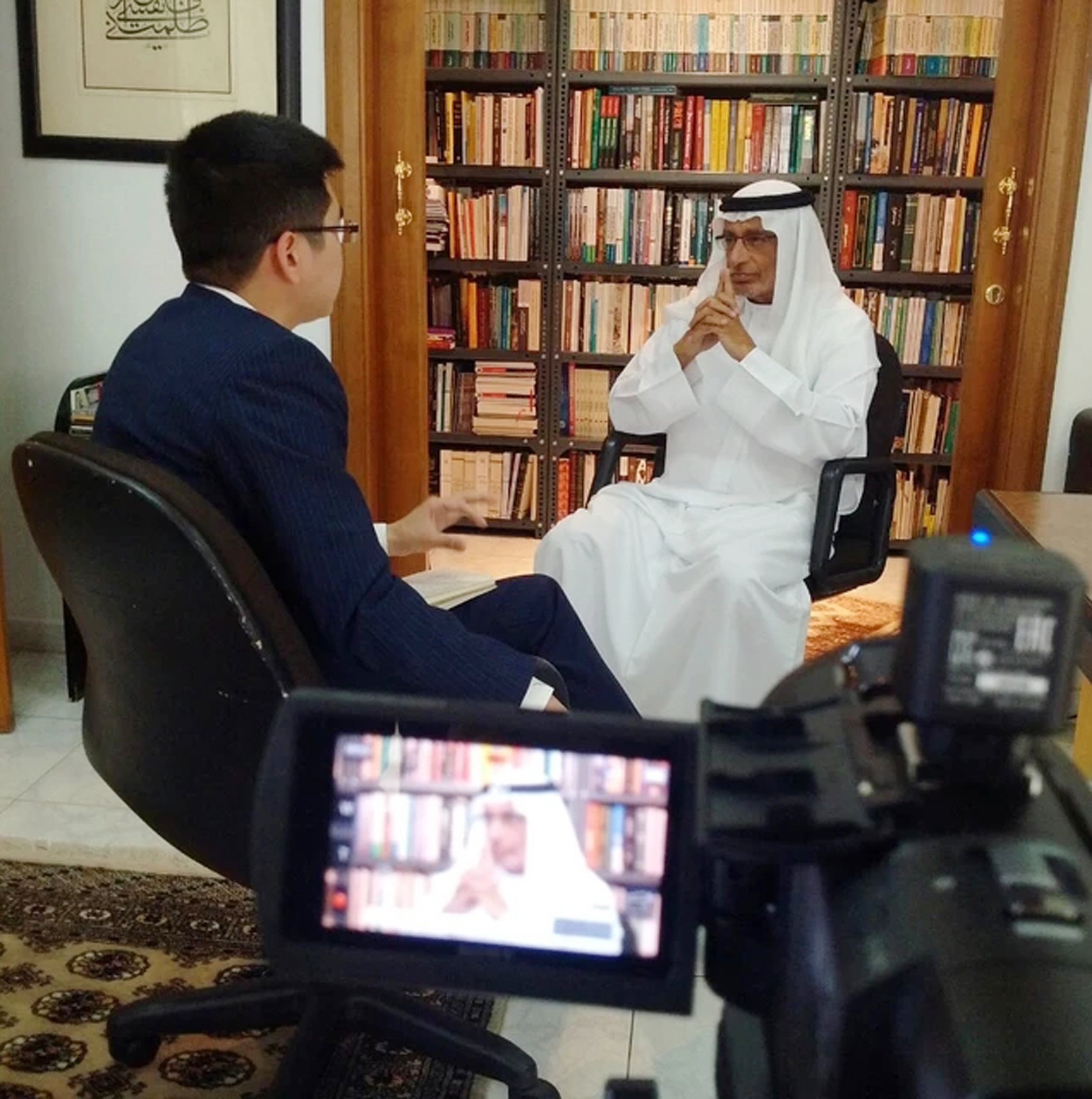
Vietnamese journalist Anh Phuong during an interview with Professor Abdulkhaleq Abdulla - Chairman of the Social Sciences Council, United Arab Emirates. Photo: Provided by the interviewee.
The Middle East is a vast region with harsh weather conditions. Can you tell our readers about a trip that you and your colleagues found most memorable?
- The earthquake on February 6, 2023, swept through 10 provinces of Türkiye. Knowing that Vietnamese forces would be coming to assist in search and rescue efforts, our team proactively arrived early. However, the reality we faced was truly beyond our imagination. Nighttime temperatures dropped to -5 or -6 degrees Celsius, infrastructure was destroyed, there was no electricity or water, and phone and internet signals were intermittent…
We slept in our sleeping bags, and every time the sun set, everyone struggled against the cold. At times like these, my cameraman and I would encourage each other by thinking of the Turkish victims who survived the earthquake; they were suffering a hundred thousand times more. But the most vivid memories are not just about the hardships or the risks from the continuing aftershocks.
What impressed me most was the image of Vietnamese soldiers at the earthquake's epicenter. And behind that, I sensed the gratitude of the Turkish people towards the international soldiers who traveled thousands of kilometers to support their people. I felt an outpouring of emotion from the Turkish people and their belief in pure love between human beings.
Here, the name Vietnam often evokes positive impressions and goodwill. In a region often plagued by suspicion and conflict, the arrival of Vietnamese journalists elicits widespread joy and welcome. Many speak of Vietnam with admiration for its history and its peaceful, friendly nature… This is truly an advantage for us in our work in a conflict-ridden area like the Middle East.
Thank you for sharing these interesting insights!
Le Tam (Editor)
Source: https://www.congluan.vn/phong-vien-phan-anh-tin-tuc-chu-dung-bien-minh-thanh-tin-tuc-post300114.html


![[Photo] Prime Minister Pham Minh Chinh presides over a meeting on private sector economic development.](/_next/image?url=https%3A%2F%2Fvphoto.vietnam.vn%2Fthumb%2F1200x675%2Fvietnam%2Fresource%2FIMAGE%2F2025%2F12%2F20%2F1766237501876_thiet-ke-chua-co-ten-40-png.webp&w=3840&q=75)

![[Photo] Prime Minister Pham Minh Chinh presides over the conference announcing the establishment of the International Finance Centre in Vietnam.](/_next/image?url=https%3A%2F%2Fvphoto.vietnam.vn%2Fthumb%2F1200x675%2Fvietnam%2Fresource%2FIMAGE%2F2025%2F12%2F21%2F1766309817714_ndo_br_dsc-3400-jpg.webp&w=3840&q=75)



















































Comment (0)