

Throughout its 80-year journey of construction and development, the Vietnam News Agency (VNA) has not only been a strategic information agency of the Party and the State, but also a "common home" for many generations of reporters, editors, and technicians – those who have dedicated their entire careers, from their youth to retirement, to bringing information to readers through text, photos, and transmission.
They are living proof of a resilient VNA (Vietnam News Agency) that overcomes all challenges, always fulfills its mission on the information front, and constantly innovates to keep up with the times.
Under the roof of the Vietnam News Agency, they dedicated themselves and grew with honor and pride, contributing to the glorious history of VNA.
A lifetime of dedication to the profession - a lifetime of honor.
One autumn afternoon in September, amidst the lingering spirit of pride and emotion celebrating National Day (September 2nd) and the eager anticipation of the 80th anniversary of the founding of the Vietnam News Agency (VNA) (September 15th, 1945 - September 15th, 2025), two journalists who have dedicated their entire careers to VNA - journalist Tran Dinh Thao and photographer and journalist Pham Tien Dung - had the opportunity to reminisce about their time working at VNA.
Mr. Tran Dinh Thao, now over 80 years old, was formerly the Deputy Head of the Domestic News Editorial Board of the Vietnam News Agency (VNA). A graduate of the 8th class of the Faculty of Literature at the University of Hanoi , he and 14 other students were assigned to VNA in 1966.
"We came to journalism not only out of a love for words, but also with the belief that this is a place where we can contribute to the country with our pens and intellect," Mr. Thao shared, his eyes filled with emotion as he recalled his youthful years.
From his early days as a reporter in areas such as Hoa Binh , Nam Ha, Hanoi, and Son La, to his roles as Deputy Editor-in-Chief of Tin Tuc Newspaper (now Tin Tuc and Dan Toc Newspaper), Deputy Editor-in-Chief of Le Courrier du Vietnam, and Deputy Head of the Domestic News Editorial Board until his retirement, Mr. Tran Dinh Thao accompanied and reported on many important events of the country.
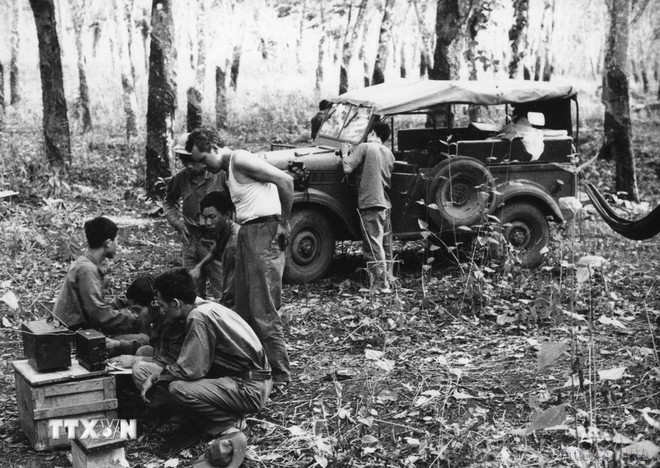
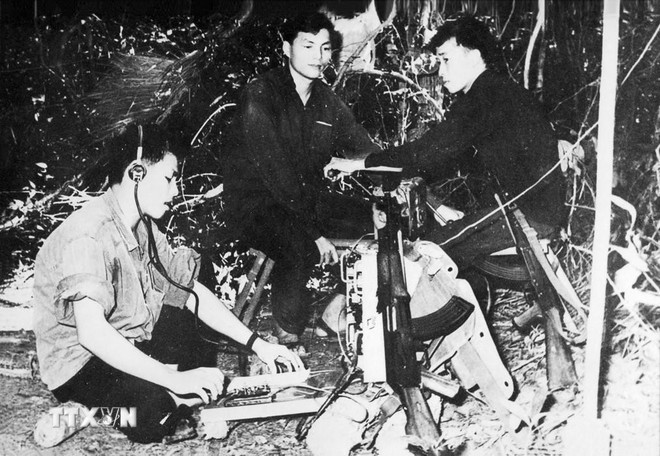
He recounted the hardships of war correspondents, sometimes having to walk or cycle for days on end, traveling hundreds of kilometers to gather information. Even after obtaining the information, transmitting it back to the headquarters via telegraph was a challenging task. Therefore, reporters at that time were always trained to write concise, clear, and comprehensive news reports – every word was a testament to their sweat and responsibility to the profession.
Throughout his career as a journalist, Tran Dinh Thao was most impressed by the significant speed at which VNA (Vietnam News Agency) disseminated information thanks to the telephone, shifting from overnight news broadcasts to same-day broadcasts.
In the 1990s, before the internet became widespread, breaking news was reported directly to the newsroom by reporters calling in person. Through close coordination between field reporters and editors, hundreds of breaking news stories about important events across the country were quickly disseminated through the VNA news bulletin.
Although the news reporting method was simple, involving only phone calls from field reporters, editors at the headquarters coordinated to process the information into a complete news story, resulting in very high work efficiency.
With this approach to timely news reporting, the then Head of the Domestic News Editorial Board, Ms. Vu Kim Hai, along with Deputy Head Tran Dinh Thao and colleagues, especially the team of reporters from provinces and cities, organized a news page for the Voice of Vietnam (VOV) to be broadcast in the 12:00, 18:00, and 21:00 daily news bulletins with the opening sentence: "According to news from a VNA reporter at… - the area where the event just occurred."
When news reports sourced from VNA are broadcast on VOV, the honor and responsibility of the reporters and editors increase as their news reporting must ensure the elements of: "Fast - Accurate - Relevant - Engaging."
What Mr. Thao cherishes most is not the quantity of articles he has written, but the feeling of contributing to the mainstream information flow, reflecting the pulse of the country and accompanying social change.
“Having worked at VNA for 37 years, I have always been proud to be a reporter for the agency. Thanks to this profession, I have witnessed and reported on many important events, traveled to many places, met many people, become a part of the stories, and conveyed what I saw and heard to readers – something I would never have had the opportunity to do in another job,” Mr. Thao expressed.
Every time a camera clicks, it's a fulfillment of the mission of a VNA journalist.
Unlike journalist Tran Dinh Thao, who used words to convey information, the journalistic journey of Pham Tien Dung, former Head of the Photo Editorial Board of VNA, was closely associated with journalistic photographs.
Born in Phu Tho in 1953, Tien Dung graduated with a major in Photography from the Journalism Faculty of Lomonosov Moscow State University. He worked at the Vietnam News Agency (VNA) from 1978 until his retirement.
Having served as a correspondent in the Soviet Union and Cambodia, and holding important positions such as Deputy Editor-in-Chief of Vietnam Photo News and Head of the Photo Editorial Board, Mr. Tien Dung always expresses his sincere gratitude to VNA for helping him grow from a recent graduate to a seasoned photojournalist and photographer.
When recalling memorable moments in his journalistic career, Tiến Dũng remembers participating in photographing Russian President Vladimir Putin during his visit to Vietnam in 2001.
"I only had a few seconds to press the shutter button when President Putin shook hands with General Secretary Le Kha Phieu. There was no second chance, no editing. Only the skill of the photographer remained. That's the familiar pressure for VNA photojournalists: It has to be not just beautiful, but accurate – at the right time, capturing the right spirit of the event," Mr. Dung said.
Creating a photo report about the "First Space Flight" of pilot Pham Tuan and his Soviet teammates in 1980 is also an unforgettable memory in Tien Dung's career as a photographer.
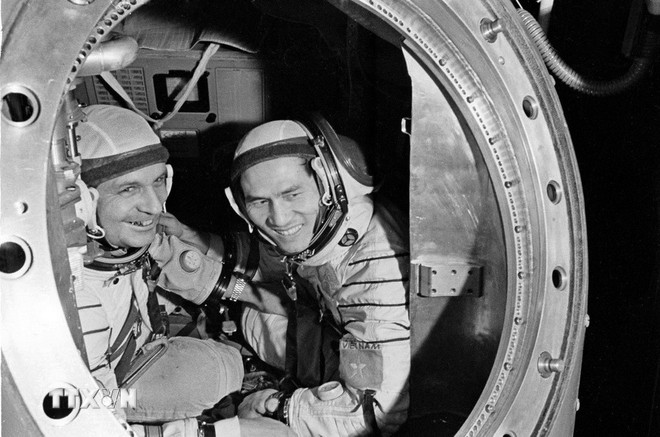
The photographs he took not only documented the arduous journey but also reflected the camaraderie and bond between the two astronauts, as well as their daily lives with family and friends. Particularly noteworthy is a rare moment captured in the collection: General Vo Nguyen Giap visiting and encouraging the two astronauts before their departure.
For Mr. Tien Dung, each time he presses the shutter button is a political mission, fulfilling the mission of a VNA journalist. The camera is a weapon, a tool that allows Mr. Dung to carry out the country's media mission with authentic, timely, and lasting images.
Mr. Pham Tien Dung shared: "This year, VNA celebrates its 80th anniversary. I have worked here for 35 years, filled with countless memorable and proud experiences. As a photojournalist, I have captured thousands of images of Vietnam's land and people, of the lives of people across the country. Furthermore, I have been fortunate enough to participate in many major events, meet many famous figures, and my life has become 'richer' because each trip has enriched my life."
After retirement, armed with the "experience" they had gained from VNA, Mr. Tran Dinh Thao and Mr. Pham Tien Dung continued to contribute to journalism through their articles and photographs, and especially continued to inspire the next generation of VNA reporters whenever they had the opportunity to meet.
Paving the way for the development of information technology.
The success of VNA news reports is not only due to the contributions of journalists, photojournalists, and editors, but also to the efforts of news technicians and engineers – those who ensure the transmission of information and images from the "producers" to the editorial board and the public.
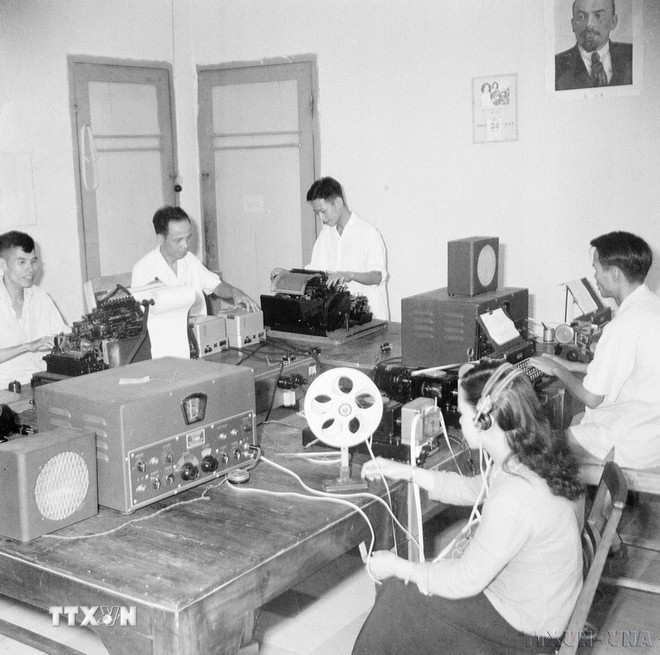
To help young journalists better understand the history and communication techniques of VNA (Vietnam News Agency) throughout different periods, Mr. Dam Hieu Dung, former Director of the Technical Center, held a conversation with officials and members at the agency's Traditional Exhibition House.
Mr. Hieu Dung recounted the process of creating the first 8-bit computer at VNA (Vietnam News Agency) - the first server, a symbol of the spirit of innovation and the effort to overcome difficulties. Although it may look simple and rudimentary now, this machine bears an important historical mark.
"Back then, VNA was under immense pressure; without the right transmission technology, we wouldn't have been able to exchange news with the world," Mr. Dung shared.
In that context, the VNA leadership tried to save every dollar to purchase components and materials from abroad. The technical team, undeterred by difficulties, designed circuit boards, manufactured printed circuits, assembled components, selected parts, and wrote software to create the first 8-bit computer – the VNA technical system server.
The advent of the first generation of computers was not only a technological breakthrough but a historical milestone. In 1984, this technological system enabled the connection and transmission of information between Hanoi and Ho Chi Minh City.
"That machine became a symbol of overcoming adversity – knowledge, experience, and finances were all limited, but we still managed to integrate Vietnamese into the computer communication system," Mr. Dung's voice was filled with pride and determination as he recalled those days.
During his career, Mr. Dam Hieu Dung most vividly remembers his role as the Head of the Transmission Team – a unit established by the VNA leadership to transmit digital information and images between VNA in Hanoi and the TASS news agency of the Russian Federation in Moscow, relaying information from the West to Vietnam via TASS.
Limited resources made the implementation process very difficult. The first phase of data transmission when the system was put into operation did not achieve the expected results.
In that situation, Mr. Hieu Dung boldly sought guidance from Comrade Do Phuong, then Director General of VNA, to request permission to borrow the Sputnik satellite voice signal from Hanoi to Ho Chi Minh City every night for testing the transmission of news and images.
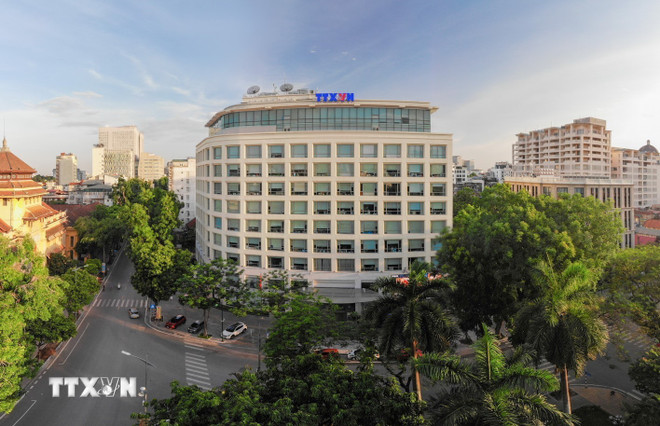
After more than three months of continuous nighttime testing, the signal transmission system was successful, achieving the goal of transmitting information and images between Hanoi and Ho Chi Minh City. The results were confirmed by TASS, which agreed to officially establish a connection between VNA and TASS.
Three technicians in the team, including Mr. Dung, later went to Russia to complete the technical connection steps. From 1990, the transmission of news and photos between VNA and TASS officially began operating, opening a modern information connection portal according to the technological standards of the 1990s.
The achievements of the News Agency's Technical Center were crucial building blocks in VNA's later digital transformation and mastery of information technology. These quiet efforts built a solid technical foundation, helping VNA affirm its role in the national and international information flow.
Over the past 80 years, under the "roof" of VNA, journalists and technicians have dedicated their entire careers, leaving behind many important contributions to the development of the industry.
Their stories are vivid evidence of the resilient spirit and relentless innovation of VNA, serving as a valuable source of inspiration for future generations to follow in their footsteps, continue writing the glorious history, and ensure the sustainable development of VNA in the new era.
Source: https://www.vietnamplus.vn/80-nam-ttxvn-nhung-nguoi-ke-chuyen-bang-cau-chu-hinh-anh-va-duong-truyen-post1061596.vnp

![[Image] Vietnam's colorful journey of innovation](/_next/image?url=https%3A%2F%2Fvphoto.vietnam.vn%2Fthumb%2F1200x675%2Fvietnam%2Fresource%2FIMAGE%2F2025%2F12%2F14%2F1765703036409_image-1.jpeg&w=3840&q=75)













































![[Image] Vietnam's colorful journey of innovation](https://vphoto.vietnam.vn/thumb/402x226/vietnam/resource/IMAGE/2025/12/14/1765703036409_image-1.jpeg)
























Comment (0)