

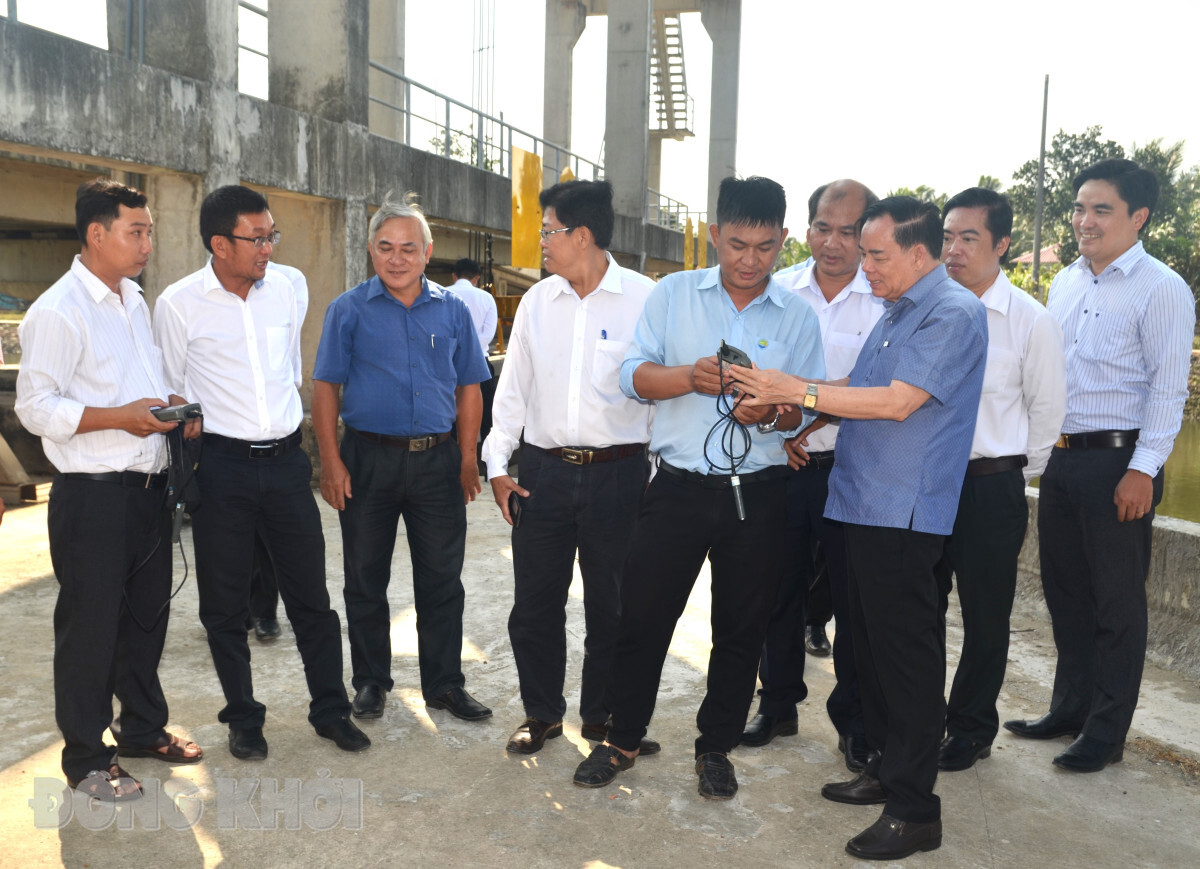
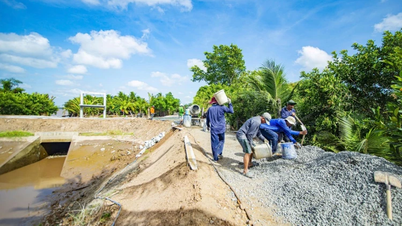
Chairman of the Provincial People's Committee Tran Ngoc Tam inspects the Sa Ke sluice gate in Mo Cay Nam district for its role in preventing saltwater intrusion and storing freshwater.
Operating irrigation systems
According to Vice Chairman of the Provincial People's Committee Nguyen Minh Canh, the province has issued a plan for preventing, combating, and responding to saltwater intrusion. Through this, local authorities, relevant departments, and the people are proactively taking preventive measures and strengthening their response capabilities to drought and salinity intrusion occurring in the province, minimizing damage to people, property, crops, and livestock.
In Chau Thanh District, Ben Tre City, several structures belonging to Phase 1 of the North Ben Tre Irrigation System Project (dikes and sluices along the Tien River, Tan Phu sluice, Ben Ro sluice, Song Ma sluice, Ba Lai reservoir, etc.) have been put into operation, basically controlling the water flow from the Tien River and Ham Luong River into the Ba Lai River. Therefore, to ensure water supply for water treatment plants, it is necessary to closely monitor the saline intrusion situation to operate irrigation works and pumping stations, in order to maximize water storage in the Ba Lai reservoir basin. At the same time, water quality must be monitored to ensure environmental sanitation.
In the districts of Giồng Trôm, Ba Tri, and Bình Đại, the Ba Lai sluice gate, combined with other sluice gates under the North Ben Tre Irrigation System Project Phase 1, the Ben Ro and Tan Phu sluice gates under the Provincial Water Management Project (JICA3), and the Trung Nhuan and Xeo Ran sluice gates, helps control water resources in parts of Giồng Trôm district towards Ba Lai and Ba Tri district (mainly drawing water from the Ba Lai River and the Kenh Lap reservoir). At the same time, sluice gates under the Tien River dike help control salinity intrusion from the Tien River into Binh Dai district.
However, in the southern communes of Giồng Trôm district (bordering the Hàm Luông River), and communes in the Thủ Cửu, Giồng Trôm, and Bình Chánh river basins, salinity levels have increased, affecting the water intake of water treatment plants due to direct impact from water sources in the Hàm Luông and Bến Tre rivers.
The northern communes of Binh Dai district (bordering the Tien River) may experience localized water shortages due to the closure of sluice gates along the Tien River dike to prevent saltwater intrusion, and insufficient water from Ba Lai to compensate for the needs of the communes along the Tien River because some canals and ditches have not yet been dredged. Therefore, water treatment plants serving the aforementioned areas are prepared with plans to transport raw water, treated water, connect to water treatment plants with low salinity levels, and supply water through RO systems, etc., to provide water to residents in case of unusually high salinity levels or depletion of water reserves. The Irrigation Works Exploitation Company Limited plans to flexibly operate the irrigation system and the Kenh Lap reservoir to ensure maximum water storage from the Ba Lai River, the Trung Nhuan - Xeo Ran reservoir area, and the Kenh Lap reservoir, and to drain water promptly to maintain water quality.
In Cho Lach district, the upstream communes (from Hoa Nghia to Phu Phung) basically have a secure water supply (salinity ≤1‰). For the remaining communes, it is necessary to encourage people to store freshwater, implement temporary structures, and combine localized water storage to provide water for daily life and production. Water treatment plants need to closely monitor the saltwater intrusion situation to operate water supply accordingly.
In Mo Cay Bac district, the Sa Ke, Giong Keo, and Bung sluice gates, combined with a temporary salinity barrier at the Cai Hang sluice gate (currently under construction), create the Cai Hang - Sa Ke water reservoir area. This contributes to preventing saltwater intrusion from the Ham Luong and Co Chien rivers, serving the daily life and production needs of the western communes of Mo Cay Bac district, Mo Cay Nam town, and some neighboring communes. Simultaneously, it provides raw water to the Mo Cay Water Supply and Drainage Company's water treatment plant, supplying drinking water to over 2,000 households in Mo Cay Nam and Mo Cay Bac districts when the Mo Cay river water source is affected by salinity.
However, in the northern areas of Mo Cay Bac and Mo Cay Nam districts (bordering the Ham Luong River, Vam Nuoc Trong River, Cai Cam River, Cai Quao River, etc.), the irrigation system is not yet fully closed, so saltwater intrusion affects surface water sources according to the tides. Therefore, in these areas, people need to proactively store water; water treatment plants should be prepared to connect to water sources with lower salinity water treatment plants in the area, supply water according to schedules, and provide centralized water supply in case of prolonged saltwater intrusion.
In the Thanh Phu area, the Southern Ben Tre Irrigation System Project has been put into operation. The saltwater intrusion prevention sluice gates help control water flow from the Ham Luong River to the area from Thanh Phu to Vam Cai Quao. On the Co Chien River side, water flow is controlled from Thanh Phu to Vam Thom.
However, increased saltwater intrusion affects water storage areas such as Ca Chat - Phu Nu (affected when salinity at Vam Thom increases) and Dong Khoi - Chin Thuoc (affected when salinity at Vam Cai Quao increases). Therefore, water treatment plants supplying these areas are prepared with plans to transport raw water, treated water, connect water sources to plants with low salinity, and supply water through RO systems, etc., to provide water to people in case of unusually high salinity levels and depletion of water reserves. The Irrigation Works Exploitation Company Limited plans to operate the irrigation system flexibly to promptly draw in fresh water, flush out salinity, and ensure water quality.
Cases of severe and widespread saltwater intrusion.
For water supply units operating centralized water supply points and RO desalination systems equipped during the 2015-2016, 2019-2020, and 2023-2024 droughts to provide domestic water to the people; operating two raw water pumping stations of the Chau Binh and Tan My water plants to draw water from the Vam Ho, Nha Tho, Trung Nhuan, and Xeo Ran sluice areas to serve the people in the area; purchasing water through main meters from other water supply units;…
In the event of severe and widespread saltwater intrusion (salinity of water sources supplying water treatment plants exceeding 1‰ across the entire province), and when water reserves in households are depleted, in addition to continuing the aforementioned response plan, it is necessary to transport raw freshwater from upstream for treatment and supply to water treatment plants affected by prolonged high salinity levels, such as Tan Hao, Luong Phu, Long Dinh, Thoi Lai, etc.
Strengthen support for local water stations and plants to ensure timely water supply for residents; transport water to supply hospitals, schools, restaurants, hotels, industrial zones, and operate established centralized water supply points to provide water to the people.
In urgent cases, water tankers can be mobilized to transport fresh water for drinking and daily use for residents, hospitals, businesses, industrial zones, schools, hotels, etc.; promptly request the Military Region to provide support with personnel and equipment to transport fresh water to people in water-scarce areas. Adjust the water supply plan according to priority order: Water for domestic use for residents. Drinking water for livestock. Irrigation water for high - value perennial crops,...
For agricultural production, promptly assign technical staff to strengthen inspection work; promptly detect and handle outbreaks of diseases affecting crops, livestock, and aquaculture, in order to minimize losses. Compile statistics and assess damage caused by saltwater intrusion (if any) and promptly implement mechanisms and policies to support agricultural production, helping people overcome losses as soon as possible according to regulations. Issue seasonal planting schedules for agricultural production; strengthen guidance for people on implementing measures to protect crops, livestock, and aquaculture under saltwater intrusion conditions.
Text and photos: Tran Quoc
Source: https://baodongkhoi.vn/phuong-an-phong-chong-ung-pho-voi-xam-nhap-man-30062025-a148967.html













































































Comment (0)