

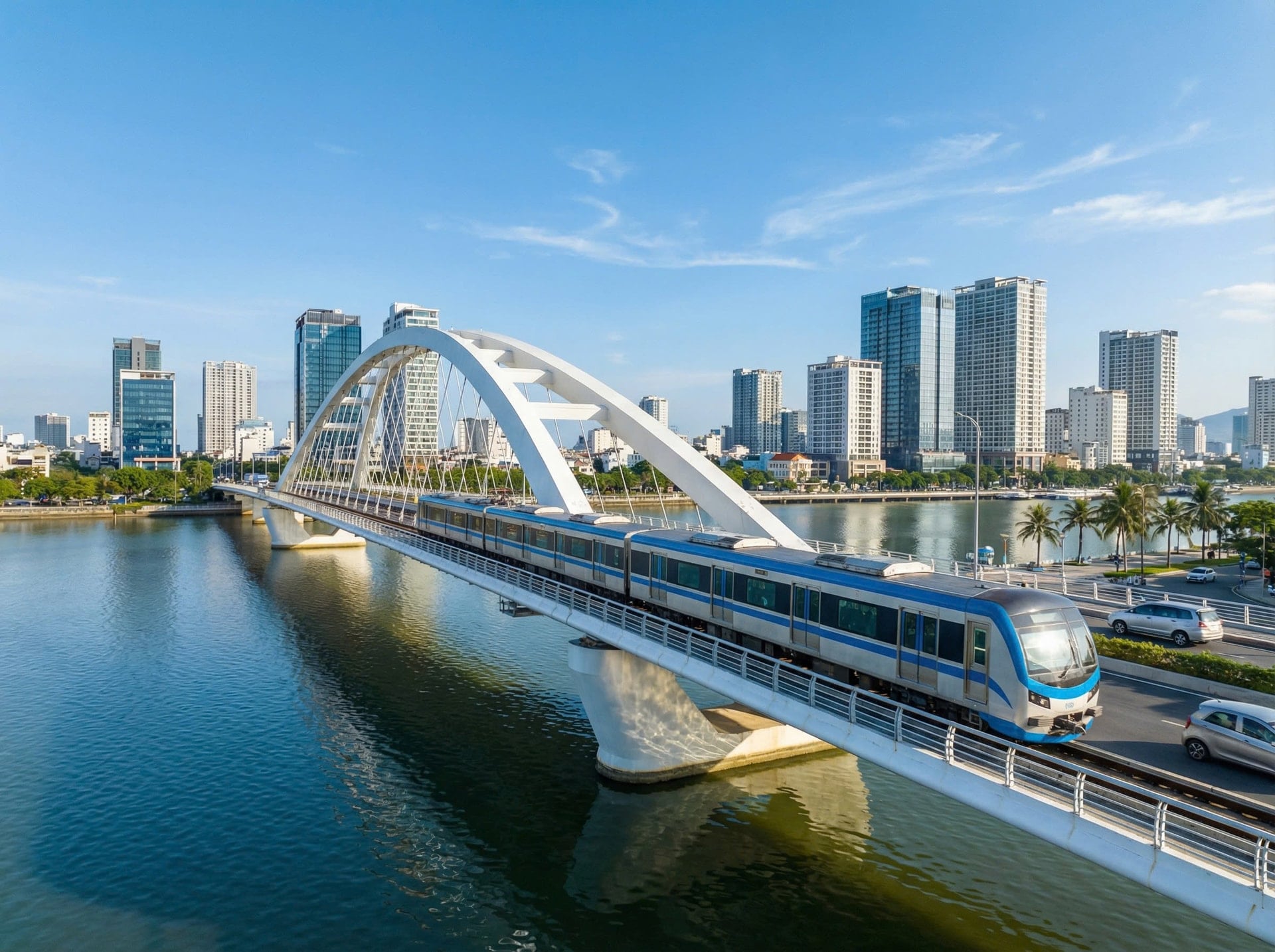
Urban railway lines will be developed alongside many modern, transport-oriented urban areas (TOD). Simultaneously, commercial and service areas will spring up around many of these urban railway transfer points, creating potential for future TOD urban development.
TOD urban development
The high-speed railway project on the North-South axis (national high-speed railway) passing through Da Nang city has its starting point in Hai Van ward and its end point in Nui Thanh commune, with a length of over 116km, passing through 24 communes and wards. The line includes 2 passenger stations in Hoa Khanh ward and Chien Dan commune, 1 freight station in Chu Lai, and 4 depots (where trains are assembled, maintained, repaired, and other technical operations are carried out)...
According to the Department of Construction, the unit is studying the planning of the area surrounding the stations along the national high-speed railway line, focusing on land utilization and TOD (Transit-Oriented Development) urban development in the area around the two new stations in Hoa Khanh ward and Chien Dan commune. The current Da Nang station will be the central urban railway station and will be redeveloped into a TOD urban area around it.
According to Deputy Director of the Department of Construction Luong Thach Vy, the urban railway system in Da Nang has 16 lines, including 2 high-speed urban railway (MRT) lines: one from the northern bus station to the current Da Nang station, and another from this station along Dong Da Street, across the Han River and along Ngo Quyen and Le Van Hien streets to Hoi An.
This high-speed railway line is also planned to extend from Hoi An, crossing the Thu Bon River, connecting to Vo Chi Cong road, passing through the Tam Ky urban area and to Chu Lai Airport.
Thus, this high-speed urban railway line connects the northern and southern parts of the city. In addition, there are 11 light rail transit (LRT) lines and 3 light rail lines serving tourism (along Nguyen Tat Thanh Street, around the Han River, and along the eastern coast from Tien Sa Port to Vo Nguyen Giap Street).
According to the urban railway plan, all traffic junctions and important areas in the city center such as Lien Chieu Port, Da Nang Airport, the northern bus station, and functional areas within the Da Nang Free Trade Zone... will be closely connected and linked with Hoi An, Tam Ky, and Chu Lai.
Mr. Luong Thach Vy also informed that, in phase 1 (from 2025 - 2030), the city will prioritize research, planning, and investment in the MRT2 high-speed urban railway line and the LRT2 light rail line to connect Da Nang Airport with Hoi An.
In phase 2 (after 2030), investment will be made to extend the MRT2 line from Hoi An to the satellite city of Tam Ky and Chu Lai Airport. In addition, depending on the progress of the national high-speed railway project section through Da Nang city, the city will prioritize investment in the LRT10 light rail line connecting the national high-speed railway station in Hoa Khanh ward with the central urban railway station (currently Da Nang station).

Legal framework
According to the Department of Construction, in addition to developing TOD (Transit-Oriented Development) urban areas around railway stations, the planned MRT2 high-speed urban railway line from the intersection of Vuong Thua Vu and Ngo Quyen streets (An Hai ward) to Chu Lai Airport will have approximately 15 second-level transfer points combined with commercial and service development. Many of these transfer points have the potential to develop into TOD urban areas in the future.
The Railway Law No. 95/2025/QH15, passed by the 15th National Assembly on June 27, 2025, at its 9th session, and effective from January 1, 2026, focuses on planning, investment, construction, management, operation, and ensuring railway safety. It also expands the scope of regulation and adds specific mechanisms for investment, infrastructure connectivity, industrial development, and TOD (Transit-Oriented Development) urban development. This is considered the first time in Vietnamese law that there are clear regulations on TOD urban development.
According to Mr. Tran Thien Canh, Director of the Vietnam Railway Department (Ministry of Construction), the 2025 Railway Law has completed the legal framework with clear orientations and is an important institutional breakthrough, creating a legal framework for the development of the railway industry. The legalization of TOD (Transit-Oriented Development) will be a breakthrough in urban and transportation development. Along with that, it will increase the proactive role and decentralize power to localities; improve transportation infrastructure connectivity, increase land value, and expand urban space.
Mr. Luong Thach Vy stated: "We advised the city to plan the development of TOD (Transit-Oriented Development) around railway stations and public transport hubs to create momentum for transportation development, as well as urban and socio-economic development of Da Nang city."
Source: https://baodanang.vn/quanh-san-ga-la-nhung-do-thi-3318752.html




![[Video] Sunset at Lap An Lagoon – Where the sun sets over the fishing nets](https://vphoto.vietnam.vn/thumb/1200x675/vietnam/resource/IMAGE/2026/05/31/1780187239592_2222.jpeg)




















![[Video] Sunset at Lap An Lagoon – Where the sun sets over the fishing nets](https://vphoto.vietnam.vn/thumb/800x450/vietnam/resource/IMAGE/2026/05/31/1780187239592_2222.jpeg)












































































Comment (0)