


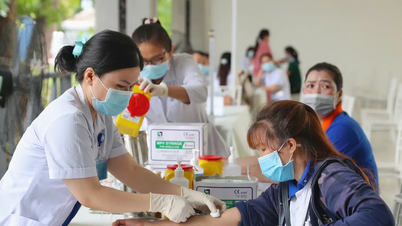
Medical personnel administer Ebola vaccines to residents in Bulape, Democratic Republic of Congo. Photo: THX/VNA.
As of May 26th, health officials in the Democratic Republic of Congo had recorded 125 confirmed Ebola cases, 17 deaths, and over 1,000 suspected cases. More worryingly, the disease is spreading to many provinces and health centers in the Northeast – an area already heavily impacted by armed conflict, population displacement, and a weak healthcare system. These conditions are ideal for the rapid and difficult-to-control spread of the Ebola virus.
To address the situation, UNICEF activated its highest level of emergency response and began airlifting more than 100 tonnes of humanitarian aid to the Democratic Republic of Congo via the EU's humanitarian airlift. The shipment, originating from UNICEF's global logistics hub in Copenhagen, included protective gear for healthcare workers, medicines, hygiene kits, and other essential medical supplies to prevent the spread of the disease. This supply is expected to support nearly 100,000 people in the most vulnerable communities.
In parallel with transporting aid supplies, UNICEF has allocated more than $6.5 million from its core resources to fund urgent response activities on the ground. The agency is working closely with local authorities and humanitarian partners across a range of areas, from infection control and ensuring access to clean water and sanitation, to community outreach and direct support for affected families.
UNICEF representative in the Democratic Republic of Congo, John Agbor, warned that this is a "race against time" and stressed that the new aid shipment is vital in protecting frontline healthcare workers and supporting affected children and families.
At the community level, health workers are coordinating with local leaders, religious organizations, women's and youth groups to raise awareness, encourage early detection, and promote safety measures – a strategy considered crucial in controlling the Ebola outbreak.
On the part of the EU and WHO, the two sides have expanded cooperation to support emergency responses not only in the Democratic Republic of Congo but also in Uganda – a neighboring country that has also seen worrying cases of Ebola. The EU announced 15 million euros for response and preparedness efforts, of which 5 million euros are specifically allocated to WHO activities.
European Commissioner Hadja Lahbib affirmed that the current crisis demands stronger international action than ever before. The WHO also stressed an undeniable fact: the virus does not stop at borders, therefore international cooperation must be strengthened accordingly.
Source: https://suckhoedoisong.vn/quoc-te-khan-cap-tang-vien-tro-giup-chdc-congo-chong-ebola-169260530063712334.htm
![[Image] Nearly 125,000 Hanoi students completed the Literature exam for the 10th grade entrance exam.](https://vphoto.vietnam.vn/thumb/1200x675/vietnam/resource/IMAGE/2026/05/30/1780117233041_ndo_br_thiet-ke-chua-co-ten-2-png.webp)





















![[Photo] Admire the coral "masterpiece" amidst the million-year-old heritage of Dak Lak province.](https://vphoto.vietnam.vn/thumb/1200x675/vietnam/resource/IMAGE/2026/05/30/1780107638639_y25-jpg.webp)





















































Comment (0)