

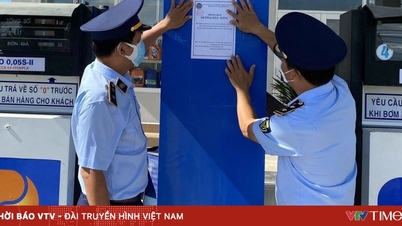
In its inspection report on compliance with policies and laws in state management of petroleum products, the Government Inspectorate pointed out a series of violations by major players in the petroleum business. Most common were violations of laws related to the establishment, management, and use of the Price Stabilization Fund (BOG) managed by the Ministry of Industry and Trade and the Ministry of Finance.
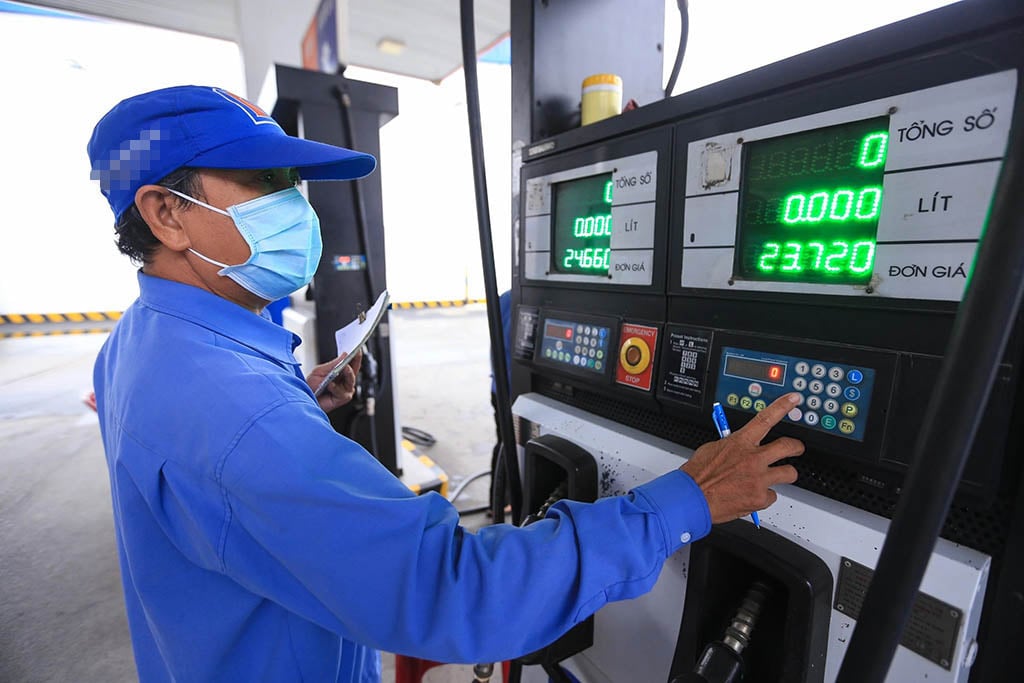
Many key businesses have violated regulations regarding the management and use of the Fuel Price Stabilization Fund; experts and retailers suggest abolishing this fund.
Trade expert Vu Vinh Phu
Instability for a long period of time
Of the 15 petroleum wholesalers, 7 misused the Price Stabilization Fund (BOG Fund) for price stabilization purposes, failing to transfer funds to the fund's account and instead leaving them in the company's payment account for several periods before returning the funds, totaling 7,927 billion VND. Among these, 3 wholesalers have been fined three or more times by competent state authorities for administrative violations: Hai Ha Water and Land Transport Company Limited (4 fines), Xuyen Viet Oil Trading, Transport and Tourism Company Limited (3 fines), and Thien Minh Duc Group Joint Stock Company (3 fines).
These are also the three businesses that the Government Inspectorate has recommended transferring their files to the investigative agency of the Ministry of Public Security for consideration and handling according to the law. Besides failing to declare and pay environmental protection tax on petroleum products, the most common violation of these three businesses relates to the misuse of the Price Stabilization Fund…
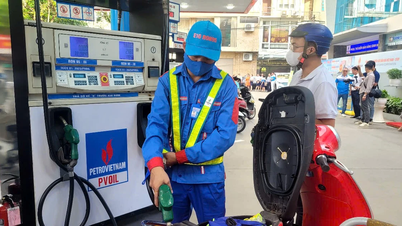
At the time of the inspection, the number of petroleum businesses nationwide included 38 primary distributors; 2 primary producers; 341 distributors; 18 general agents; 312 agents; and 17,449 retail gasoline stations... The Government Inspectorate stated that the shortcomings in the establishment, management, and use of the Price Stabilization Fund (BOG Fund) had existed for many years but had not been addressed promptly, leading to a shirking of responsibility, lax management, and affecting the effectiveness of the BOG Fund.
According to trade expert Vu Vinh Phu, we didn't wait for the inspection report to see the inadequacies in the management and use of the Fuel Price Stabilization Fund. Prior to this, there were many public concerns about these inadequacies, but it seems that the management agencies didn't pay attention, or rather, "ignored" them, allowing the violations to occur.
"I say the problem stems from the fact that the money deducted from the Price Stabilization Fund by gasoline buyers is managed by businesses, and the use of the fund is decided by the authorities. It is this lax management and operation of the fund that creates opportunities for businesses to withdraw and use it for other purposes, misappropriating the funds. Furthermore, penalties, if detected, are not strictly enforced. Not to mention the shirking of responsibility when problems arise, as the Government Inspectorate has already pointed out. Secondly, the deduction and expenditure of the Price Stabilization Fund have long been criticized for not keeping pace with world price fluctuations. Each deduction is 300 VND/liter; if the price decreases by 5%, more deductions are allowed; only when the price increases by 7% is the fund allowed to be released," Mr. Phu explained.
Mr. Nguyen Xuan Thang, Director of Au Hai Phat Petroleum Company, acknowledged that the unregulated operation of the Petroleum Price Stabilization Fund (BOG Fund) in recent times has led to negative consequences and shortcomings when the management of the fund's account is entrusted to leading enterprises. "Using petroleum to stabilize prices will help increase profits for retail businesses and stabilize prices for the market, instead of entrusting the money to a component in the petroleum supply chain to manage. I also raised this issue in my comments on the draft decree on petroleum business that the Ministry of Industry and Trade is currently seeking opinions on. In my opinion, the shortcomings and irrationalities related to the BOG Fund are very clear, so it should be abolished or converted into a source of petroleum distributed to the market. The purpose is to stabilize prices according to the decision of the governing body," Mr. Thang emphasized.
What can be done to resolve the fund's "instability"?
In practice, to regulate gasoline prices and curb inflation, taxes and fees included in the import price of gasoline are considered one of the important tools of the Price Stabilization Fund.
However, the fund carries many risks and, more importantly, has "run out of steam," as the fuel price adjustment cycle has decreased to weekly, closer to world prices. Expert Vu Vinh Phu analyzed: In the past, many opinions have assessed this fund as ineffective and needing an alternative solution. To make the fuel market efficient and avoid supply disruptions, the most important thing is to stockpile fuel in kind, instead of keeping money in a fund and managing it as is currently the case. Modern commercial theory states that circulation without reserves is essentially non-circulation. The whole country produces 20 million tons of fuel per year, but only 7 days of reserves is insufficient; reserves should be for at least 3 to 6 months. In some countries, fuel reserves are even profitable, with low prices for buying and high prices for selling. Reserves do not mean locking down fuel depots but rather entrusting them to economic accounting units that buy, sell, and circulate fuel, ensuring quality.
According to Mr. Phu, the petroleum market must be restructured, with businesses independently managing their own finances, bearing profits and losses, freely choosing buying and selling partners, and even allowing retailers to determine prices. In particular, there must be a "revolution in the petroleum distribution system," cutting out intermediaries and going directly from supply to retail, instead of the current layered system that dictates costs. Furthermore, reserves should be transferred to physical inventory, with the State only managing product quality and ensuring fair competition. The rest should be managed by a single ministry to avoid a situation where too many different ministries are involved.
As one of the economists who early on proposed abolishing the Fuel Price Stabilization Fund, Associate Professor Pham The Anh of the National Economics University commented that this fund was "a unique creation of Vietnam" and had failed to achieve its goal of price stabilization. While other countries switched to reserving fuel in their own reserves, Vietnam used the Fuel Price Stabilization Fund, and what has happened today is proof of that early warning: the fund should be abolished, and prices should be allowed to operate according to market forces, freeing up resources for society.
"Essentially, the BOG Fund doesn't help consumers reduce costs; it still operates by having people deposit money into the fund in advance, which can be returned in the next operating period, to reduce volatility when prices rise. However, in reality, when world oil prices fluctuate too much, having the fund or not doesn't have much effect," said Associate Professor Pham The Anh.
In 2022, he also analyzed and asserted that the allocation/disbursement of the Petroleum Price Stabilization Fund was "problematic" because more funds were allocated to oil products than to gasoline products. This led to oil users "subsidizing" gasoline users, which increased inequality…
In reality, managing, supervising, and auditing the fund is not too difficult. Building a mechanism to manage and control the fund's cash flow through technology is entirely feasible. In particular, it is necessary to quickly define the agency responsible for supervising the allocation and use of funds, along with regularly monitoring the actual fund balance.
Only in exceptional circumstances
The Price Stabilization Fund should only operate in exceptional circumstances when the state wants to subsidize businesses and consumers, utilize surplus revenue from petroleum-related taxes, shorten price adjustment periods, and restructure the petroleum market towards greater competition.
Associate Professor Pham The Anh
Source link
![[Photo] Ba Lang An Lighthouse - the "eye of the sea" amidst the "rock museum" of Quang Ngai province.](https://vphoto.vietnam.vn/thumb/1200x675/vietnam/resource/IMAGE/2026/05/29/1780038698840_anh-man-hinh-2026-05-29-luc-14-10-42.png)



![[Image] Pleasant weather helps students enter the 10th grade entrance exam with confidence.](https://vphoto.vietnam.vn/thumb/1200x675/vietnam/resource/IMAGE/2026/05/29/1780034401612_ngay-1-thi-lop-10-minh-duy-8-5009-jpg.webp)















































































Comment (0)