

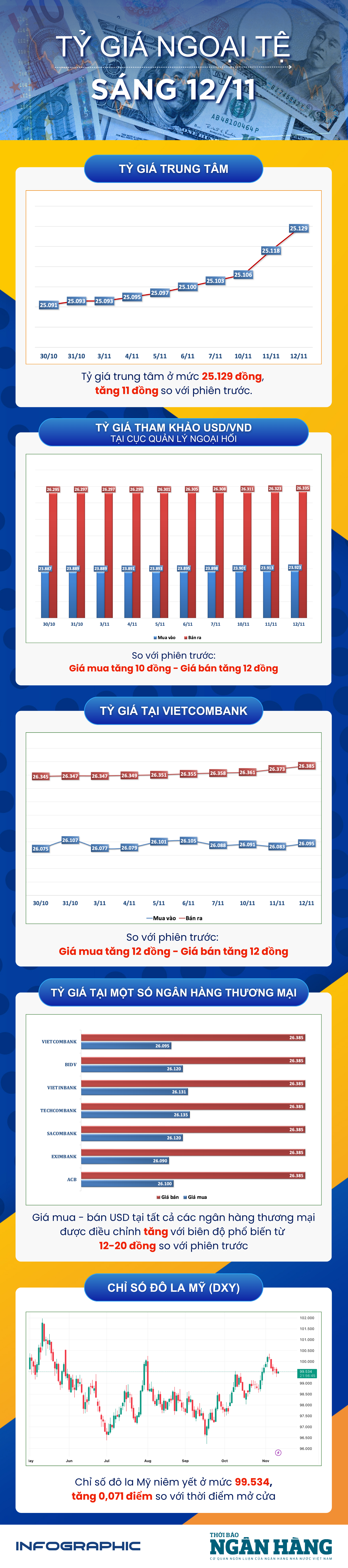
The USD weakened after private sector jobs data showed signs of a weakening US labor market, as investors prepared for the possibility of a US government reopening and the release of delayed economic data.
According to the ADP jobs report, U.S. businesses cut an average of more than 11,000 jobs per week through the end of October, reflecting a slowing hiring trend, a factor closely monitored by the Federal Reserve.
Immediately after the data was released, the US dollar fell and struggled to recover as investors increased their bets on the possibility of the Fed cutting interest rates in December.
The euro fell 0.05% to $1.1576.
The British pound traded at $1.3139, down 0.08%, a considerable distance from its previous seven-month low.
The US dollar index, which measures the strength of the greenback against a basket of major currencies, fell to its lowest level in more than a week, currently fluctuating around 99.46.
“Recent data suggests the labor market is weakening, albeit gradually. We will have more evidence when official data is released after the government reopens,” said Sim Moh Siong, currency strategist at Bank of Singapore.
According to CME's FedWatch tool, traders are now pricing in a 68% chance that the Fed will cut interest rates by 25 basis points next month, up from 62% the previous day. In the US bond market, the 10-year yield fell 3 basis points to 4.0791%, while the two-year yield retreated to 3.5596%.
"The balance of risk factors, from the labor market and inflation to consumer spending, still supports the possibility of the Fed cutting interest rates by 25 basis points next month," said Brian Martin, Head of G3 Economics at ANZ.
Recently, Fed policymakers have been more cautious about easing policy, citing a lack of key economic data due to the U.S. government shutdown. However, the possibility of a federal government reopening may be imminent as House members return to Washington on Tuesday to vote on ending the longest government shutdown in history.
The House of Representatives, controlled by the Republican Party, is expected to vote on a compromise aimed at restoring funding for federal agencies and ending the shutdown that began on October 1st.
This information helped the Australian dollar and the New Zealand dollar to edge up slightly.
The Australian dollar is currently trading at 0.6523 USD, up 0.05%.
The New Zealand dollar rose 0.07% to $0.5659.
Conversely, the Japanese yen continues to face pressure as risk appetite increases. The yen is currently down 0.1% at 154.32 yen per USD, after touching a nine-month low of 154.495 yen per USD in the previous session. Thus, the currency has fallen nearly 0.5% since the beginning of the week.
The yen also faced additional pressure from expectations that the Japanese government would ease fiscal policy, with Prime Minister Sanae Takaichi indicating her desire to set a new long-term fiscal plan that would allow for more flexible spending – a stance contrary to the Fed's tightening policies.
Source: https://thoibaonganhang.vn/sang-1211-ty-gia-trung-tam-tang-11-dong-173443.html
![[Photo] Ba Lang An Lighthouse - the "eye of the sea" amidst the "rock museum" of Quang Ngai province.](https://vphoto.vietnam.vn/thumb/1200x675/vietnam/resource/IMAGE/2026/05/29/1780038698840_anh-man-hinh-2026-05-29-luc-14-10-42.png)




![[Image] Pleasant weather helps students enter the 10th grade entrance exam with confidence.](https://vphoto.vietnam.vn/thumb/1200x675/vietnam/resource/IMAGE/2026/05/29/1780034401612_ngay-1-thi-lop-10-minh-duy-8-5009-jpg.webp)































































































Comment (0)