

According to the Maritime Project Management Board, the Quy Nhon waterway upgrade project is currently undergoing environmental procedures to begin construction soon. The project has completed the environmental impact assessment (EIA) and has submitted it to the Ministry of Natural Resources and Environment for approval.
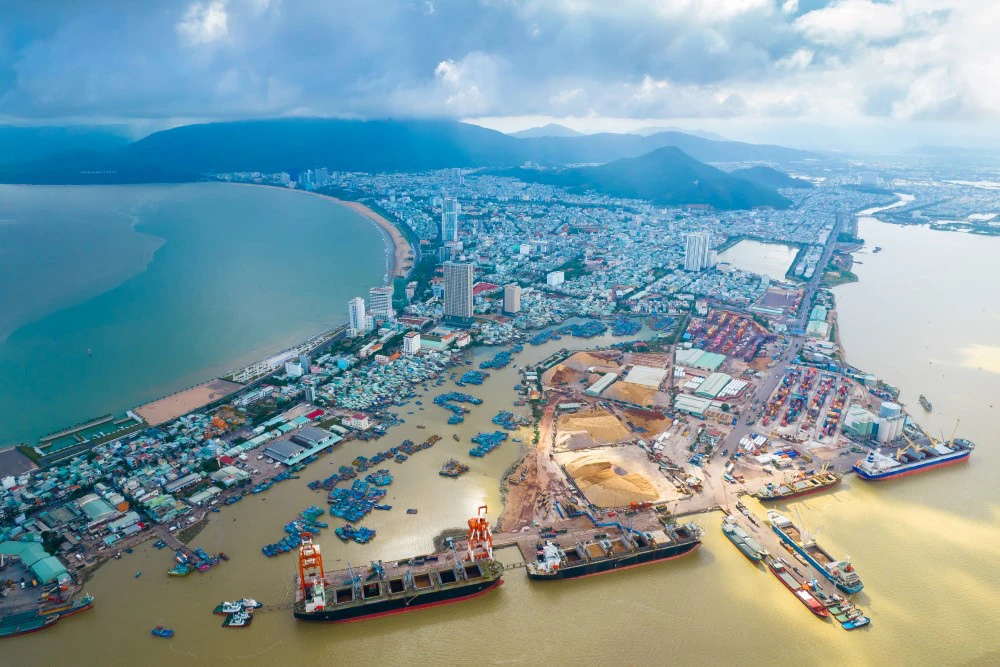
The project involves the construction and upgrading of the Quy Nhon channel to accommodate 50,000 DWT vessels, aiming to expand the channel to a length of 7km, a width of 140m, and a channel bottom elevation of (-13m).
"Only after the Environmental Impact Assessment (EIA) is approved can the investment project be prepared and the next steps implemented. If the EIA can be approved early, the project could be ready to start construction in 2024," a leader of the Maritime Project Management Board informed.
Mr. Ho Lien Nam, Deputy General Director of Quy Nhon Port Joint Stock Company, said that in the coming time, the port will maintain the water area in front of berths No. 2, 3, 4, and 5 to be able to receive fully loaded 50,000 DWT vessels.
"However, the shipping channel has not been upgraded and currently does not meet the original standard of -11m. This affects the operation and efficiency of the port. The inability of large ships to enter also reduces maritime fees and charges," Mr. Nam said.
According to the leaders of Quy Nhon Port, the domestic and international shipping market is continuing to increase the size of ships to optimize time and save costs. The number of cargo ships arriving at seaports in general, and Quy Nhon Port in particular, to receive/deliver goods tends to decrease in terms of the number of vessels, but increase in total tonnage and deadweight tonnage, aiming to increase transport volume while reducing sea freight and import/export logistics costs.
At Quy Nhon Port, the demand for handling fully loaded 50,000 DWT and partially loaded 70,000 DWT vessels for transporting import and export goods such as containers, steel coils, wood chips, wood pellets, mineral ores, and equipment (accounting for 85% of the total throughput at the port) is very large and practical for shippers and ship owners.
For goods with large and stable supply through ports in Port Groups 2 and 3, shippers and ship owners often use a fixed fleet of vessels that rotate between ports for transporting and delivering goods.
Currently, the volume of container cargo handled through Quy Nhon port is approximately 150,000 – 200,000 TEU/year. Shipping lines typically call at ports in the North before heading to overseas destinations.
"However, restrictions on receiving ships due to limitations on tonnage, length, and draft in the channel prevent the acceptance of large-tonnage vessels. Meanwhile, Quy Nhon port is the final destination for ships before leaving Vietnam, so there are often cases where ships have to reduce their cargo at adjacent ports or cut back on Quy Nhon cargo, or even cancel their voyages to Quy Nhon," Mr. Nam said.
In addition, service routes connecting with mother vessels at hubs such as Cai Mep - Thi Vai, Singapore, Hong Kong, and financial routes that require feeders longer than 200m to increase transport volume, run longer routes, and reduce costs, can currently call at Hai Phong and Da Nang but cannot call at Quy Nhon to pick up and deliver goods.
The fixed fleet of bulk carriers also has a large deadweight tonnage of approximately 50,000 DWT, usually serving to transport wood chips, wood pellets, and rolled steel sheets at some ports in Port Groups 2 and 3 that can dock at Quy Nhon port to load and unload cargo. However, only berth 4 of the port is permitted to receive ships.
"During peak times, the number of ships arriving to load/unload cargo is high. Prolonged waiting times at the berths, lasting for days, lead to losses for cargo owners and ship owners, and waste resources for import-export businesses and port operators," shared a leader of Quy Nhon port.
Notably, the Quy Nhon port has now been authorized by the Vietnam Maritime Administration to put berth No. 1 into operation after the completion of its upgrade. Berth No. 1 has a water depth of -12.2m in front of the berth, and its structure is designed to accommodate vessels with a deadweight tonnage of up to 50,000 DWT. Conditions regarding the navigation channel, pilotage capacity, tugboat fleet capacity, manpower, and handling equipment are basically met.
Therefore, this company believes that if the investment project to renovate and upgrade the Quy Nhon maritime channel is carried out according to the design, it will enhance the capacity to receive ships and goods through the port. This will contribute to the socio-economic development of Binh Dinh province and the Central and Central Highlands regions.
The project aims to renovate and expand the channel with a length of 7km, a width of 140m, and a channel bottom elevation of (-13m). The estimated dredging volume is approximately 3.05 million m3, meeting the needs of goods transportation in the area.
Source: https://www.baogiaothong.vn/sap-nang-cap-luong-quy-nhon-192240529180805862.htm











































































































Comment (0)