

Currently, the rice crop is in the panicle differentiation to flowering and pollination stage. This is a very important stage, determining the final rice yield; however, pests and diseases are emerging and causing widespread damage across the rice crop.
The infected area is 1.4 times larger than in the same period of 2022.
We were present at the Middle Field, Bach Cu Agricultural Cooperative, Ninh Khang commune, Hoa Lu district, and easily observed that many rice fields had their leaves turning white due to damage caused by leaf-rolling caterpillars.
Mr. Do Xuan Duy, from Team 2, Phan Trung Hamlet, Ninh Khang Commune, shared: "This season, the weather is favorable, and the rice is growing very well, but conversely, there are also many pests and diseases. My family planted 8 sao (approximately 0.8 hectares), mainly two varieties, Bac Thom and LT2. Nearly a month ago, we had to spray once with a combination of pesticides to control blast, leaf-rolling caterpillars, and planthoppers. However, perhaps because we sprayed during a period of heavy rain, the effect was not as expected. I'm planning to spray a second time to completely control the pests."
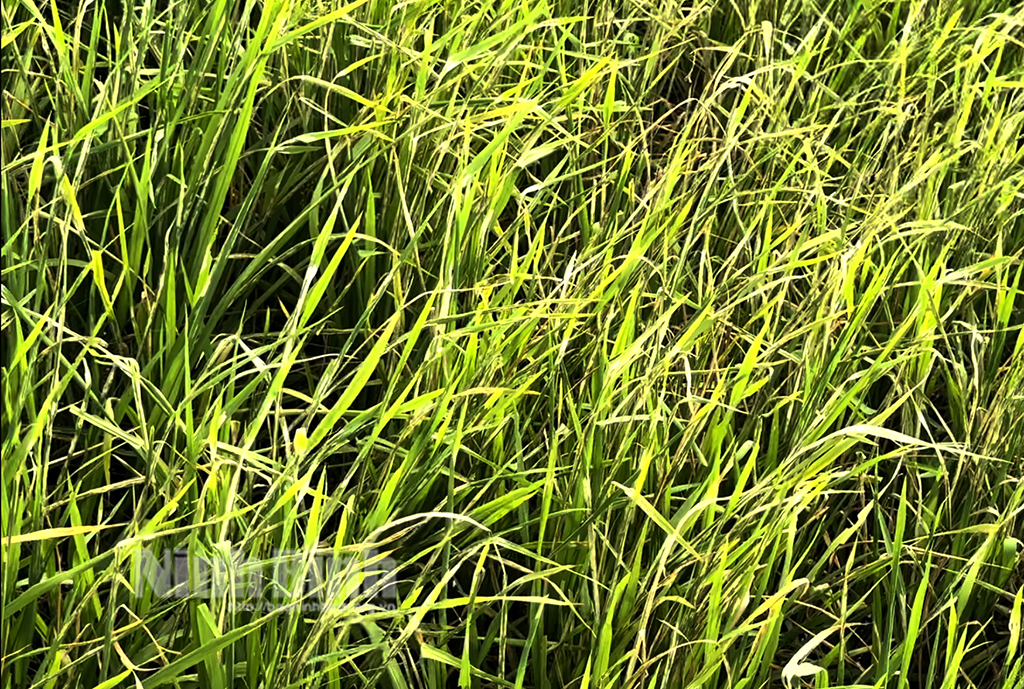
According to the Hoa Lu District Agricultural Service Center, the small leaf-rolling caterpillar is not only causing severe damage in Bach Cu Agricultural Cooperative but also scattered across many other cooperatives such as Dong Dan - Ninh Van, Thinh Hoi - Ninh An, Hong Phong - Ninh Hoan, Trung Tru - Ninh Giang... with very high densities (over 200 caterpillars/m2). In addition, two-spotted stem borer, brown planthopper, white-backed planthopper, bacterial blight... are also continuing to increase damage to rice crops.
Regarding the pest and disease situation throughout the province, Mr. Nguyen Ngoc Tuan, Deputy Head of the Provincial Department of Crop Production and Plant Protection, stated: In general, the emergence of pests and diseases in this crop season is earlier than the average of many years and 5-10 days earlier than the 2022 Summer crop season. The total infected area throughout the province to date is over 38,400 hectares (1.4 times higher than the same period of the 2022 Summer crop season). Of which, the severely infected area is 21,310 hectares (2.5 times higher than the same period of the 2022 Summer crop season).
According to Mr. Tuan, it is noteworthy that in this case, the small rice leaf roller appeared in unusually high densities and caused widespread damage. More concerning is that these rice crops are in the heading stage; if damaged, rice yields will be significantly affected. However, in some localities, the implementation of pest control measures has been untimely and complacent. It is predicted that the rice leaf roller infestation will remain complex in the coming period, and if not controlled promptly, it will cause heavy losses to the crop season.
Focus on spraying during the first half of September.
According to the forecast of the Provincial Department of Crop Production and Plant Protection: The seventh generation of rice leaf roller moths will emerge in large numbers from August 28th to September 7th, with larvae hatching in large numbers from September 3rd to September 13th, causing widespread damage to rice crops that have headed after September 5th in districts and cities throughout the province. Common moth density: 50-70 moths/m2; exceptionally over 200 moths/m2. The scale and severity of damage are higher than in the same crop of 2022. If not detected and controlled promptly, many areas will be severely damaged, causing the flag leaves to turn white, significantly affecting rice yield.
In addition, the fifth generation of the two-spotted rice stem borer moth continues to emerge until September 12th. Larvae hatch in large numbers from August 29th to September 19th, causing damage to rice crops that have headed after September 1st in the northern districts of the province and after September 5th in the southern districts. The scale and severity of damage are higher than in the 2022 crop season. Rice planthoppers hatch in large numbers from September 13th to 23rd, causing widespread damage to rice crops, especially mid-season rice crops in the ripening to mature stages. In many areas, planthopper density is very high, such as in Kim Son, Yen Mo, Yen Khanh, and Hoa Lu districts, potentially causing crop blight in the ripening to mature stages. Furthermore, rats and rice blast disease continue to increase damage to rice crops; weeds and black stripe dwarf disease cause localized damage.
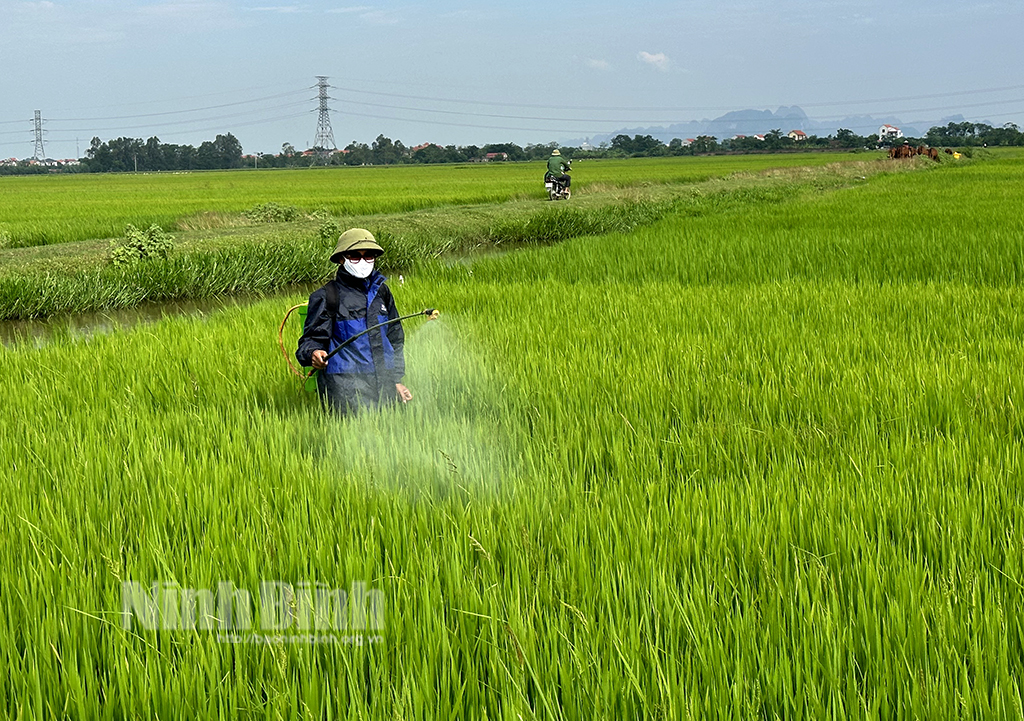
Mr. Nguyen Duy Khuong, Director of Bach Cu Cooperative (Ninh Khang commune, Hoa Lu district), said: It is expected that the entire area of the cooperative's summer rice crop will flower between September 15th and 20th. This is a very important stage; if not properly controlled, the outbreak of pests and diseases will seriously affect the rice yield at the end of the season. In reality, field inspections show that the density of the sixth generation of rice leaf rollers is very high, and brown planthoppers and white-backed planthoppers have also emerged and pose a risk of widespread damage. Therefore, the cooperative has widely publicized the pest and disease situation through the public address system and disseminated information through associations and organizations to guide people on appropriate control measures, ensuring the "four correct principles": "correct pesticide, correct dosage, correct timing, and correct method". Specifically, they will focus on spraying small rice leaf rollers simultaneously from September 6th to 11th. The cooperative has also prepared sufficient quality pesticides and supplies to provide to farmers.
Pest and disease control guide For rice leaf rollers: Spray on areas with a density of 20 or more larvae/m2. When the second instar larvae are abundant, spray from September 6th to 11th using specific insecticides such as: Clever 150SC; 300WG; Directer 70EC; Fenrole 240 SC, Virtako 40WG; Voliam Targo 063SC; Silsau 3.5EC; Dylan 2EC... (Fields with a high density of over 200 larvae/m2 must be sprayed twice, with the second spraying 4-5 days after the first). For the two-spotted rice stem borer: Spray on fields with an egg cluster density of 0.3 clusters/m2 or more, when first-instar larvae are hatching in large numbers. Spraying should begin from September 1st for the northern districts of the province and from September 5th for the southern districts. Fields with an egg cluster density of 1 cluster/m2 or more must be sprayed twice, the second time 5-7 days after the first, using one of the following specific insecticides: Prevathon 5SC; Voliam Targo 063SC, Virtako 40WG... For brown planthoppers and white-backed planthoppers: Spraying should be carried out from September 16th to September 21st. Specifically: + During the heading and flowering stages: Spray on fields with a planthopper density of 2,000 or more individuals/m2 when the second instar planthoppers are abundant, using one of the following systemic insecticides: Chess 50WG, Titan 600WG, Palano 600WP, Niten Super 500WP, Matoko 50WG… + During the green-tailed stage: Spray on fields with a density of 1,500 or more planthoppers/m2, when the second instar of planthoppers is abundant, using one of the contact insecticides such as: Nibas 50EC, Bassa 50EC, Vibasa 50EC… Note that when using contact insecticides, it is essential to part the rows so that the spray comes into direct contact with the planthoppers, and choose insecticides that ensure the required harvest waiting period. In addition, combine control measures against brown spot disease, black kernel disease, bacterial blight, bacterial leaf streak, and neck blast on susceptible varieties. Continue rodent control. ( Note : Depending on the specific situation in each locality, it is necessary to identify the main pests in order to take timely and effective control measures; it is possible to combine spraying against the above pests, but it is necessary to ensure sufficient dosage and the amount of diluted pesticide solution is 25-30 liters/acre). |
Nguyen Luu
Source

![[Photo] The General Secretary, President and his wife begin their state visit to the Philippines.](https://vphoto.vietnam.vn/thumb/1200x675/vietnam/resource/IMAGE/2026/05/31/1780230559452_anh-man-hinh-2026-05-31-luc-19-28-11.png)

![[Photo] Admire the coral "masterpiece" amidst the million-year-old heritage of Dak Lak province.](https://vphoto.vietnam.vn/thumb/1200x675/vietnam/resource/IMAGE/2026/05/31/1780221235105_anh-man-hinh-2026-05-31-luc-16-53-27.png)
![[Photo] Solemn bathing ceremony and Buddha procession in Hue](https://vphoto.vietnam.vn/thumb/1200x675/vietnam/resource/IMAGE/2026/05/31/1780228263543_1-jpg.webp)


















![[Video] Sunset at Lap An Lagoon – Where the sun sets over the fishing nets](https://vphoto.vietnam.vn/thumb/340x192/vietnam/resource/IMAGE/2026/05/31/1780192137701_beach-landscape-sea-water-nature-grass-745871-pxhere-com.jpeg)




































![[Photo] Admire the coral "masterpiece" amidst the million-year-old heritage of Dak Lak province.](https://vphoto.vietnam.vn/thumb/402x226/vietnam/resource/IMAGE/2026/05/31/1780221235105_anh-man-hinh-2026-05-31-luc-16-53-27.png)




























Comment (0)