

From a dream of becoming a photojournalist…
Nguyen Hai Phong arrived for our meeting wearing a polo shirt and jeans, with a backpack and a jumble of belongings on his shoulder. "Phong looks so young and bookish," was my first thought. Young, simple, and approachable. I half-jokingly asked if he was a director, and he laughed, shook his head, and replied, half-jokingly, "An editor."
But with the documentary "Journey for Peace," broadcast on the National Defense Television channel on April 30, 2026, Phong was more than just an editor or a director. He wrote the script, formulated the issues, developed the characters, controlled the visuals, and directly interviewed generals and former leaders of the Ministry of National Defense and the Ministry of Foreign Affairs. Phong represented the directing team of that film.
Phong (real name Nguyen Hai Phong, born in 2003 in Dong Trieu, Quang Ninh) is one of the young members of M21 (Media 21 Communications Co., Ltd.), a media company specializing in historical and military documentaries.
Phong entered university intending to become a photojournalist. But what changed him wasn't a film or a book, but travel. While a student, Phong joined a special volunteer club: they organized trips to honor veterans, taking students along with veterans to revisit old battlefields, war cemeteries, and memorials.

Phong during a print journalism assignment. Photo: Provided by the interviewee.
He remembered an old veteran named Dat who had fought in the 273rd Armored Brigade. In one battle, out of the five tank crews, only Dat survived, but the fire had taken away half of his face, and his body bore irreparable damage; he was a severely wounded soldier.
Uncle returned to the old battlefield to reunite with his former comrades, revisit the places where he had faced life and death, and pay tribute to those who never returned. Phong only met Uncle on that trip. Later, they briefly crossed paths, but never had the chance to sit down and chat again.
Amidst the large crowd that day, he always kept his distance. Not because he was cold, but because there was something heavier about him. "I felt like he was living for his remaining comrades," Phong recounted, his voice slowing... The moment he stood silently among the rows of graves, quietly walking past, his eyes staring into the distance, was an image that haunted Phong for many years afterward.
Those trips didn't teach him filmmaking. They made him realize that history isn't just found in books. It's in the memories of the people sitting next to him, in the look in their eyes as they stand before a tombstone, in stories yet to be written down.
When offered the opportunity to collaborate on M21, Phong hesitated. He didn't know how to film or edit. But he felt the subject matter resonated with him. "Well, let's just go for it, and a path will be formed," he said. The decision was as simple as that.
...to the young "director"
Phong's debut film at M21 is the documentary "Journey for Peace," based on the memoir of the same name by Lieutenant General Nguyen Chi Vinh, former Deputy Minister of National Defence of Vietnam (in charge of foreign affairs, intelligence, and peacekeeping operations). The work helps viewers understand the origins of the Vietnamese blue beret force and its journey through strategic thinking challenges, thereby expressing the desire to build and protect the country and contribute to peace and stability in the region and the world .
Before starting the project, Phong read the memoir "Journey for Peace." Not just once, but dozens of times. "From my generation onwards, we tend to absorb too much short content, so reading a thick book is a challenge," he admitted.
But with this memoir, Phong recounts that the first time he picked it up, he was immediately captivated, especially the early sections about the journey of building the Green Berets. Phong didn't dare put the memoir down halfway through for fear of losing his train of thought and missing the full content. This section deals heavily with policies, guidelines, and strategies, making it one of the most important parts of the book. Those seemingly dry passages actually presented the biggest challenge when making the film: how to make it engaging without being inaccurate.
Using the book as a foundation, Phong sought out the quiet spaces between the pages: stories never before recorded, the anxieties of those involved before the official establishment of the Green Beret force.
He met the General's family. Phong recounted that the family held him in high regard and always encouraged him throughout his work. He met with officers who had worked directly with the General, listening to everything from behind-the-scenes stories to major issues such as the General's vision in building and developing peacekeeping forces to affirm Vietnam's military strength and military culture, and, more importantly, the image of Vietnam as a responsible member state making positive contributions and leaving its mark in the region and the world.

Director Nguyen Hai Phong interviews Major General Hoang Kim Phung - former Director of the Peacekeeping Department - for the documentary film "Journey for Peace". Photo: Provided by the interviewee.
Phong said that the most difficult part of the entire process of completing a documentary film is not filming or editing, but writing the script. A memoir is written in a linear timeline, but when adapted into a film, it requires piecing together information from many sources, many people, and many perspectives into a coherent narrative. “Sometimes the initial idea is one thing, but interviews yield different content. You have to find a way to harmonize it, not omitting valuable material but also not straying too far from the initial script.”
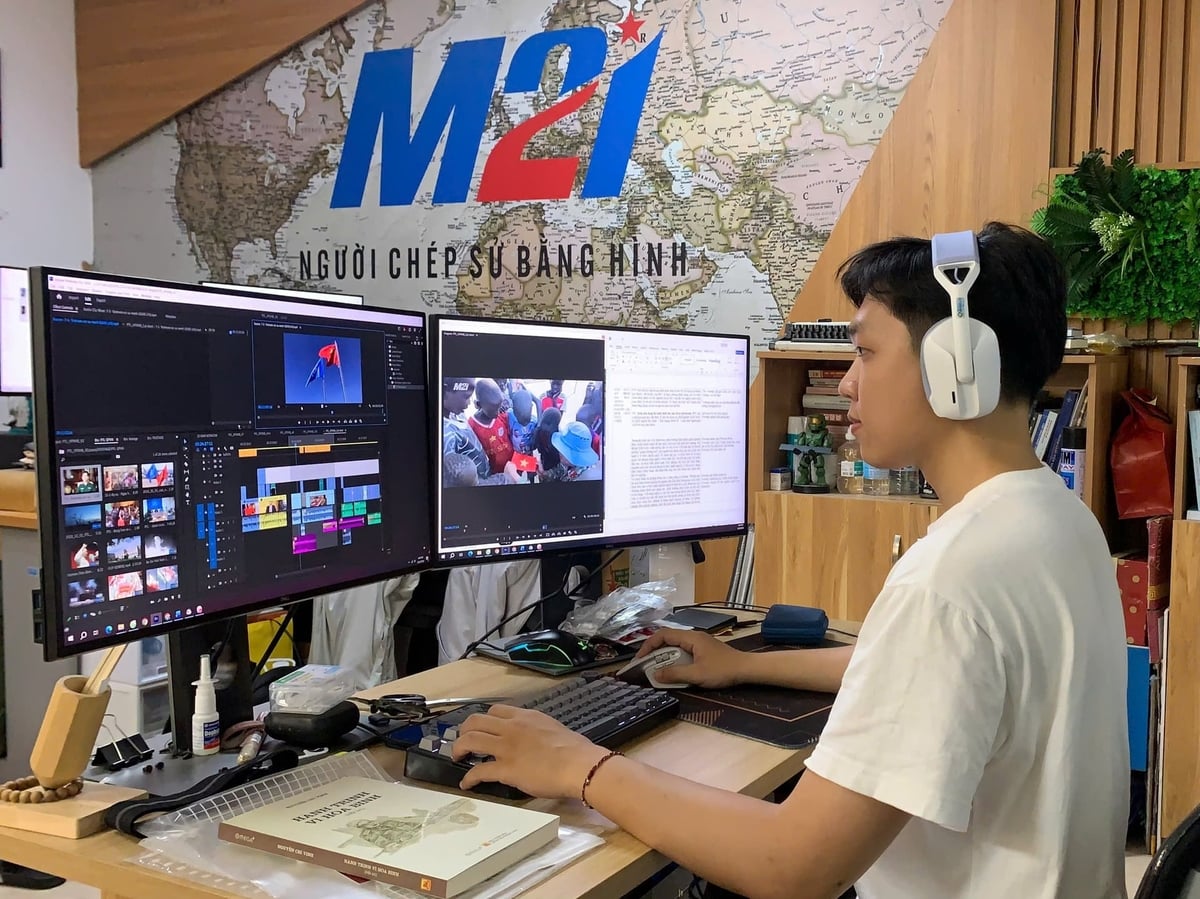
Phong always has a guiding principle for all his actions. Photo: Minh Toàn.
However, the film script has undergone many revisions. These weren't minor changes; Phong sometimes decided to rebuild it from scratch. He explained that sometimes it was because it wasn't cohesive, not interconnected, or not engaging enough. Sometimes it was simply because he felt something was off. And instead of patching things up, he chose to tear it down and start over. "Through those times of tearing it down and rebuilding, I gained a deeper understanding of the core issues and how the events connect," he said.
As the release date approached, he was still making adjustments, but only minor details. The real challenge had already been solved through previous rework.
When asked what kept him from giving up, Phong paused thoughtfully before repeating a quote from General Nguyen Chi Vinh that he deeply appreciated: "You must work hard; do as others do."
"I told myself that if my colleagues could do it, even if they faced much more complex projects, why couldn't I? Thinking simply like that, I diligently worked, one way or another, learning from those who came before me and applying it to myself."
History should be told according to the principle: accuracy first, then appeal.
Phong always prioritizes historical accuracy before considering how to tell it in an engaging way. He has a clear principle: "History must be told accurately and completely. Only then should we consider the appeal of the presentation."
Phong gave an example: a beautifully shot documentary about the Green Berets, filmed with modern technology and sharp images, could perfectly illustrate a commentary. But if the film is about the period before the force was established, using modern imagery would be wrong. Few people would notice immediately. But Phong knew. And he didn't use it.
According to Phong, the strengths of young people in this field are "understanding the tastes of young people, knowing what narrative pace keeps viewers engaged, knowing where to place visual anchors so that people don't turn off the film after three minutes. And knowing how to use technology to make images and sound more beautiful and sharper. Using the expression of today's generation to present old issues."

Phong didn't hide his weakness: his knowledge wasn't deep enough compared to the previous generation. There's no shortcut to overcoming that deficiency. The only solution is to read, ask questions, and keep practicing.
When asked who he wanted to be remembered as in ten years, Phong didn't mention awards or fame. "I hope people think of me as a journalist, an editor who speaks the truth. Telling true stories from my objective perspective, I hope that in 10, 20, or 30 years I will still maintain the sincerity and integrity in my work. And if I had a choice, I would choose to be a director of historical films so I could live within history."
Source: https://nongnghiepmoitruong.vn/song-trong-lich-su-d812168.html

![[Image] Nearly 125,000 Hanoi students completed the Literature exam for the 10th grade entrance exam.](https://vphoto.vietnam.vn/thumb/1200x675/vietnam/resource/IMAGE/2026/05/30/1780117233041_ndo_br_thiet-ke-chua-co-ten-2-png.webp)

















































































Comment (0)