


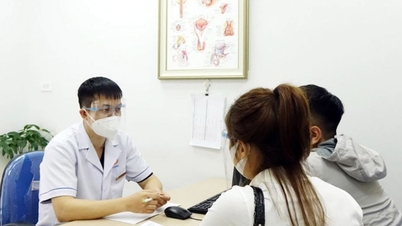
Illustration.
Before hospitalization, the patient had a continuous high fever of 39-40 degrees Celsius and had self-treated at home without improvement. Upon admission to Phuc Hung Hospital ( Quang Ngai ), the patient was lethargic, had generalized muscle tremors, high blood sugar, high blood pressure, and a fever of 39 degrees Celsius.
Recognizing this as a severe infection, suspected to be meningitis, the doctors quickly lowered the fever, provided respiratory support, administered fluids, and transferred the patient to the intensive care unit for specialized treatment.
Clinical examination and necessary tests revealed the patient was diagnosed with purulent meningitis, presenting with typical symptoms including high fever, nuchal rigidity, and decreased consciousness. Lumbar puncture results showed cloudy white fluid, elevated white blood cell count of 675 cells/uL, and a positive Pandy reaction.
The patient received intensive treatment with high-dose broad-spectrum antibiotics, corticosteroids, and anticonvulsant medication, while blood sugar and blood pressure were closely monitored. After 3 days of treatment, the patient's fever subsided, consciousness improved significantly, and seizures ceased.
According to MSc. Dr. Le Nguyen Thanh Hang, Deputy Head of the Emergency - Intensive Care - Toxicology Department, purulent meningitis is a dangerous infection of the central nervous system that can quickly lead to sepsis, irreversible nerve damage, and even death if not detected early. The risk of complications is even higher in people with underlying chronic diseases such as diabetes.
Doctors advise people to seek medical attention immediately if they experience symptoms such as prolonged high fever, severe headache, lethargy, altered consciousness, or seizures. Early detection and treatment within the "golden time" helps reduce the risk of complications and improve the chances of recovery.
Source: https://vtv.vn/sot-cao-lien-tuc-cho-dieu-tri-tai-nha-100260530145233887.htm

![[Photo] The General Secretary, President and his wife begin their state visit to the Philippines.](https://vphoto.vietnam.vn/thumb/1200x675/vietnam/resource/IMAGE/2026/05/31/1780230559452_anh-man-hinh-2026-05-31-luc-19-28-11.png)
![[Image] Hanoi Police officially crowned champions of V-League 2025/2026](https://vphoto.vietnam.vn/thumb/1200x675/vietnam/resource/IMAGE/2026/05/31/1780244769054_ndo_br_039d561b692be875b13a-jpg.webp)

![[Photo] Solemn bathing ceremony and Buddha procession in Hue](https://vphoto.vietnam.vn/thumb/1200x675/vietnam/resource/IMAGE/2026/05/31/1780228263543_1-jpg.webp)
![[Photo] Admire the coral "masterpiece" amidst the million-year-old heritage of Dak Lak province.](https://vphoto.vietnam.vn/thumb/1200x675/vietnam/resource/IMAGE/2026/05/31/1780221235105_anh-man-hinh-2026-05-31-luc-16-53-27.png)


















![[Video] Sunset at Lap An Lagoon – Where the sun sets over the fishing nets](https://vphoto.vietnam.vn/thumb/340x192/vietnam/resource/IMAGE/2026/05/31/1780192137701_beach-landscape-sea-water-nature-grass-745871-pxhere-com.jpeg)


































![[Photo] Admire the coral "masterpiece" amidst the million-year-old heritage of Dak Lak province.](https://vphoto.vietnam.vn/thumb/402x226/vietnam/resource/IMAGE/2026/05/31/1780221235105_anh-man-hinh-2026-05-31-luc-16-53-27.png)
































Comment (0)