

 |
Acrophobia is not simply the feeling of "shaky legs" when standing in a high place. (Illustration: Pexels) |
Do you feel anxious at the thought of bungee jumping from a high bridge or standing at the top of a rickety ladder? In fact, anxiety about heights is a perfectly natural bodily reaction. But when the fear becomes so intense that it causes a person to panic and avoid any situation involving heights, it could be a sign of acrophobia (fear of heights).
Why do people fear heights?
The exact causes of acrophobia (fear of heights) are not yet fully understood. Most experts believe it develops from a combination of genetic, environmental, and psychological factors.
According to Verywell Mind , studies show that a fear of heights exists not only in humans but also in most visual animals. This suggests that the fear of heights may have been "programmed" as a survival mechanism through evolution.
In 1960, two psychologists, Eleanor J. Gibson and Richard D. Walk, conducted the famous experiment known as "The Visual Cliff".
In this experiment, babies learning to crawl, along with the young of various animals, were placed in front of a space with a thick glass pane above, creating the illusion of a chasm. Despite the mother's constant calls and reassurance from the other side, most babies refused to crawl across, demonstrating an early fear of heights.
However, most children and adults only exercise necessary caution and do not develop an extreme obsession.
According to experts, acrophobia, like many other phobias, is an exaggerated reaction of the natural fear mechanism. This fear can develop after a fall, a negative experience related to heights, or be influenced by parental anxiety.
Some studies also suggest that what frightens people isn't necessarily the height itself, but the fear of falling uncontrollably.
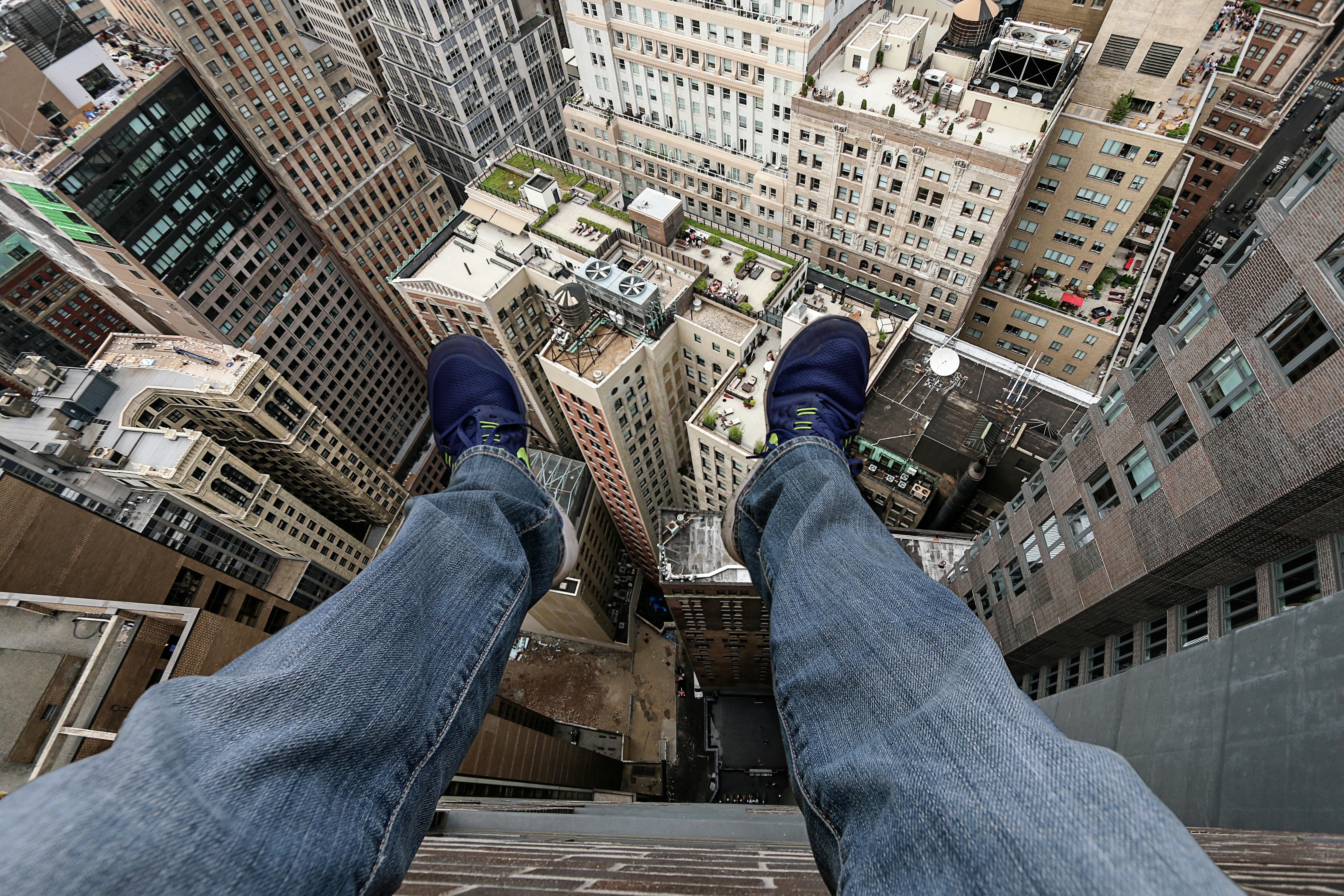 |
A fear of heights exists not only in humans but also in most visual animals. Photo: Pexels. |
What happens to the body when someone suffers from acrophobia (fear of heights)?
Acrophobia is not simply a feeling of "shaking legs" when standing in a high place. People with this syndrome can experience a range of emotional and physical reactions, similar to other forms of phobia.
Specifically, upon realizing they are far above the ground, many people with acrophobia immediately fall into a state of panic. They often instinctively look for something to hold onto because they feel unbalanced and no longer trust their ability to control their bodies.
Some common reactions include quickly trying to get down, crawling on all fours, kneeling, or trying to lower the body to feel safer.
Besides affecting the psyche, fear of heights also causes many noticeable physical symptoms such as chest pain, dizziness, nausea, rapid heartbeat, shortness of breath, and trembling.
People with acrophobia often try to avoid any situation involving heights. They might worry about staying in a high-floor hotel room on vacation, postpone home repairs because they're afraid of using ladders, or be reluctant to visit friends who live in apartments with balconies or windows high up.
Over time, this avoidance behavior can severely impact daily life. Some people are even unable to go to school, work, meet friends, or leave the house because of the prolonged fear.
Source: https://znews.vn/su-that-chung-so-do-cao-post1650681.html


![[Image] Close-up view of the interchange connecting the two expressways and Long Thanh Airport.](https://vphoto.vietnam.vn/thumb/1200x675/vietnam/resource/IMAGE/2026/05/25/1779703378210_ndo_br_z7863716673926-224453a31600126cce10622af6290afd-4549-jpg.webp)


![[Image] Hanoi's urban life under the challenge of a "scorching hot" environment](https://vphoto.vietnam.vn/thumb/1200x675/vietnam/resource/IMAGE/2026/05/25/1779706979265_nang-nong-t5-2026-minh-duy-7-4636-jpg.webp)




























































































Comment (0)