

Yen Bai actively preserves and develops rural craft villages.
Traditional craft villages in Yen Bai contribute to building new rural areas.
Yen Bai has 15 craft villages and traditional crafts associated with tourism.
Yen Bai's traditional craft villages face a life-or-death crossroads.
Yen Bai strives to have 4 new traditional craft villages recognized in 2025.
Products from traditional craft villages, because they embody the skill of the artisans and the secrets passed down through generations, create special value for customers and a brand associated with traditional cultural identity. This is precisely what gives many traditional craft villages in Yen Bai their vibrant spirit.
"Brand" of a traditional craft village
In late March, the lingering chill of the season made the wind from Thac Ba Lake feel somewhat dry and biting. I traveled upstream to Dong Tam village, Phuc An commune, a traditional craft village specializing in shrimp trap weaving. This is the first craft village in Yen Bai province, and also the first in Yen Binh district, to be recognized by the Provincial People's Committee. Although it's a craft village, the shrimp trap weaving trade isn't as bustling as other traditional craft villages. The village is peaceful. Here and there, under the eaves of houses or in front of courtyards, it's not difficult to spot women diligently weaving traps.
I visited the family of Ms. Le Thi Ngoc Tham, a long-time shrimp trap maker and one of the leading traders in the lake area, with a working capital of over 1 billion VND per year. Ms. Tham shared: "For over two decades, we've been weaving shrimp traps. This craft has been intertwined with the lives of the people in the Thac Ba lake area for generations. There's no need to worry about it disappearing; it's just that in the past, the materials were readily available, so many people did it, but now there are fewer. With hard work, you can earn hundreds of thousands of dong a day, providing your family with some extra income."
Ms. Tham's statement was rather modest, because in Dong Tam village, the only occupation being weaving shrimp traps is the shrimp trap weaving, yet Ms. Nguyen Thi Yen, who single-handedly raised two children through university, has even managed to build a spacious, well-built house worth several hundred million dong. Village head Do Quang Tuyen boasted, "This is a very exemplary family in the village in terms of their determination to escape poverty. Before, Yen's family was very poor. Three years ago, Ms. Yen voluntarily wrote a letter requesting to be removed from the list of poor households. Many families with both husband and wife haven't been able to do what she has."
As Village Head Do Quang Tuyen had predicted, in the newly built, neat and tidy house, Ms. Yen and her niece were busily shaping the bamboo strips, and the lovely shrimp traps were taking shape.
Sharing her story about her profession and life, Ms. Yen couldn't hide her emotion, her eyes glistening with pride: "My husband left when my second daughter was only 5 years old, our house was dilapidated like a buffalo shed, the hardship was indescribable… This shrimp trap weaving profession saved me and my two children from poverty. I didn't know how to do anything else besides weaving traps, a skill passed down from my grandparents, and yet I managed to raise my two children, educate them, and build a decent, sturdy house. I can give up anything, but I can't give up this profession. To be honest, I'm not worried about not being able to sell the products; it's just that I don't have enough strength to do it…"
Dating back to their great-grandparents, the craft of weaving shrimp traps has been passed down through generations in Phuc An. Phuc An shrimp traps have become the best-selling item at the local ethnic minority markets and provide the main source of income for many households in the commune. In July 2017, the Dong Tam village in Phuc An commune was recognized as a traditional craft village by the People's Committee of Yen Bai province. Since then, the value of Dong Tam village's shrimp traps has become closely linked to the village's brand value.
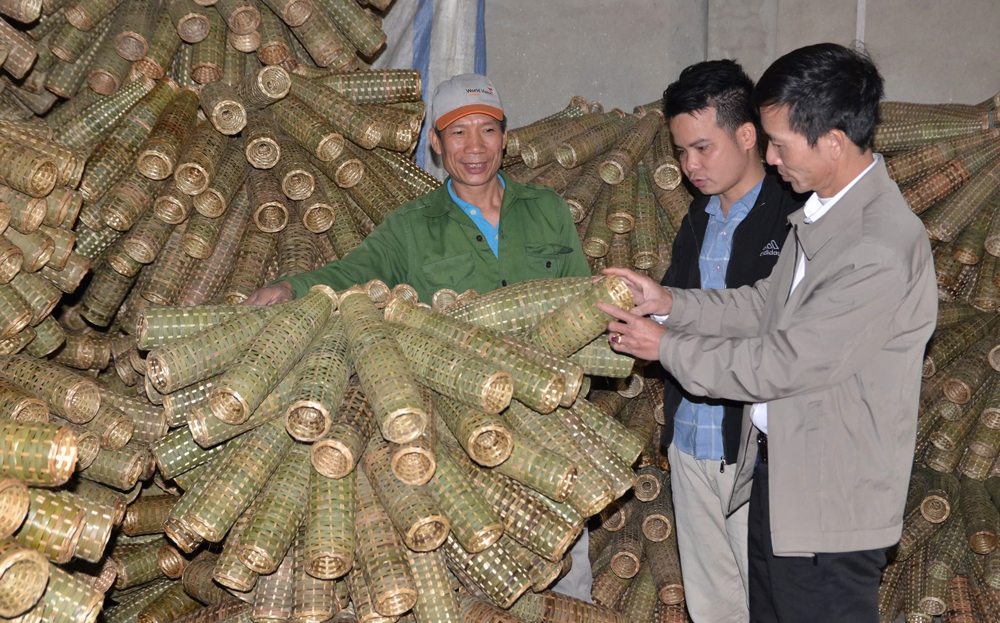
Mr. Hoang Van Ba (on the left) from Phuc An commune, Yen Binh district, has working capital of approximately 3 billion VND per year from purchasing shrimp traps.
Mr. Hoang Van Ba, a large and experienced shrimp trap trader in Phuc An, with a working capital of several billion VND per year, said: "Shrimp traps are purchased from many places in the region and exported to localities with hydroelectric reservoirs such as Na Hang - Tuyen Quang, Hoa Binh ... However, the shrimp traps from Dong Tam village are unmistakable; you can tell immediately. Therefore, the purchase price is always 1-2 thousand VND/piece higher than shrimp traps from other localities in the region. Market prices fluctuate, but basically, everything the villagers produce is sold..."
Tourism in Ngoi Tu village in Vu Linh and community-based tourism in Phuc An are developing, and the traditional shrimp trap weaving village in Dong Tam hamlet is also a destination offering interesting experiential tourism activities for foreign tourists… Clearly, the secrets and brand of the craft villages have created the brand and added value of the products. It is for this reason that the traditional crafts are always consciously passed down to future generations by the people of Phuc An.
Promoting the value of traditional craft villages.
Traveling through the newly developed rural areas – truly livable countryside in each locality of Yen Bai province – it is undeniable that the new rural development has breathed fresh air and vitality into the revival and development of traditional crafts. Along with this, the "One Commune, One Product" (OCOP) program has revived cultural values, elevated traditional crafts, and transformed village products into distinctive, high-value specialties meeting the OCOP standards of Yen Bai province. Examples include the rice wine of the La Pan Tan Rice Wine Village Cooperative in Mu Cang Chai district; and the sticky rice flakes and glutinous rice from the Tan Tu Le sticky rice cultivation, production, and processing village in Na Long and Pha Duoi hamlets, Tu Le commune, Van Chan district.
The Tú Lệ region is often referred to as the "land of beautiful women" and is blessed with a cool climate, pure water sources, and mineral-rich soil, which have nurtured Tan Lả sticky rice into a specialty product, including Tú Lệ sticky rice flakes and Tú Lệ glutinous rice. In 2019, the sticky rice flake villages of Nà Lóng and Phạ Dưới were recognized as traditional craft villages. The entire commune has nearly 400 households producing and trading sticky rice flakes, collaborating to create a large quantity of high-quality products to meet market demand.
The value of traditional craft products has been elevated as the Tu Le General Service Cooperative has linked up with over 200 households producing Tu Le sticky rice according to VietGAP standards on a scale of over 50 hectares. The people of Tu Le could never have imagined that a product once simply used as an offering to ancestors would now become a famous regional specialty of Yen Bai province, achieving OCOP 4-star certification, bringing stable income and becoming a source of pride for the people of Tu Le.
La Pán Tẩn commune in Mù Cang Chải district has long been famous for its traditional rice wine produced by the Mong ethnic group. Nearly 200 households in the commune produce rice wine using traditional methods, averaging over 30,000 liters per year. As part of the new rural development program in La Pán Tẩn, the establishment of the La Pán Tẩn Rice Wine Village Cooperative has gradually transformed the traditional rice wine production of the Mong people into a branded product of the highland district of Mù Cang Chải.
The director of Hang A Chay Cooperative shared: "In addition to the 8 members, the cooperative has now linked production with several households in the village to ensure quality products and sufficient quantity to meet market demand. In 2024, the cooperative produced about 3,000 liters of rượu (rice wine), with customers mainly in Hai Phong, Hai Duong, Hanoi… This traditional craft is gradually opening up opportunities for economic development and increasing income for local people.”
Having weathered the ups and downs of time, and facing numerous opportunities and challenges in the context of economic integration and development, traditional crafts and craft villages in Yen Bai have been affirming their vitality and competitiveness through traditional values, aligning with the green consumption trend. The province is paying close attention to the sustainable development strategy to preserve and promote the value of craft villages with many synchronized solutions. The goal for 2025 is to restore, preserve, and recognize the development of four new craft villages linked to tourism, striving for 20% of craft villages to have products protected by trademarks, and 40% of craft villages to have products classified as OCOP products. The province's perspective is to promote the development of industries and services in rural areas, focusing on developing new craft villages and industries from purely agricultural villages and villages with non-agricultural industries; emphasizing value chain linkages, developing craft villages linked to tourism, contributing to rural economic development and the construction of new rural areas.
Currently, Yen Bai province has over 250 craft villages and villages with traditional crafts, of which 15 have been officially recognized. These craft villages have contributed to creating jobs for approximately 70,000 direct laborers, making a positive contribution to the socio-economic development of the locality. |
Minh Thuy
Source: https://baoyenbai.com.vn/215/347865/Suc-song-o-lang-nghe-Yen-Bai.aspx


![[Photo] Prime Minister Pham Minh Chinh attends the Conference on the Implementation of Tasks for 2026 of the Industry and Trade Sector](/_next/image?url=https%3A%2F%2Fvphoto.vietnam.vn%2Fthumb%2F1200x675%2Fvietnam%2Fresource%2FIMAGE%2F2025%2F12%2F19%2F1766159500458_ndo_br_shared31-jpg.webp&w=3840&q=75)










































































Comment (0)