

A man who went to the doctor because of weight loss discovered he had kidney cancer.
A 51-year-old male patient residing in Hoa Lu, Ninh Binh , with a history of good health, came to the hospital for examination due to weight loss (approximately 5kg) in one month.
The patient underwent clinical examination and necessary tests and imaging diagnostics at Ninh Binh Provincial General Hospital. A CT scan of the abdomen revealed a left kidney tumor measuring 4.5-5 cm, which was diagnosed as a left kidney tumor. Immediately afterward, a consultation was held, and the patient was scheduled for laparoscopic radical nephrectomy.
The patient underwent total nephrectomy, removal of the left ureter, and removal of all perirenal fat tissue, along with lymph node dissection for radical treatment. The surgery was successful; the patient had all drainage removed on the third day, was able to walk normally, and was discharged after 5 days of treatment.
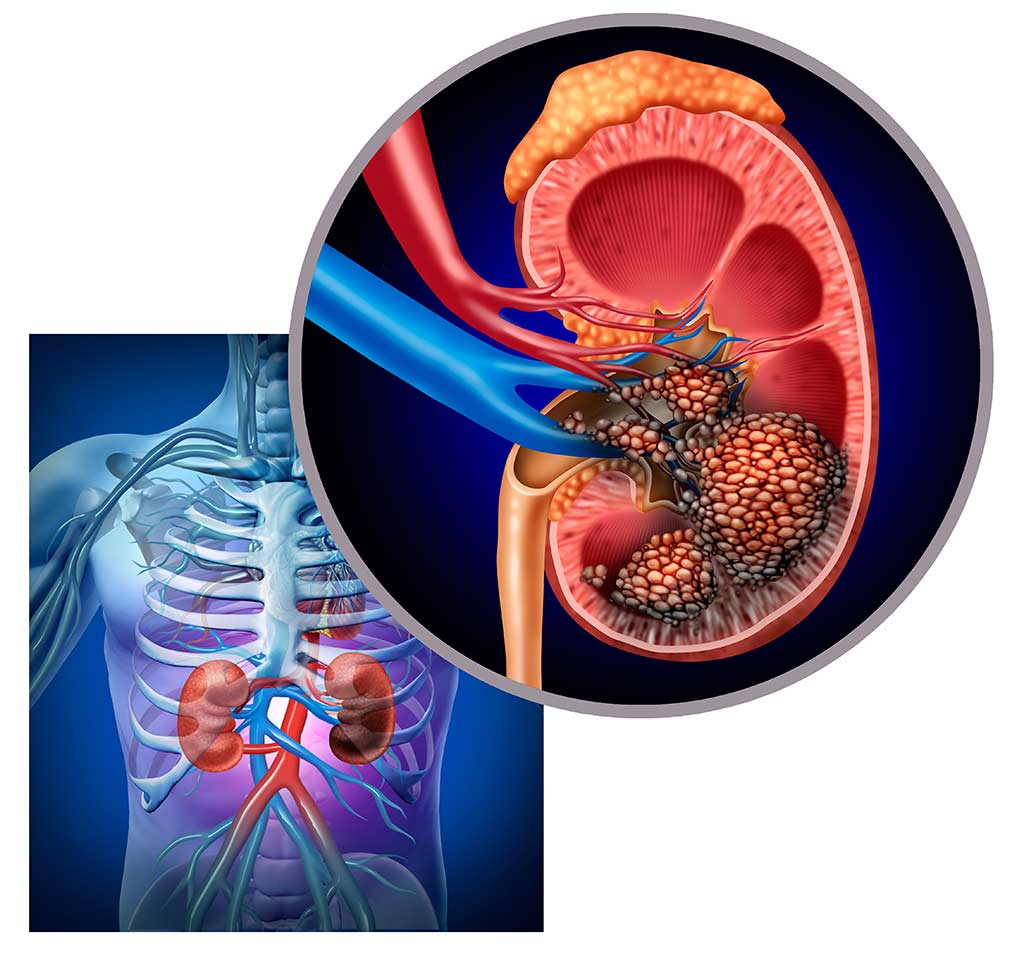
Images of kidney cancer.
What causes kidney cancer ?
The exact causes of kidney cancer are not definitively established, however, several risk factors have been shown to potentially lead to kidney cancer, such as:
- Smoking: This is one of the high-risk factors for kidney cancer. On average, about 30% of men and about 24% of women who smoke heavily will develop this terrible disease.
- Due to chemical exposure: Numerous studies have shown that people who work in jobs involving exposure to these chemicals have a relatively high incidence of the disease, typically printing workers, chemical workers, dye workers, or those who frequently come into contact with gasoline and oil.
- Due to genetic factors: The disease can potentially occur in many people within the same family. Individuals with a missing segment on chromosome 3 or translocations of chromosomes 3 and 8 also have a relatively high rate of kidney cancer.
Symptoms of kidney cancer
Kidney cancer often causes no signs or symptoms, but sometimes symptoms may include: blood in the urine; pain on one side of the lower back (not from a collision or fall); a lump on the side of the back or in the lower back; feeling tired; weight loss, if not trying to lose weight; a persistent fever not caused by a cold;...
However, to confirm kidney cancer, doctors order several tests such as:
- Urine test: Urine is tested in a laboratory to check for blood or cancer cells.
- Blood tests: Blood biochemistry tests show how well the kidneys are functioning. A complete blood count (CBC) measures the number of blood cells in the blood, such as white blood cells, red blood cells, and platelets. People with kidney cancer often have low red blood cell counts (this is called anemia).
- Chest X-ray: An X-ray may be taken to see if the cancer has spread to the lungs.
- CT scan: Helps to determine if the cancer has spread.
- MRI scan: This test can be used to see if the cancer has spread.
- Ultrasound: This test can help show whether a mass in the kidney is solid or contains fluid (kidney cancer is usually solid). If a kidney biopsy is needed, ultrasound can be used to guide a needle to the tumor to obtain some cells for testing.
- Kidney biopsy: For most cancers, a biopsy is the only way to know for sure if cancer is present. But a biopsy isn't always necessary to determine if kidney cancer is present. X-rays or CT/MRI scans are sometimes sufficient.
Doctor's advice
Kidney cancer can have systemic effects, including paraneoplastic syndromes, weight loss, hematuria, and acute bleeding caused by ruptured kidney tumors.
The patient's prognosis depends heavily on the stage of the disease at diagnosis. In early stages, the 5-year survival rate is approximately 60-80%, while in later stages this rate drops to 15-20%, and even lower when metastasis occurs.
Therefore, patients need to have regular health checkups or when they experience unusual symptoms in order to receive timely treatment.
Preventing kidney cancer primarily involves controlling risk factors, including: not smoking; avoiding exposure to chemicals; effectively managing systemic diseases such as obesity and diabetes; and promptly and correctly treating urinary tract diseases such as urinary tract infections, urinary stones, and kidney failure. Regular health checkups are also crucial for early detection of any lesions.
MSc. Dr. Nguyen Thi Huong
Source: https://giadinh.suckhoedoisong.vn/sut-can-nhanh-co-phai-ung-thu-than-172241003162027288.htm

![[Photo] Conference on the transfer and reception of Party organizations and Party members between the Party Committee of the Government and the Party Committees of the Central Party Agencies](https://vphoto.vietnam.vn/thumb/1200x675/vietnam/resource/IMAGE/2026/04/01/1775036784472_ndo_br_bnd-2620-jpg.webp)

![[Photo] Conference announcing the Politburo's Decision on organizational and personnel matters](https://vphoto.vietnam.vn/thumb/1200x675/vietnam/resource/IMAGE/2026/04/01/1775017881825_bnd-2410-1472-jpg.webp)






























































![[Photo] Prime Minister Pham Minh Chinh receives the Ambassador of the Russian Federation to Vietnam](https://vphoto.vietnam.vn/thumb/402x226/vietnam/resource/IMAGE/2026/04/01/1775046774818_anh-man-hinh-2026-04-01-luc-19-32-33.png)

































Comment (0)