

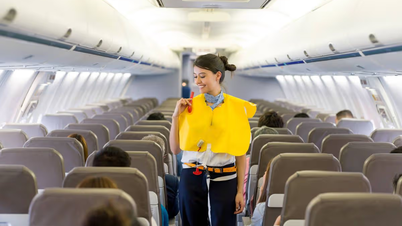
Anyone who flies frequently and is familiar with this mode of transportation will know for sure that there is usually no row 13 on an airplane. Meanwhile, the rows with other numbers are always full. This is a question many people have, and most have yet to find a specific answer.
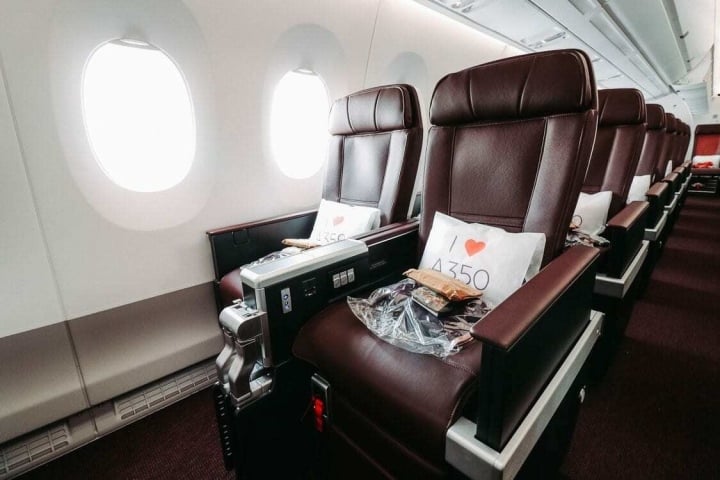
Many airlines often remove row 13, but the other rows remain unchanged.
Why is row 13 often missing on airplanes?
Western culture often considers the number 13 to be unlucky and associated with misfortune. This has led many airlines around the world to skip seat 13 and jump directly from 12 to 14.
The practice of basing seat numbering on superstition may seem strange, but it's actually been in place for many years. However, this change is the result of careful research by airlines into new aviation operational procedures. Because this is a highly specialized industry, it cannot be done based on intuition alone.
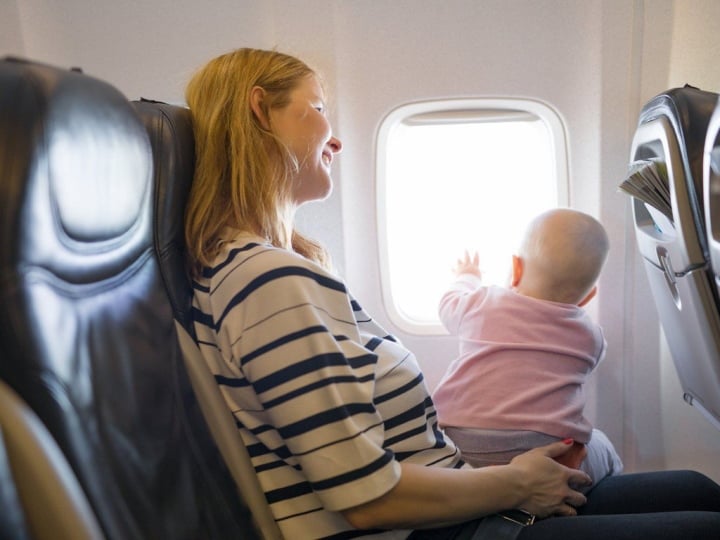
Some people believe that the number 13 is unlucky, and therefore it should not appear on airplanes.
This also helps some customers feel more secure when sitting on the plane and not have to worry about accidentally sitting in a particular seat number during the trip. However, many people are different; they feel that sitting in any seat number is the same, as long as the airline provides them with comfort.
Not only do airlines choose to omit the number 13, but many hotels and office buildings around the world also remove the 13th floor. In 2007, a survey on this issue was conducted in buildings worldwide, and the results indicated that 13% of Americans would be disturbed if they were in a room on the 13th floor.
Numbers 14 and 17 are also considered unlucky.
In some countries, such as Italy or Brazil, the number 17 is considered unlucky, not 13. This is because 17 is often written as XVII. When the letters are reversed, we get VIXI, which in Latin means "my life has ended." Lufthansa is one of the airlines that has removed seat 17 to respect this superstition.
In China and some other Asian countries, the numbers 4 and 14 are considered unlucky. In Chinese, the pronunciation of these numbers is similar to the word for death. Furthermore, many buildings in China do not have a 4th or 14th floor. However, the national airline, Cathay Pacific, and Hong Kong Airlines argue that the absence of seats in rows 4 and 14 is due to the numbering system, not superstition.
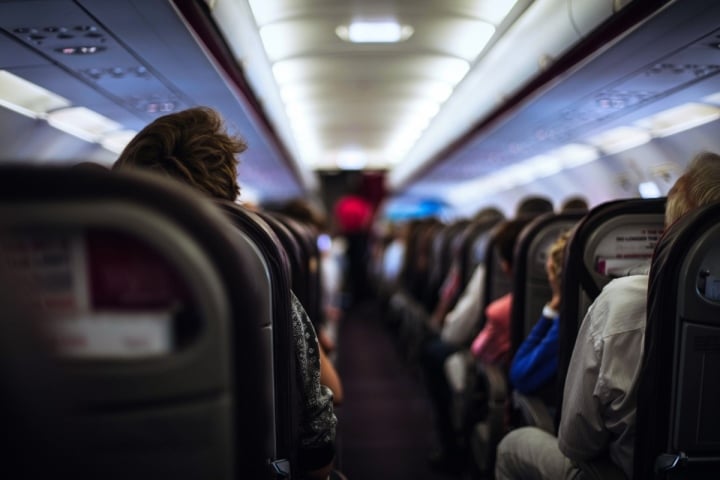
Many Chinese airlines do not have seats with seating positions of 4 or 14.
What's even more interesting is that Air China keeps seat number 14, not following the superstition of other domestic airlines. Additionally, United is another noteworthy foreign airline that respects Chinese beliefs by omitting seat number 14.
Depending on the airline and country, seats numbered 4, 13, 14, and 17 may be removed or kept in that order. Not all airlines worldwide follow this superstition and rule.
Tuyet Anh (Source: Compilation)
Beneficial
Emotion
Creative
Unique
Wrath
Source
![[Photo] First session of the 14th Congress of the Vietnam Trade Union](https://vphoto.vietnam.vn/thumb/1200x675/vietnam/resource/IMAGE/2026/06/03/1780465947883_ndo_br_img-3852-jpg.webp)
![[Photo] General Secretary and President To Lam presides over a meeting with the Central Organizing Committee.](https://vphoto.vietnam.vn/thumb/1200x675/vietnam/resource/IMAGE/2026/06/03/1780482764658_a1-bnd-4741-3342-jpg.webp)
![[Photo] Secretary of the National Assembly Party Committee, Chairman of the National Assembly presides over the meeting of the Standing Committee and Executive Committee of the National Assembly Party Committee.](https://vphoto.vietnam.vn/thumb/1200x675/vietnam/resource/IMAGE/2026/06/03/1780480353201_ndo_br_bnd-2585-jpg.webp)














































![[Video] Sunset at Lap An Lagoon – Where the sun sets over the fishing nets](https://vphoto.vietnam.vn/thumb/1200x675/vietnam/resource/IMAGE/2026/05/31/1780192137701_beach-landscape-sea-water-nature-grass-745871-pxhere-com.jpeg)





























Comment (0)