

A strange phenomenon
As the world's largest iceberg, A23a has attracted considerable attention from scientists , who have been monitoring it since it broke off from the Filchner-Ronne ice shelf in Antarctica in 1986.
Currently, the fate of this iceberg remains uncertain as it is still stuck in a rare situation that scientists consider unprecedented. Dr. Les Watling, professor emeritus of life sciences at the University of Hawaii at Manoa, wrote in an email: "To our knowledge, this has never happened before."
The iceberg, with an area of approximately 3,672 square kilometers – twice the size of London – drifted past an underwater mountain and became trapped in a phenomenon known as a Taylor column, a swirling vortex caused by ocean currents colliding with the underwater mountain. According to the UK's Antarctic Survey, the iceberg is currently rotating about 15 degrees per day in a cylindrical motion above the underwater mountain.
Experts say the iceberg is melting but will not affect sea levels; instead, it will provide more insight into the life cycle and the impact of the climate crisis on Antarctic ice sheets.
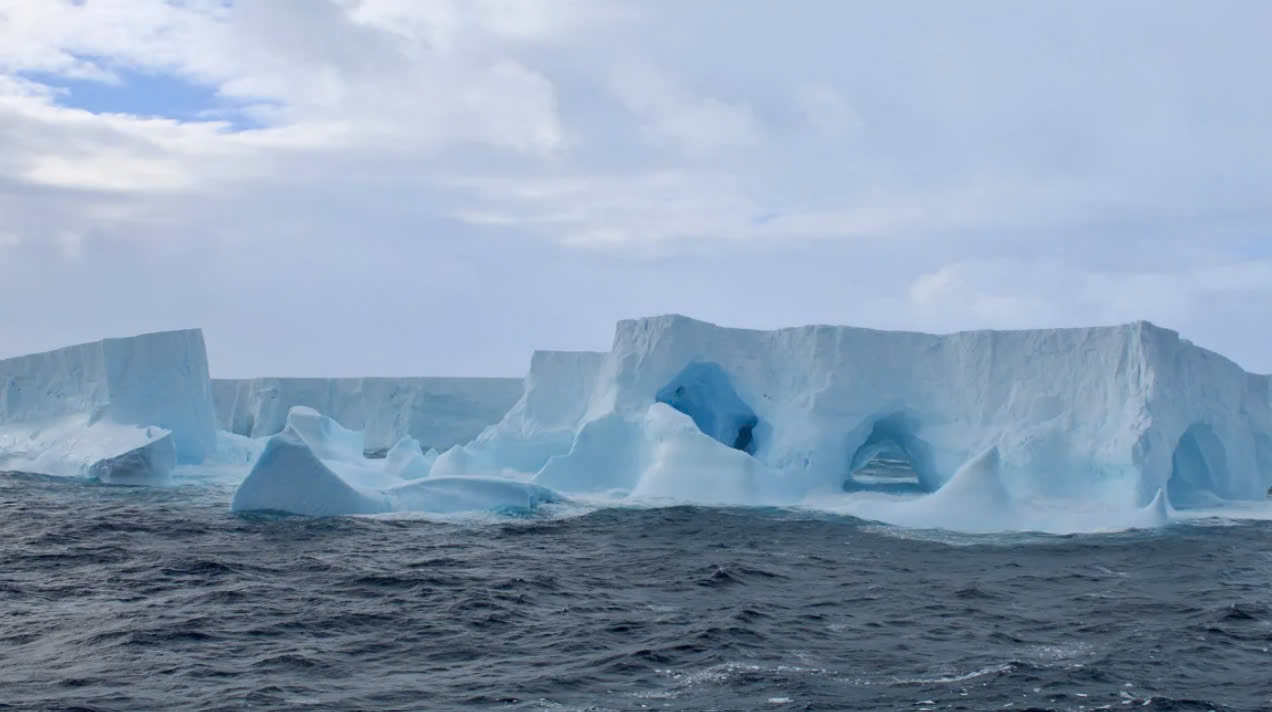
The world's largest iceberg, known as A23a, is rotating about 15 degrees per day in the Southern Ocean. Photo: Emily Broadwell/British Antarctic Survey
Why are these giant icebergs "spinning"?
When the original iceberg broke off from the ice shelf in the 1980s, it didn't drift far before becoming stranded in the Weddell Sea. More than three decades later, in 2020, it began drifting toward the world's largest ocean current system – the Antarctic Circumferential Current. But upon reaching the current in the spring, instead of reaching the South Atlantic, its journey came to a halt once again.
The iceberg is slowly rotating over an underwater mountain called Pirie Bank Seamount, which is about 1,000 meters high. The iceberg measures approximately 61 x 59 km, slightly smaller than the mountain, and “is positioned appropriately in terms of size, where it is held in place by Taylor's column but not protruding too much. So it's not easily pushed away,” said Dr. Alexander Brearley, a physical oceanographer with the UK's Antarctic Survey.
The research institute noticed a strange rotation in the satellite imagery, suggesting the iceberg was stuck at a point near the South Orkney Islands. Because it was rotating so slowly, it was not immediately noticeable.
Brearley said: "We've studied these Taylor columns before, not just to study icebergs, but because they are actually fascinating oceanographic phenomena and have significant implications for ocean circulation."
Meanwhile, Dr. Watling stated that the conditions of the Taylor column must be "just right" to hold the massive iceberg. He explained: “Generally, Taylor columns are formed when there is a balance between the flow of water and the size and shape of the underwater mountain… If the water is moving too fast, eddies will flow downstream of the underwater mountain. If the water is not moving fast enough, then the water will flow around it.”
Are giant icebergs a danger?
As long as the iceberg remains stuck, it will melt more slowly than if it continued to drift. Brearley said that no matter where the ice melts, it will not affect sea levels.
He said that the formation of ice shelves along the Antarctic coast is also a natural part of the Earth and there is no urgency for any individual iceberg.
But the worrying aspect is that the ice shelves in West Antarctica are thinning amid the climate crisis, which could lead to more icebergs and faster melting of onshore ice, thus causing sea levels to rise.
Brearley said, "I think we shouldn't be too worried about this. But generally, we should be concerned about icebergs – understanding their numbers, origins, significance on land, and their stability in the future."
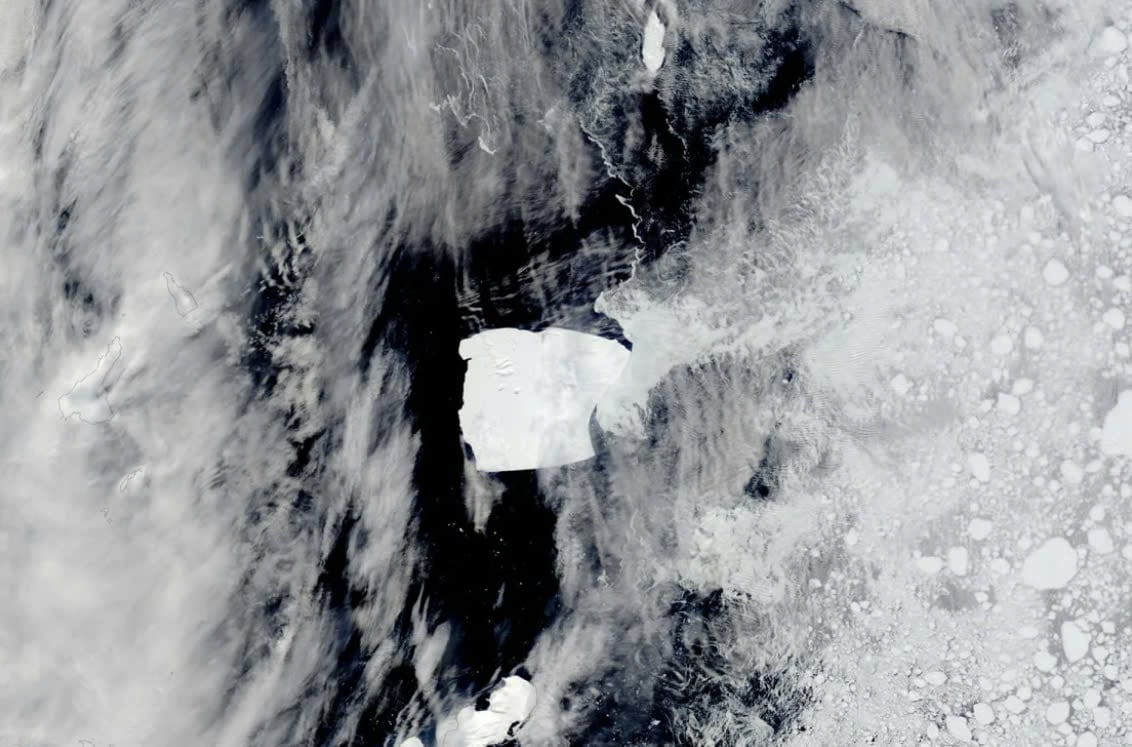
The massive mass is slightly larger than Rhode Island and twice the size of London. Photo: MODIS/NASA
How long will this cycle last?
While researchers don't know how long the iceberg will remain in the column, Brearley pointed out in a January 2015 study that researchers from the UK's Antarctic Survey found a buoy, a surface-measuring instrument, that had been sitting in the Taylor column for four years. The buoy was the size of a human, so the researchers didn't think the iceberg would stay in the column for that long.
“It’s possible that a combination of wind changes, currents, and the precise shape of the ice mass caused it to move away from the Taylor column. But we’re quite surprised it’s lasted this long. So let’s wait and see,” he added.
Dr. Tony Koslow, an emeritus oceanographer at the Scripps Institution of Oceanography at the University of California, San Diego, suggests that due to its large size, the iceberg could continue to rotate for a long time, possibly even years.
Underwater mountains are known to be areas of marine biodiversity, as ocean currents flowing around the mounds create ideal conditions for invertebrates to cling to the mountains or for other species to feed on food scraps carried by the currents, as Koslow shared with CNN in a previous report.
The melting of the iceberg could affect these natural conditions, but further research is needed to know for sure, according to Watling.
"I think it could reduce biodiversity in the water column but have a mild impact on bottom-dwelling marine organisms. This iceberg is large enough to participate in 'primary production' processes like diatoms, which are created when nutrient-rich water surges up and feeds phytoplankton. So if that happens, the food supply will decrease," Watling said via email.
He added, "I see no reason to worry. However, it's really great and once again proves how interesting the world we live in is."
Ha Trang (according to CNN)
Source: https://www.congluan.vn/tang-bang-troi-lon-nhat-the-gioi-dang-mac-ket-trong-vong-xoay-dai-duong-post307961.html







































































































Comment (0)