A fortunate connection with ancient pottery
At previous workshops and scientific conferences both within and outside Bac Ninh province, professors, archaeologists, and experts have made important observations about the ancient Luy Lau pottery. According to them, Luy Lau pottery originated more than 2,000 years ago, making it one of the oldest pottery traditions in Vietnam, with many unique products demonstrating a high level of skill in shaping and firing. The red pottery products from the Dau - Luy Lau region are considered standard examples, meeting the specific technical and artistic standards that scientists have long referred to as Red River pottery. Ancient Luy Lau pottery is notable for its olive green glaze and exquisite red pottery pieces. Beyond serving daily life, this pottery tradition also holds cultural and historical value, becoming a distinctive symbol of the ancient Luy Lau region and a source of inspiration for artisans restoring and developing traditional pottery today.
 |
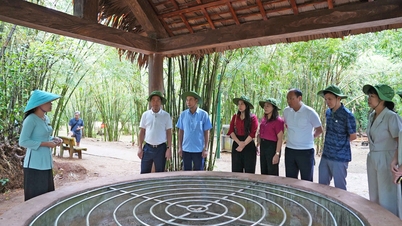
Mr. Pham Van Dung introduces the ancient pottery style to tourists. |
Born and raised in the ancient land of Dau - Luy Lau, the unique traditional culture, relics, and artifacts of his homeland have been deeply ingrained in Mr. Pham Van Dung's soul since childhood. In his childhood memories, during his time accompanying his parents to the fields, he would occasionally come across pieces of pottery, bronze, or ancient bricks. Instead of throwing them away, he would pick them up, admire them, and then bring them home to keep. Mr. Dung recounted: "Back then, whenever I saw a broken piece of pottery, I would pick it up and bring it home. Sometimes I didn't understand what it meant, but I would keep it and look at it for a long time. It felt like it contained a message from my ancestors."
| "Luy Lau pottery is a famous ancient pottery line, dating back approximately 2,000 years, considered a model of ancient Vietnamese folk pottery. However, this pottery line has long since disappeared. Various levels of government, agencies, and researchers have organized numerous seminars, archaeological excavations, and research trips to study this pottery line. The fact that someone like Mr. Dung is collecting and promoting Luy Lau pottery in the area is very significant, contributing to the preservation and promotion of traditional cultural values," said Mr. Nguyen Van Phuong, Head of the Culture and Social Affairs Department of Song Lieu Ward. |
And so, his passion grew over the years. Whenever he heard of someone accidentally unearthing ancient "unusual artifacts," Mr. Dung would travel to the location, patiently inquiring and researching. In 2000, he collected his first antique – a small ceramic vase, its glaze faded, its body slightly cracked over time. "When I held the vase in my hand, my heart trembled. The vase was old and simple, yet it seemed to possess a soul, strangely captivating. From then on, I became even more determined to research and learn about this ancient pottery style in particular and antiques in general." After many years of persistent research and collecting, Mr. Pham Van Dung now owns thousands of antiques, most notably Luy Lau pottery and other pottery styles.
Mr. Dung's house now resembles a "miniature museum." On wooden shelves and iron racks, each vase, jar, and pot—thousands of years old—is carefully preserved and cherished. Many artifacts in his collection are highly valued by researchers for their artistic, historical, and archaeological value, such as: the "Emperor's Tower for Controlling the Heavenly Destiny"—a tower used to ward off evil spirits during the Ly Dynasty; a Dong Son vase with unique patterns; a garlic-shaped vase dating from the 1st-3rd centuries AD; and a 16 kg monolithic dragon head identified as dating from the late Ly Dynasty or early Tran Dynasty. For Mr. Dung, each antique item possesses a spirit, energy, and essence; therefore, he has never sold or rented any of his artifacts, even when offered very high prices.


Introducing ancient artifacts to the community.
During his collecting journey, Mr. Dung had the opportunity to meet and converse with Professor Tran Quoc Vuong, historian Duong Trung Quoc, and many experts knowledgeable in folklore, as well as antique societies in Phu Tho, Quang Ninh, Hanoi, and other places. These conversations helped him realize the profound value of each antique and the great significance of preserving cultural heritage in modern life. He confided: "Everyone advised me to take good care of them. Because antiques are the embodiment of history. Losing one is like losing a part of memory that can never be recovered."
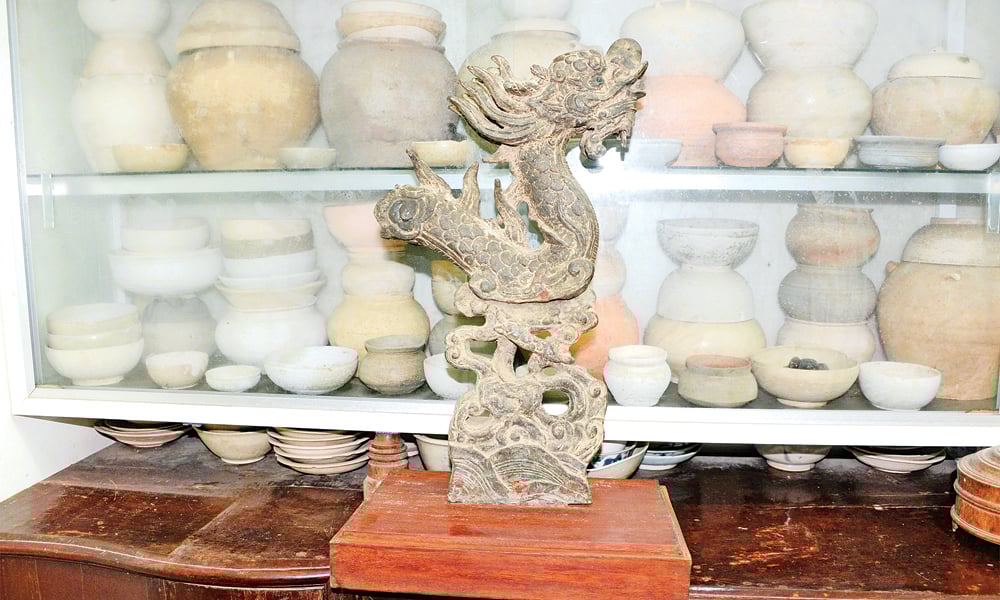 |
Mr. Dung collected and preserved a single-piece dragon head dating back to the late Ly Dynasty or early Tran Dynasty. |
Not content with just collecting, Mr. Dung was always deeply concerned with reviving the fading pottery craft of his ancestors. In the early years of the 21st century, he and artisan Nguyen Dang Vong (from the same village) established the Luy Lau Pottery Cooperative. In the beginning, the pottery workshop was just a few temporary rooms, with meager capital, and the products were not yet well-received by the market, but they did not give up. He recounted: “Many nights I sat by the kiln and thought to myself, our ancestors didn't have modern machinery or molds, yet they still created beautiful pottery. We, as their descendants, have the support of science and technology, so why should we be defeated...?” Then he sought out old kilns, persistently learning the techniques of firing, glazing, and selecting clay. Some batches of pottery failed a dozen times, but he still remade and experimented until he achieved the correct traditional Luy Lau glaze. However, for various reasons, the Luy Lau Pottery Cooperative had to temporarily cease operations, leaving behind much regret.
Despite owning a priceless collection of ceramic artifacts, Mr. Dung doesn't keep them to himself. He always welcomes researchers, ceramics enthusiasts, students, and the general public to visit his home to learn about his collection. Whenever someone comes to see him, he puts aside everything to welcome them and introduce them to the red ceramics of the Dau region and the process by which he painstakingly collected each artifact. "I've never considered them my own. Each piece of pottery is a part of the soul of my homeland, of the Kinh Bac region. I feel like I've been chosen to preserve that memory, to prevent it from fading away," he said.
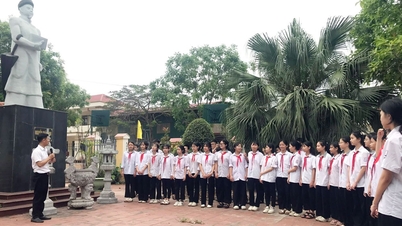
Nguyen Phuong Linh, a student from Thuan Thanh No. 1 High School, shared her thoughts after visiting the pottery exhibition at Mr. Pham Van Dung's house: "We were deeply moved when Mr. Pham Van Dung told us about the ancient Luy Lau pottery artifacts. Through these artifacts, I gained a better understanding of the land and people of the ancient Dau region – considered the most bustling cultural, political, and economic center of ancient Giao Chi."
According to Mr. Nguyen Van Phuong, Head of the Culture and Social Affairs Department of Song Lieu Ward, Luy Lau pottery is a famous ancient pottery line, dating back approximately 2,000 years, considered a model of ancient Vietnamese folk pottery. However, this pottery line has long since disappeared. Various levels of government, agencies, and researchers have organized numerous seminars, archaeological excavations, and research trips to study this pottery line. The fact that someone like Mr. Dung in the area is collecting and promoting Luy Lau pottery is very significant, contributing to the preservation and promotion of traditional cultural values.


More than just a collector, Mr. Dung is like a storyteller of history and culture through ancient ceramics. "My greatest wish right now is to have a display space, a small museum right here in Song Lieu, so that locals and tourists can come and see and touch these ancient artifacts – the pride of our nation's beautiful traditional culture," Mr. Pham Van Dung shared.
Source: https://baobacninhtv.vn/gin-giu-hon-gom-luy-lau-postid433796.bbg