

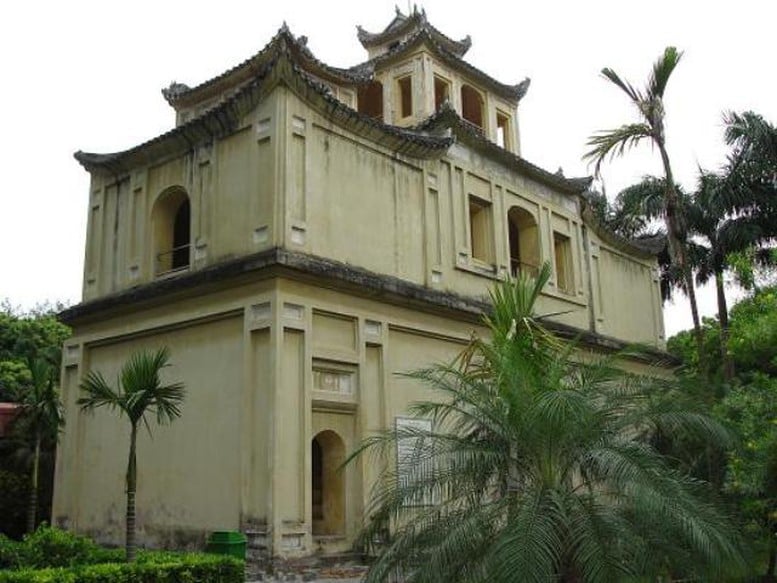
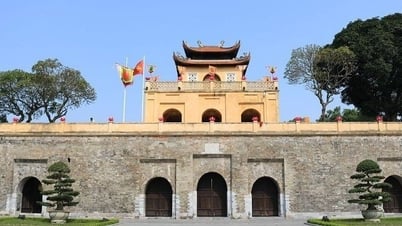
In the architectural complex of the ancient Thang Long Imperial Citadel, Hau Lau or Princess's Pavilion or Tinh Bac Lau is the innermost tower, close to Bac Mon - the back gate of the Imperial Citadel.
Different names
Hau Lau is also known by many other names, such as Tinh Bac Lau, Lau Cong Chua or Hau Dien. Each name is associated with different explanations.
Because it is the last building facing south, this building is called Hau Lau or Hau Dien (the palace in the back).
Ancient history books still record that the residence of the queen, concubines, and beauties is often referred to as the Harem. The Harem Palace or the Harem Palace is probably also a name with a similar meaning to the Harem.
In other words, it can be inferred that Hau Lau – which has been restored and renovated many times since then and its architecture has changed a lot compared to the original – has been the residence of concubines, beauties, queens and princesses since its inception. Perhaps that is why Hau Lau is also known as the Princess's Palace.
Regarding the name Tinh Bac Lau, some say that this name comes from the meaning that this is the tower that guards the peace for the North of Thang Long citadel.
However, it is also possible that this is the northern tower used as a resting and recuperating place for the Royal family, so it is called Tinh Bac Lau.
Each different name of Hau Lau is associated with many different explanations. Perhaps, there needs to be specific research on this issue to clarify the origin of each name of Hau Lau. Only then can we correctly determine the use of this building.
East-West architectural fusion
According to the traditional house-building pattern of the Vietnamese, houses are usually built facing south. This direction helps to avoid the hot sun from the East and West in the summer and the cold north wind in the winter.
The palaces in the ancient Thang Long Imperial Citadel also paid great attention to the traditional orientation. Therefore, in general, Thang Long Imperial Citadel faces south. The southern gates are called the front gates, the northern gates are called the back gates.
During the French bombardment of Hanoi , the old Hau Lau building was destroyed. Later, the French rebuilt this building as a residence and workplace for the French army. Therefore, the current architecture of Hau Lau is a blend of Vietnamese royal architecture and French architecture.
Overall, the Hau Lau is a three-story building. The ground floor is built in a box shape with three separate rooms. The two gable rooms are accessed by two entrances from the front. Behind these two rooms is a closed corridor leading to the middle room. The middle room has no door from the front of the building, so it is the most closed room. This room gets natural light from two arched windows at the back of the building.
Right next to the two front doors of the Hau Lau are two arched staircases leading up to the second floor.
The second floor of the Hau Lau building is also divided into three rooms, but unlike the first floor, the middle room here is the most airy with the main doors opened wide right at the front. The two side rooms on the second floor are also more airy than the two side rooms on the first floor because they have large doors facing East and West.
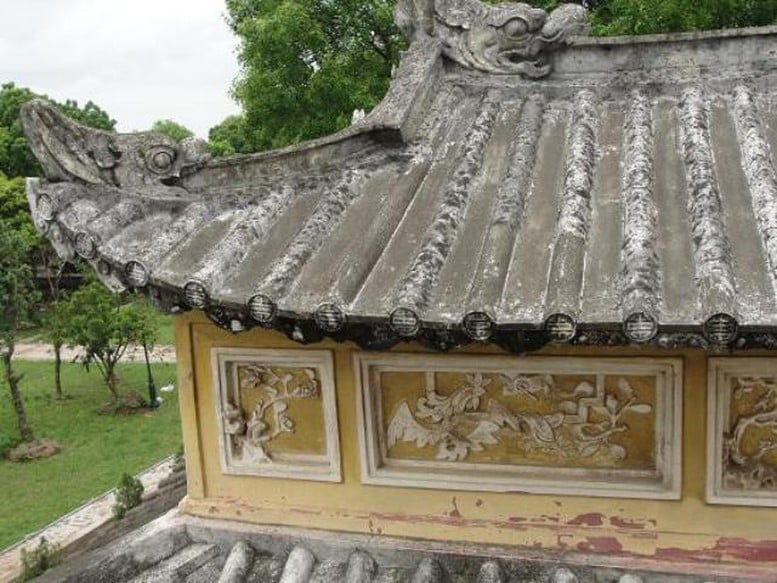
The rooms on the second floor all have cement roofs that imitate the ancient royal roof architecture. The two side rooms are covered with two layers of eight curved roofs decorated with dragon heads. Cement tiles are made to look exactly like the tube tiles on the palace roofs. The middle room has four roofs built similarly to the bottom layer of the two side rooms. Behind this middle room is a small staircase leading to the third floor.
The third floor has only one room and is the most spacious of all the rooms in the Hau Lau. This top room opens to three directions (East – West – South) and each direction has three large doors close together. This is the ideal floor to enjoy the scenery below, catch the cool breeze and watch the clear moon.
The top floor is covered with two layers of eight roofs. The roofs of this floor are also built in the style of a royal palace roof with tubular tiles and curved corners decorated with dragon heads.
The upper two floors of the Hau Lau building are decorated with many wall reliefs depicting musical instruments, bronze urns, dragons, phoenixes, and four types of trees representing the four seasons of the year.
The most distinctive feature of French architecture in this Hau Lau building is the thickness of its walls. Thick walls like these keep the rooms cool in the summer and warm in the winter.
It is this East-West architectural fusion that has created the unique character of Hau Lau. Therefore, the presence of this building has greatly helped us in proposing UNESCO to recognize the central area of Thang Long Imperial Citadel as a world heritage, highlighting the global value of the central area of the Imperial Citadel.
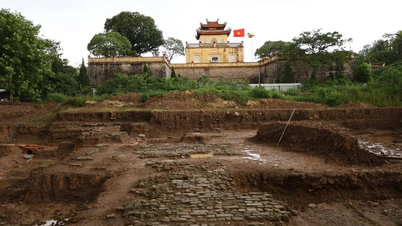
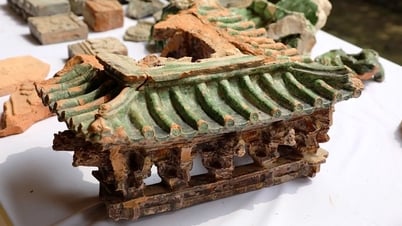
Hau Lau is also the place where archaeologists conducted archaeological excavations and found many valuable artifacts. The artifacts found here became extremely valuable archaeological materials for research on the Imperial City.
Source: https://baochinhphu.vn/toa-lau-nhieu-ten-trong-hoang-thanh-10237311.htm
![[Photo] Scientific workshop "Building a socialist model associated with socialist people in Hai Phong city in the period of 2025-2030 and the following years"](https://vphoto.vietnam.vn/thumb/1200x675/vietnam/resource/IMAGE/2025/5/21/5098e06c813243b1bf5670f9dc20ad0a)
![[Photo] Prime Minister Pham Minh Chinh attends the groundbreaking ceremony of Trump International Hung Yen Project](https://vphoto.vietnam.vn/thumb/1200x675/vietnam/resource/IMAGE/2025/5/21/ca84b87a74da4cddb2992a86966284cf)
![[Photo] Determining the pairs in the team semi-finals of the National Table Tennis Championship of Nhan Dan Newspaper](https://vphoto.vietnam.vn/thumb/1200x675/vietnam/resource/IMAGE/2025/5/21/eacbf7ae6a59497e9ae5da8e63d227bf)


![[Photo] Prime Minister Pham Minh Chinh receives Rabbi Yoav Ben Tzur, Israeli Minister of Labor](https://vphoto.vietnam.vn/thumb/1200x675/vietnam/resource/IMAGE/2025/5/21/511bf6664512413ca5a275cbf3fb2f65)

























































Comment (0)