

Restoring the Kinh Thien Palace, which has disappeared through the ups and downs of history, is extremely necessary for future generations to better understand ancient royal architecture and fine arts; to promote tourism development, especially when the Thang Long Imperial Citadel has been recognized by UNESCO as a World Cultural Heritage.
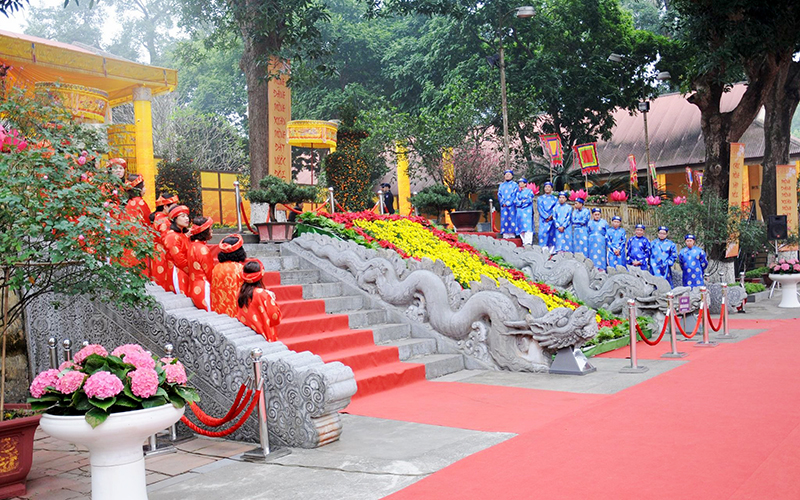
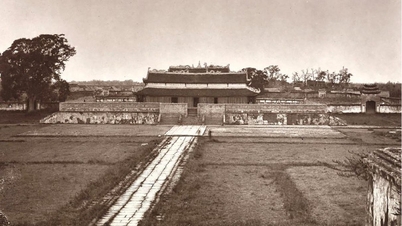
Dragon Threshold - the way up to Kinh Thien Palace in the ancient Thang Long Imperial Citadel.
From archaeological discoveries, combined with many other sources of information, scientists are gradually rediscovering the glory of the past.
Find a way to restore Dien Kinh Thien
Thang Long Imperial Citadel ( Hanoi ) was honored to be recognized by UNESCO as a World Cultural Heritage based on three criteria: Cultural and historical length throughout 13 centuries; continuity of a center of power and rich and diverse layers of relics and artifacts.
However, many people who visit the Imperial Citadel of Thang Long have different thoughts. The most valuable things are the ruins deep underground. If you are not an expert, it is difficult to perceive the value.
Vice Chairman of the National Council for Cultural Heritage, Associate Professor Dang Van Bai shared: Every time they visit Thang Long Imperial Citadel, if they only look at the archaeological artifacts, children cannot imagine the beauty of the ancient royal palace. Through the Ly, Tran, Le, Mac and then Le Trung Hung dynasties, Thang Long Imperial Citadel was the center of supreme power of the whole country.
In that sacred land, the most typical construction is where the emperor held court with hundreds of mandarins, discussed national affairs, and promulgated policies related to the people. Under the Ly dynasty, it was Can Nguyen Palace, under the Tran dynasty it was Thien An Palace. Under the Le dynasty it was Kinh Thien Palace. The location of Kinh Thien Palace has not changed since the early Le, Mac, and Le Trung Hung dynasties, lying on the Than Dao axis of Thang Long Imperial Citadel.
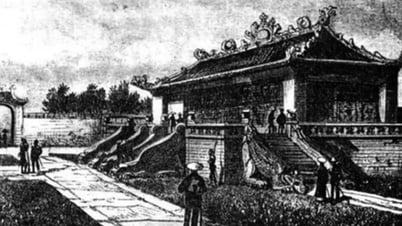
Later, the Nguyen Dynasty moved the capital to Hue, and Kinh Thien Palace was only the royal palace during the Northern tour. When the French occupied Hanoi, the palace was completely demolished. Now, only the palace foundation, nine dragon steps, and a pair of stone dragons erected during the reign of King Le Thanh Tong remain.
The royal court not only represents the center of power, but also a work that represents the country's typical architectural form, construction techniques, and decorative arts. Restoring such a work is necessary and also in line with Vietnam's commitment to UNESCO to preserve and promote the value of this World Cultural Heritage.
However, how to restore it is a question that makes scientists ponder. Did the ancient royal roof use fish-scale tiles like communal houses and pagodas, or other types of tiles? What was the support system for that roof? What was the system of columns and beams like?... are all questions without answers.
In 2017, for the first time, during archaeological excavations at the Imperial Citadel of Thang Long, large numbers of “dragon tiles” were found. These were yellow glazed tiles (hoang luu ly) and blue glazed tiles (thanh luu ly) decorated with dragons, dating from the Le Dynasty.
At that time, Associate Professor Tong Trung Tin, Head of the archaeological site, happily emphasized: “Royal glazed tiles were originally only for the emperor’s works. With a large number of artifacts related to the palace roof, we can clearly imagine the palace roof of this period.
The roof tiles of the Le Dynasty palaces were made of tubular tiles. All rows of yang tiles were decorated with a round dragon statue. The first tile at the eaves was decorated with a dragon's head, the following tiles formed a dragon's body, with scales and a pointed dorsal fin.
The last tile in the attic is the dragon's tail. The entire roof of the palace resembles a flock of dragons, moving from the roof down to the courtyard on all four sides. This is a unique roof architecture not seen in East Asia.
The next question is what is the support for the roof system? Right at the Imperial Citadel of Thang Long, researchers have found about 70 wooden structures from the early Le Dynasty. Dr. Bui Minh Tri added: “Pottery from the early Le Dynasty has many drawings of the dou-cong architecture, which are quite vividly described with many roof levels. Excavations around the Kinh Thien Palace area also found many wooden structures, including columns, beams, floorboards, some of which are part of the dou-cong structure.
In particular, the excavation of the east side of Kinh Thien Palace in 2021 found a very unique green glazed architectural model. This model depicts quite realistically the roof of the building covered with tubular tiles, and the frame of the building is a system of trusses similar to the architecture of the rear palace of Boi Khe Pagoda (Thanh Oai, Hanoi).
Archaeological artifacts in the Imperial Citadel show that many roofing components were painted red and gilded. To apply the red paint, the artisans painted a white primer, then a dark red before covering it with a bright red paint layer. The gold paint was even more elaborately painted, the first two layers were similar to the red paint, the third layer was a gold primer using mineral stone. The final layer was covered with thinly-crushed real gold leaf.
Putting together that data, we can see a splendid golden roof system, especially when the sun shines on the layers of yellow and blue glazed tiles, the palace becomes even more brilliant.
Continue to decode the secret
In the world, especially in countries with the same culture as Vietnam such as Korea and Japan, the restoration of palaces is quite common. The ancient capital of Nara was a ruin, with no structures above ground, but many palaces were later rebuilt.
Gyeongbokgung Palace in Korea was also destroyed in many parts during the war and many new structures were restored in the 1990s. Currently, they are cultural symbols and top tourist attractions in Japan and Korea.
These are suggestions about the potential and significance of restoring Kinh Thien Palace as well as other works in the center of Thang Long Imperial Citadel.
However, the restoration work still faces many difficulties and challenges. Scientists have not yet found the complete foundation plan of a palace from the early Le Dynasty around the Kinh Thien Palace, leading to difficulties in interpreting the steps of the rooms, the number of columns as well as other structures. However, based on clues from excavations in the area behind the Kinh Thien Palace, Associate Professor Tong Trung Tin has initially drawn up an architectural plan of the Kinh Thien Palace with a Cong (I) shaped plan, the front and back palaces are equal and both have seven rooms and two wings, the palace has 10 rows of wooden columns, each row has six columns.
This is a large-scale wooden construction never seen before in our country. The structure of this ground plan is similar to the architectural plan of Lam Kinh Main Hall (Thanh Hoa). In the context of difficulties in documentation, the scale of Lam Kinh Main Hall can be a useful solution.
Dr. Bui Minh Tri said: “Lam Kinh includes a mausoleum, a temple and a palace to serve the Le kings when they come to pay respect to their ancestors. Based on historical documents and excavation results of the Vietnam History Museum, we can have many important clues to research about Kinh Thien Palace. Studying the floor plan of Lam Kinh Palace, we see that the steps in Kinh Thien Palace are quite similar to those of Lam Kinh Palace. Based on this document and on the remaining traces of dragon-carved stone steps at Kinh Thien Palace, we have tried to interpret and draw a 3D architectural model of Kinh Thien Palace.”
Associate Professor Tong Trung Tin has been involved in the archaeology of Thang Long Imperial Citadel for decades. He believes that tens of thousands of square meters must continue to be excavated to decipher the mystery.
However, with new archaeological discoveries and interdisciplinary research, the appearance of Kinh Thien Palace is gradually taking shape. Restoring Kinh Thien Palace is not only the desire of scientists, but also the aspiration of the people.
Many researchers believe that archaeological excavations in the coming years should focus on the Kinh Thien Palace foundation area, instead of digging in one area each year as is currently the case.
Vice Chairman of the National Council for Cultural Heritage, Associate Professor Dang Van Bai shared: “We need to understand that restoration is based on scientific data, but it does not mean it must be 100% like the original. We have many documents and archaeological bases. We need to continue excavation in parallel with restoration using drawings and 3D technology to get interdisciplinary opinions, moving towards restoration.”
Source: https://danviet.vn/dien-kinh-thien-trung-tam-quyen-luc-nhat-cua-hoang-thanh-thang-long-tiep-tuc-giai-ma-bi-mat-20230407234113404.htm
![[Photo] Lam Dong: Images of damage after a suspected lake burst in Tuy Phong](https://vphoto.vietnam.vn/thumb/1200x675/vietnam/resource/IMAGE/2025/11/02/1762078736805_8e7f5424f473782d2162-5118-jpg.webp)
![[Photo] President Luong Cuong receives US Secretary of War Pete Hegseth](https://vphoto.vietnam.vn/thumb/1200x675/vietnam/resource/IMAGE/2025/11/02/1762089839868_ndo_br_1-jpg.webp)








































































Comment (0)