

Since the country transitioned to a market economy, with its fast-paced rhythm, Tet (Lunar New Year) has also blended into the new way of life. Children and grandchildren work far and wide, and Tet is no longer a time for family reunions. The New Year's Eve dinner on the thirtieth day of the lunar month is often attended only by the elderly. The ancestral altar still has a feast and a few pairs of sticky rice cakes, but the atmosphere of children and grandchildren gathering together is gone. Parents' hearts sink with worry for their children and grandchildren working far away. Will this Tet be complete and peaceful? Tet still passes, spring still arrives, trees still sprout, bloom, and bear fruit. The atmosphere of Tet fades away very quickly.
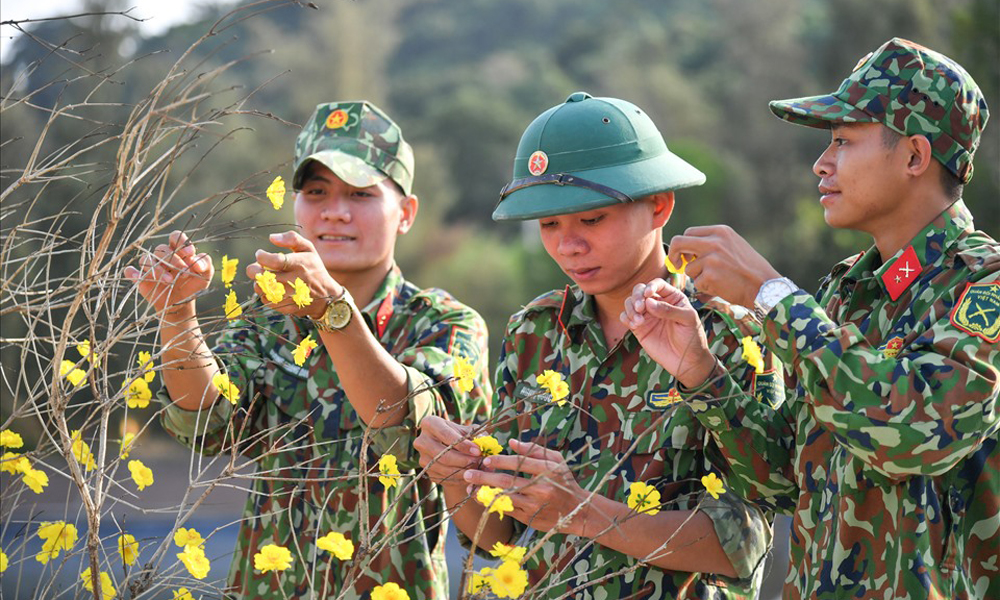 |
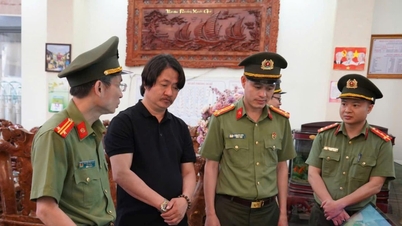
Soldiers' Tet (Lunar New Year). (Illustrative image.) |
But for the elderly, there are certain Tet holidays that remain vividly etched in their memories: the Tet of childhood. On the 27th and 28th of Tet, all farming and work are put aside. The village is bustling with the atmosphere of Tet preparations. Mothers take their children to the Tet market, the last market of the year, to buy new clothes, a few paintings, and couplets to hang up for Tet. As for the meat, six months in advance, three or four families have chosen a local pig raised on homemade feed, a pig with firm, fragrant meat. On the 29th of Tet, they slaughter the pig and share the meat. Every family gathers to wrap banh chung (traditional rice cakes), the sound of pounding meat echoing throughout the village. The children run around, asking to wrap their own tiny banh chung. Once the banh chung are wrapped, fathers place them in a pot on three bricks to make a makeshift stove, and light the fire. The whole family gathers around the table with a meal of pig's offal and a pot of fragrant offal porridge, filled with laughter and joyful conversation, ending a year of hard work to enjoy a warm and joyful Tet reunion.
Here and there in the village, the scattered sounds of firecrackers added to the festive atmosphere of Tet. On the morning of the first day of Tet, every family prepared a feast to offer to their ancestors. In the afternoon, people went in groups to wish their relatives and neighbors a happy new year. In the yard, children played excitedly, showing off their new clothes and shoes. The Tet of our childhood years was simple but full of images of family and village, deeply imprinted in our hearts. The Vietnamese Tet taught us about family affection and the strong bonds of community that create the great unity of the Vietnamese people, overcoming all storms and preserving the nation.
The Tet holiday of our childhood has passed as a beautiful memory. Our generation grew up while the whole country was waging a war of resistance against imperialist invaders, defending our beloved homeland. The older generation and the younger generation sang marching songs, taking up arms and heading to the front lines, "with hearts full of hope for the future." Along with my peers, after two years of teacher training, I became a teacher, teaching younger students. I and some classmates bid farewell to chalk and blackboards, taking up arms to fight the enemy and protect the homeland. Since then, the Vietnamese Tet holiday has become just a beautiful memory for us.
During my years as a volunteer soldier fighting on the battlefields of our brotherly country, the Vietnamese New Year was just a vague concept. On the battlefield, the Vietnamese New Year coincided with the campaign season. The soldiers fought continuously, and no one remembered the New Year. Some years, it was December, and as we prepared for battle, if the roads were clear, each soldier would receive a bag of sweets and a pack of Truong Son cigarettes distributed by the unit – that was an early New Year for the soldiers. Other years, after the campaign ended and the unit had secured its position, we had a celebratory feast to mark the victory; we called it a late New Year. During our years fighting on the battlefields of our neighboring country, Laos, we Vietnamese soldiers never experienced the atmosphere of the New Year, because the Laotians celebrate the New Year in April (Buddha's Birthday).
I remember after the Plain of Jars - Xieng Khouang campaign, my unit was stationed at a relatively quiet village in Ban to protect the road. We discussed the need for sticky rice cakes for Tet (Vietnamese New Year). Everyone agreed. We decided to buy rice from the village; the Laotians grew sticky rice in their fields, so there was no shortage of rice, but the soldiers didn't have Laotian currency. We discussed it enthusiastically, and since we didn't have money, we decided to trade things the Laotians liked. So, everyone who had needles and thread, camouflage parachutes, flares, or flint gathered them. My comrade, the nurse fluent in Laotian, and I went to see the village chief to explain our desire to exchange some items for sticky rice to make Vietnamese New Year cakes. Hearing that we wanted sticky rice for Tet, the village chief immediately supported us. He went from house to house, persuading people to exchange sticky rice for the soldiers to make cakes for Tet.
In just half a morning, we had over a dozen kilograms of sticky rice and mung beans. Everyone was excited that this Tet holiday we would have green banh chung (traditional Vietnamese rice cakes), pickled onions; the red couplets were replaced with the slogan "Determined to defeat the American invaders," written in black charcoal on white paper. The Tet altar, made of bamboo, had a flag and a picture of President Ho Chi Minh, which was very dignified. The banh chung wrapping team was very creative; without dong leaves, they used wild banana leaves, softened over a fire. Without fresh pork, they used canned meat for the filling and replaced pepper with Laotian mac khen (a type of spice). All the rice, beans, canned meat, and mac khen were used to make Tet banh chung. With the amount of sticky rice and mung beans we exchanged, we managed to wrap more than 20 banh chung.
On the first day of the Lunar New Year, at noon, we invited the village chief and several elderly villagers to join us for the New Year's feast. After we finished setting out the food, the road leading to the unit was filled with laughter and chatter, not only from the chief and elders but also from many other villagers. An unexpected situation arose, outside of our planned scenario. The soldiers exchanged glances. I whispered, "Cut the rice cake into slices and put them in bowls for the chief and elders, while the villagers and soldiers used banana leaves as makeshift bowls." Our New Year's feast consisted of sticky rice cakes as the main course, with sweets and tea as the main dishes. That's all there was to a battlefield New Year's celebration. The village chief, on behalf of the villagers, wished the soldiers a Happy New Year. I thanked Po, Me (parents) and the people for celebrating the Vietnamese New Year with the soldiers. After the meal, the village chief brought out an empty gasoline can and tapped it, causing the soldiers and villagers to stand in a line according to Lao custom. The Lao women and young people clasped their hands in front of their chests and bowed their heads in greeting to the soldiers.
During our years fighting in Laos, my comrades and I became proficient at playing the lamvong, our feet tapping to the rhythm of the drums. The villagers clapped in joyful response. At the end of the afternoon, the festivities concluded, and the soldiers and civilians parted ways, their greetings of "khop chay, xa ma khi" (thank you, solidarity) echoing through the evening forest. Nearly a decade of fighting on the Laotian battlefield, this Tet (Lunar New Year), though lacking in material comforts, was filled with the warmth of camaraderie between soldiers and civilians in our brotherly country of Laos. This simple, unpretentious affection has forged a lasting and enduring Lao-Vietnamese bond, higher than the Truong Son Mountains and wider than the sea, as President Ho Chi Minh and the Laotian revolutionary leaders once taught.
Source: https://baobacninhtv.vn/tet-xua-nho-mai-postid439339.bbg


![[Photo] National Assembly Chairman Tran Thanh Man working with the Standing Committee of the Law and Justice Committee](https://vphoto.vietnam.vn/thumb/1200x675/vietnam/resource/IMAGE/2026/05/21/1779378929214_ndo_br_1-4610-jpg.webp)
![[Photo] General Secretary and President To Lam presides over a working session with the Central Policy and Strategy Committee on the development of the materials industry.](https://vphoto.vietnam.vn/thumb/1200x675/vietnam/resource/IMAGE/2026/05/21/1779359935432_a3-bnd-3129-1412-jpg.webp)























































Comment (0)