

Night training sessions at the 210th Air Defense Brigade (Military Region 1) not only focus on honing the skills and operational proficiency of each individual but also enhance the organizational, command, and training management capabilities of officers, as well as the combat coordination of the entire unit, meeting the requirements of combat missions in the new situation.
Immediately after the afternoon training session concluded, officers and soldiers of Company 2, Battalion 1 (210th Air Defense Brigade) rushed to complete all preparations for the night training sessions. From setting up positions, checking weapons, lighting equipment, and ensuring the supply of materials synchronized with the artillery, everything had to be meticulously prepared before nightfall. Sergeant Tran Thanh Minh, Squad Leader of Squad 3, Platoon 1, shared: “Preparing for night training is more complex than daytime training. It not only requires additional support materials but also demands high levels of vigilance, combat readiness, and proficiency in individual and collective tactical and technical movements.”
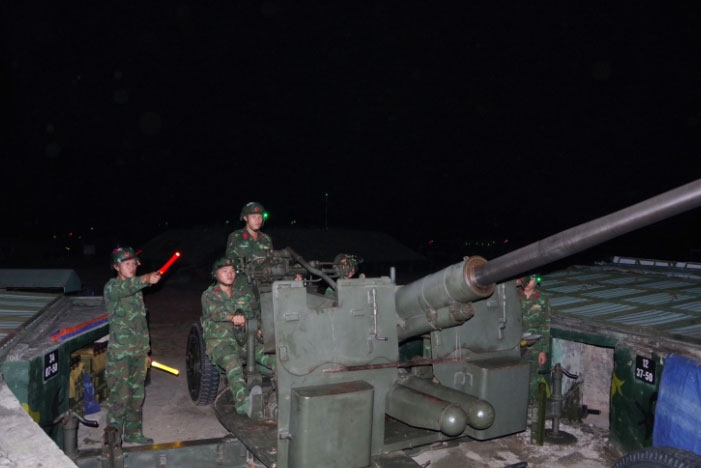 |
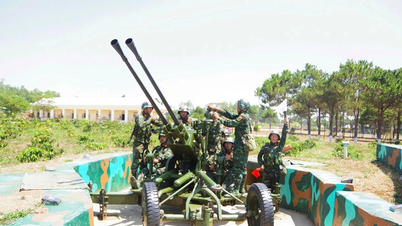
| The 57mm artillery crew of Company 2, Battalion 1, 210th Air Defense Brigade practices shooting down low-flying aircraft during night training. |
After all preparations were complete, at the start of the training session, the unit commander assembled all personnel, assigned patrol, guard, and combat readiness duties at their respective positions; briefed them on safety rules and some points to note during night training; and assigned officers and ordnance personnel to be responsible for safety at the training sites. This training session also included the use of model aircraft. These were simulated targets designed to resemble enemy aircraft, allowing the unit's anti-aircraft artillery crews to practice aiming at low-flying targets in nighttime conditions.
In the dead of night, the alarm bell signaling the unit's deployment to Level 1 sounded. Groups of officers and soldiers fanned out in all directions, heading towards the 57mm artillery batteries. The resounding bell seemed to urge the officers and soldiers of Company 2 to quicken their pace, approaching the gun emplacements and their combat positions. Receiving clear and decisive orders from the command post, the reconnaissance units searched for and tracked targets, continuously updating the situation. Each battery quickly checked its weapons, balanced its firepower, and agreed on a common aiming point. Each person had a task: some scanned for targets, others adjusted the aiming and direction, and still others loaded ammunition. The gunners coordinated seamlessly, moving swiftly and efficiently like shuttles, without a single wasted movement. Operating the gun emplacements at night was no different from practicing in broad daylight; the 57mm barrels quickly rose into the sky, aiming directly at the targets.
Captain Nguyen Huu Toan, Company Commander of Company 2, Battalion 1, said: “To conduct a night training session and coordinated combat at the platoon level like this, the soldiers had to undergo many hours of daytime training to become proficient. Night training limits visibility, making it difficult for both the artillerymen's operations and the commanders' observation and control. Even basic steps like balancing the artillery become more difficult; or the loading process, where a small mistake can easily lead to accidents, such as getting a hand caught in the loading mechanism and causing serious injury. Therefore, to ensure safety, the unit prepares thoroughly during the day; only the content that has been practiced and mastered during the day is organized for night training.”
We observed that during night training, the unit's officers and soldiers followed the training principle of progressing from easy to difficult, from slow to fast and gradually mastering the skills; they trained in specific numbers and groups, mastering individual operations before organizing combined training in squad and platoon formations. The company commander assigned officers to ensure safety and conducted thorough inspections, promptly correcting mistakes and motivating the troops during training.
When the flying targets appeared, the battlefield became most intense. “12 flying low, speed 90, long range!” Receiving orders from the commander, the gun crews quickly tracked the targets; the reconnaissance and rangefinder units continuously updated the target's position. “Target approaching, 30, 28, 26…”. The entire anti-aircraft battlefield erupted with excitement. Simultaneously, the 57mm gun crews opened fire, destroying the targets…
Directly monitoring and inspecting the night training unit, Lieutenant Colonel Pham Phung Hoi, Deputy Brigade Commander and Chief of Staff of the 210th Air Defense Brigade, shared: “The Brigade has developed a rigorous, scientific , practical, and effective combat training plan (including night training); suitable to the organization, personnel, and terrain of the combat area. The regulations stipulate that night training time must account for 30% to 40% of the time spent on practical air defense tactics and techniques; combined with training and professional development for officers to standardize the organization and methods of night training throughout the unit; monitoring, directing, guiding, and inspecting the preparation and organization of night training by various departments. In particular, the unit prioritizes organizing reviews, drawing lessons learned, and promptly commending and rewarding achievements according to the hierarchical structure; and replicating best practices. Through this, we gradually improve the organizational and command capabilities of our officers; their proficiency in using weapons and equipment; and their combat coordination skills.” "The units, individual artillerymen, gunners, radar operators, and communications soldiers fought in nighttime conditions, meeting the increasingly demanding requirements of training and combat readiness."
Text and photos: QUOC HA - QUY HUNG
Source

![[Image] Close-up view of the interchange connecting the two expressways and Long Thanh Airport.](https://vphoto.vietnam.vn/thumb/1200x675/vietnam/resource/IMAGE/2026/05/25/1779703378210_ndo_br_z7863716673926-224453a31600126cce10622af6290afd-4549-jpg.webp)



![[Image] Hanoi's urban life under the challenge of a "scorching hot" environment](https://vphoto.vietnam.vn/thumb/1200x675/vietnam/resource/IMAGE/2026/05/25/1779706979265_nang-nong-t5-2026-minh-duy-7-4636-jpg.webp)







































































Comment (0)