

Tug-of-war is easy to organize and inexpensive. All you need is a flat piece of land, like a village square or volleyball court, and a rope—"as strong as rope," braided from jute or hemp fibers, about 2-3 cm in diameter, ensuring that each side can hold onto it and pull in opposite directions with all their might in a straight line without breaking or injuring the players' hands. The referee team consists of two assistants whose job is to observe the players' conduct and one main referee standing between the two teams, waving a flag to start the game and witnessing which foot is pulled across the boundary line to end the match and declare the winning team.
 |
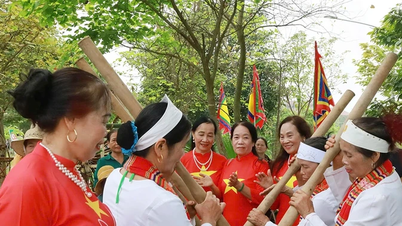
Residents of Viet Hung ward ( Hanoi City) happily participate in a tug-of-war at the Truong Lam village traditional festival in 2026. |
Tug-of-war is primarily for fun. The players are villagers, men, women, the elderly, and children alike, all enjoying participating. The losing team might even be more delighted and laugh louder than the winning team, precisely because of their own shortcomings and clumsiness in strategy. The winning team, on the other hand, is chivalrous and cheerful, embracing the losing team's players, sharing their experience, and wishing them success next year...
Tug-of-war at village festivals attracts spectators like a magnet attracts iron. Farmers and freelance workers choose to skip travel and refrain from drinking; villagers welcome friends from all over to their homes... to conveniently watch the tug-of-war. At most village festivals (usually lasting three consecutive days), the organizers, if any of those three days include a Saturday or Sunday, schedule the tug-of-war competition around 3-4 PM on one of those two days so that civil servants, employees, armed forces personnel, and workers in businesses can all participate in this game.
Spectators in the tug-of-war join in the fun by standing on either side of the formation, extending their arms and swinging them as far as they can in the direction of the rope pull, chanting in unison: "Come on! We will win!" Some even adapt the "Cannon Pulling Chant" by composer Hoang Van to match the tug-of-war rhythm, clapping and singing at the top of their lungs: "We will pull across! Just one more beat. Feet on the ground, hands holding tightly to the rope..." Then they clap and cheer until their hands are sore and their voices are hoarse...
Mr. Au Xuan Kien, former Head of the Management Subcommittee of Truong Lam Temple (Viet Hung Ward, Hanoi), who has presided over many tug-of-war competitions at local festivals, shared a very practical piece of advice. He said that in village festivals, clans should not be used as the unit for tug-of-war competitions, especially in areas with many public agencies and units. When clans compete in tug-of-war, the outcome can easily lead to prolonged resentment due to extreme individual attitudes. Just because one clan's team lost to another, there have been cases of arrogant behavior: "My clan accepts your clan's challenge, two rounds and the cat has opened its eyes!" (meaning they won both rounds without needing a third). Even with "internal control, external control" in place, problems can still arise.
Therefore, let's use neighborhood groups, residential areas, associations, and organizations as units for tug-of-war competitions, in a fun and harmonious way. In short, when it comes to tug-of-war competitions, we should try to encourage and motivate all segments of society to participate, thereby demonstrating the deepest and most enduring spirit of community cohesion.
Source: https://www.qdnd.vn/van-hoa/doi-song/keo-co-tro-choi-thu-vi-o-lang-viet-1041153


![[Image] Close-up view of the interchange connecting the two expressways and Long Thanh Airport.](https://vphoto.vietnam.vn/thumb/1200x675/vietnam/resource/IMAGE/2026/05/25/1779703378210_ndo_br_z7863716673926-224453a31600126cce10622af6290afd-4549-jpg.webp)
![[Image] Hanoi's urban life under the challenge of a "scorching hot" environment](https://vphoto.vietnam.vn/thumb/1200x675/vietnam/resource/IMAGE/2026/05/25/1779706979265_nang-nong-t5-2026-minh-duy-7-4636-jpg.webp)

























































































Comment (0)