

To fully explore the beauty of Vietnam and experience its enchanting way of life, perhaps nothing is better than a train journey along the length of the country. Newly commissioned 5-star train carriages and ongoing inter-provincial railway projects are gradually creating a comfortable and clean train journey across Vietnam.
Connecting high-speed railways from the North Pole to the South Pole.
The Ministry of Transport has submitted a document to the Prime Minister requesting the allocation of contingency funds from the central government budget for 2024 to prepare for investment in the Lao Cai – Hanoi – Hai Phong railway line. According to the Ministry, preparing for investment in this railway line is necessary and urgent. The Vietnam-China Joint Statement during the visit of General Secretary and President of China Xi Jinping to Vietnam on December 12-13, 2023, agreed to promote the strategic connectivity between the two countries, effectively implement the cooperation plan for connectivity within the framework of the two corridors and one belt with the Belt and Road Initiative between Vietnam and China. At the same time, it agreed to promote the connection of standard-gauge railways across the Vietnam-China border and to study the construction of a standard-gauge railway from Lao Cai to Hanoi and Hai Phong.
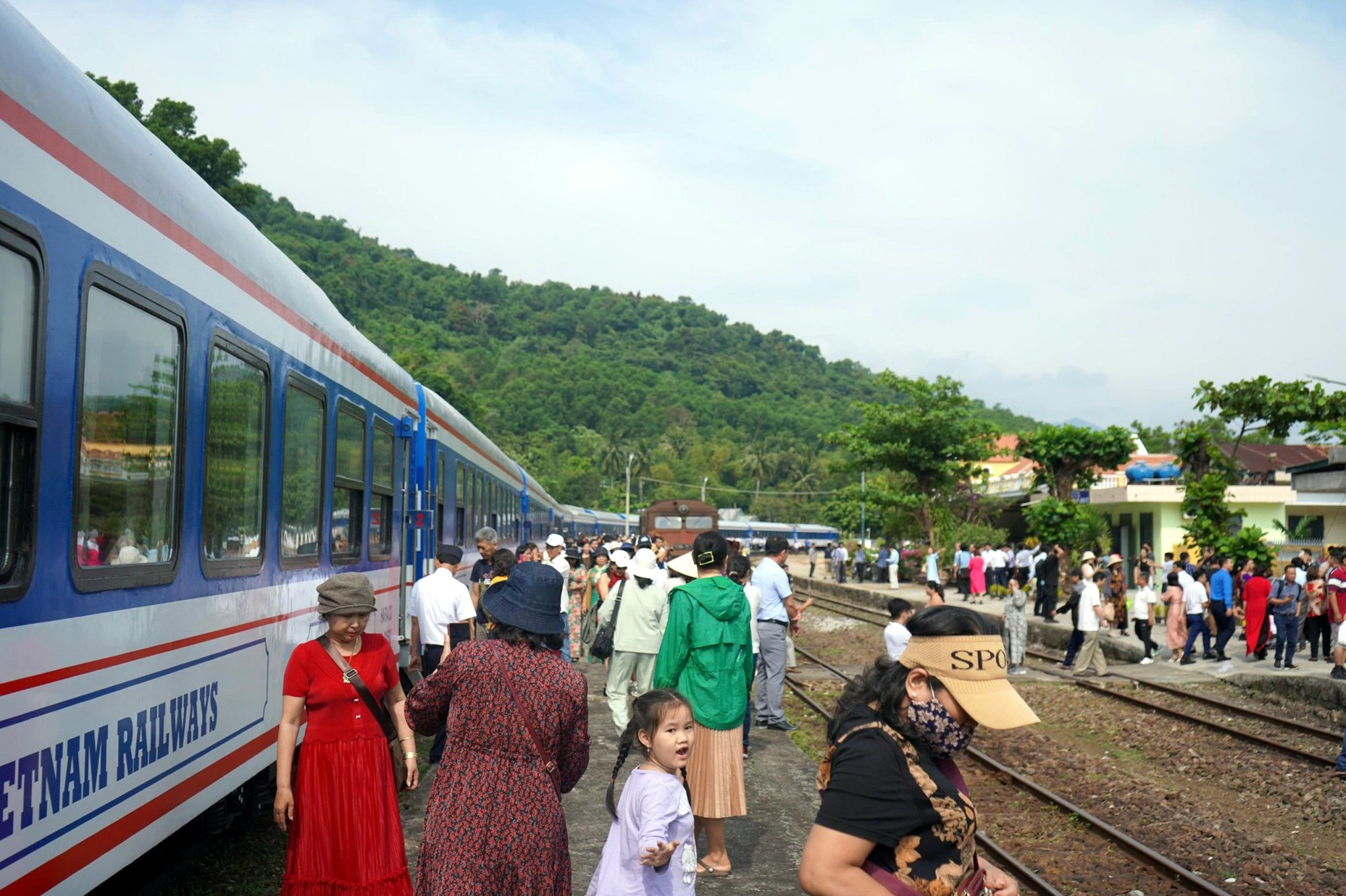
Tourists traveling on the Central Vietnam Heritage Journey train. NGOC NAM
Furthermore, Conclusion No. 49 of the Politburo on the development orientation of Vietnam's railway transport system until 2030, with a vision to 2045, also sets a target for 2030 to commence construction on several lines connecting international gateway seaports (Hanoi – Hai Phong, Bien Hoa – Vung Tau…) and international border gates (Hanoi – Lao Cai , Hanoi – Lang Son…).
Most recently, Conclusion No. 72 dated February 23rd by the Politburo also affirmed the priority of investing resources in the North-South high-speed railway project, the Lao Cai - Hanoi - Hai Phong lines, etc. Based on these requirements, the Ministry of Transport proposes that the competent authorities allow the allocation of funds from the central budget reserve for 2024 to promptly implement the procedures for research and approval of investment in the project.
Previously, the consortium of consultants, including the Transport Investment and Construction Consulting Joint Stock Company and the Transport Design Consulting Corporation (TEDI), submitted a mid-term report to the Vietnam Railway Authority on the planning of the Lao Cai – Hanoi – Hai Phong – Quang Ninh railway line. Specifically, the line starts at Lao Cai station (from the point where the rail connects with the Chinese railway), ends at Ha Long station (part of the Kep – Ha Long railway line), and passes through 10 provinces and cities: Lao Cai, Yen Bai, Phu Tho, Vinh Phuc, Hanoi, Bac Ninh, Hung Yen, Hai Duong, Hai Phong, and Quang Ninh. Notably, to ensure competitiveness with the Lao Cai – Hanoi – Hai Phong – Quang Ninh expressway, the consulting team proposed an initial design speed of 160 km/hour, which could be increased to 200 km/hour in the future, thus shortening the travel time of the new railway line to only 4-5 hours compared to road transport.
While the railway line connecting Quang Ninh to Lao Cai is being actively developed, people across provinces and cities from North to South are enthusiastically sharing information about the North-South high-speed train with trends like: "Saigon broken rice in the morning, Hanoi egg coffee in the afternoon"; "Saigon broken rice in the morning, Hai Duong mung bean cake in the afternoon"... According to the scenario being studied by the Ministry of Transport, if the design speed of 350 km/hour is approved, the high-speed train journey from Ho Chi Minh City to Hanoi, a distance of 1,730 km, will only take about 5 hours, plus more than 2 hours to reach Hai Duong, and about 2-3 hours to continue the railway line to the Lao Cai border.
In the southern direction, the Ho Chi Minh City – Can Tho high-speed railway line is also being accelerated by businesses and local authorities in coordination, with a design speed of approximately 190 km/hour for passenger trains and 120 km/hour for freight trains. Upon completion, the travel time from Can Tho to Ho Chi Minh City will only take 75-80 minutes. Across the country, sections of high-speed railway lines are being connected with the goal of trains traveling from the northernmost to the southernmost point of the country in less than 15 hours.
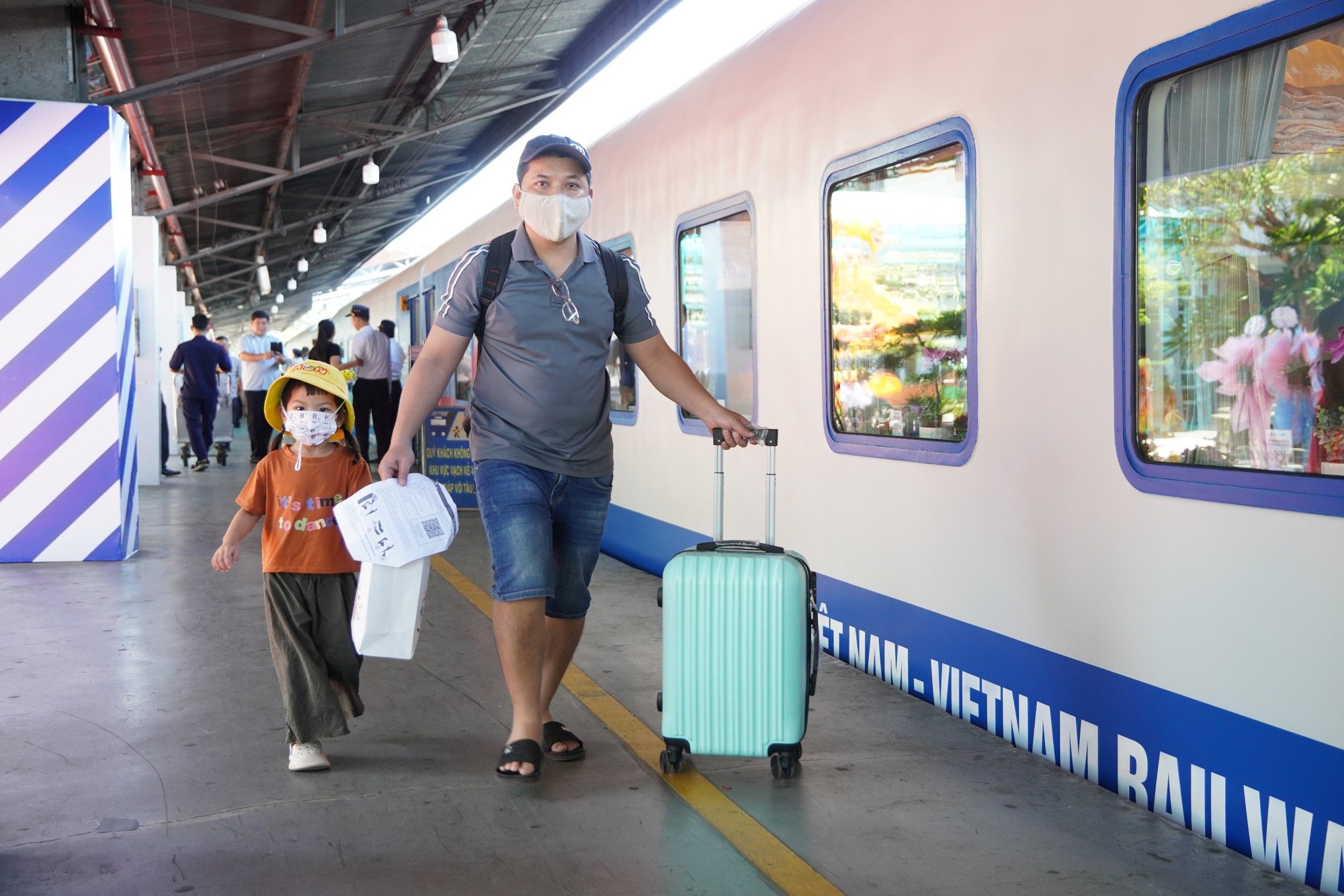
High-quality train service (Saigon – Da Nang route). NGUYEN ANH
A journey to experience unique local culture.
According to experts, railways and waterways must take the lead in developing goods transportation because they are methods of transporting large volumes at a much lower cost than road and air transport. Investing in railways, relieving traffic congestion, and facilitating the flow of goods to stimulate the economy is an urgent task for major economic hubs like Ho Chi Minh City and Hanoi. Moreover, railways are expected to become a unique tourism product of Vietnam.
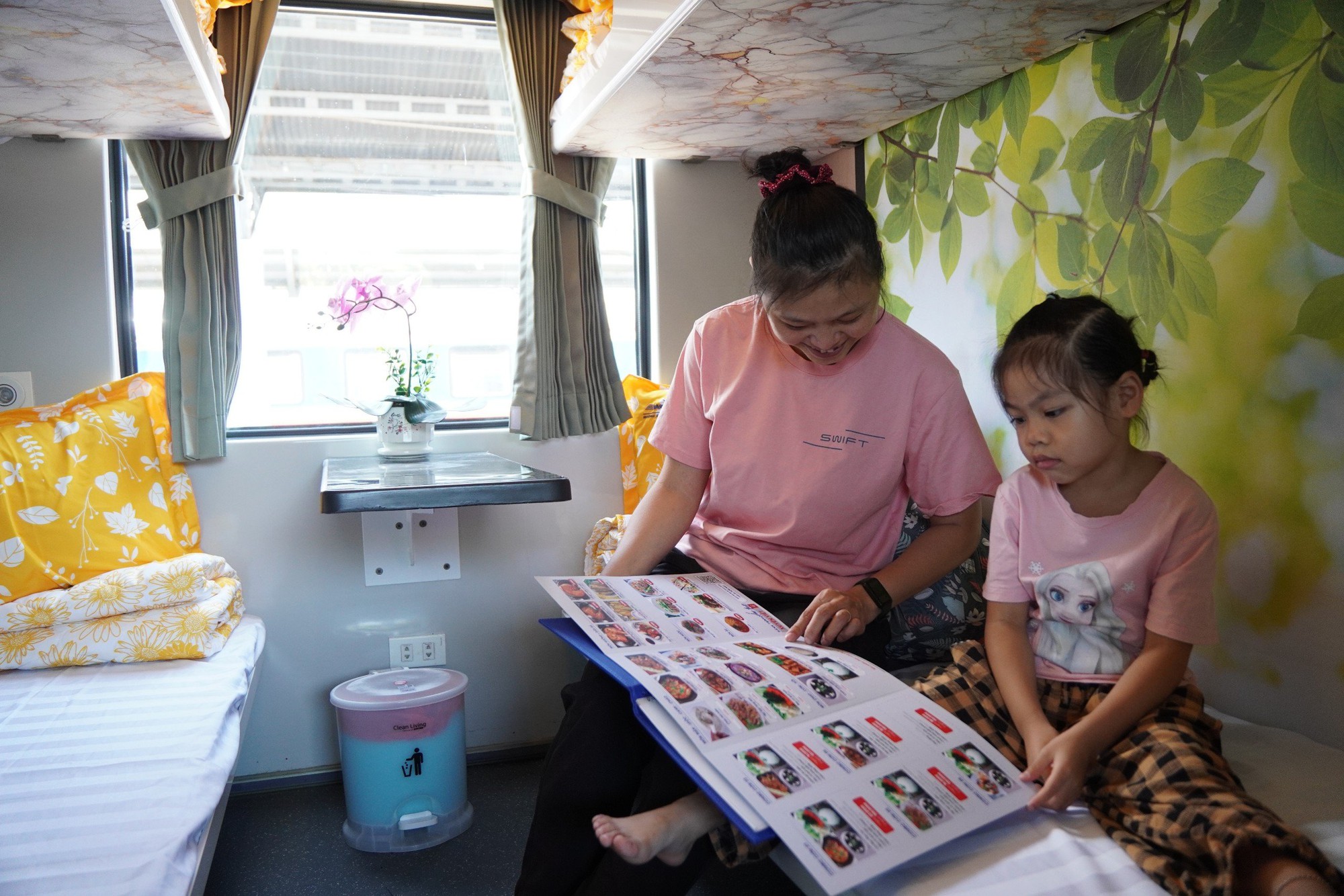
Recently, the railway industry has collaborated with tourism companies to operate the 5-star SE19/20 Hanoi – Da Nang train and the SE21/22 Saigon – Da Nang train, quickly becoming a unique tourism product attracting many domestic and international tourists. Most recently, the YouTube channel with 50,000 followers of a couple from Canada, Eric and Sarah, shared their story of a luxurious 17-hour train journey from Da Nang to Hanoi, instead of choosing a flight that would only take a little over an hour. Booking a VIP sleeper compartment for two, priced at 6.6 million VND per night, the Canadian couple said it was completely worth it for the wonderful experience on the beautifully designed train compartment, with comfortable and well-organized interiors; the food was delicious, clean, and reasonably priced.
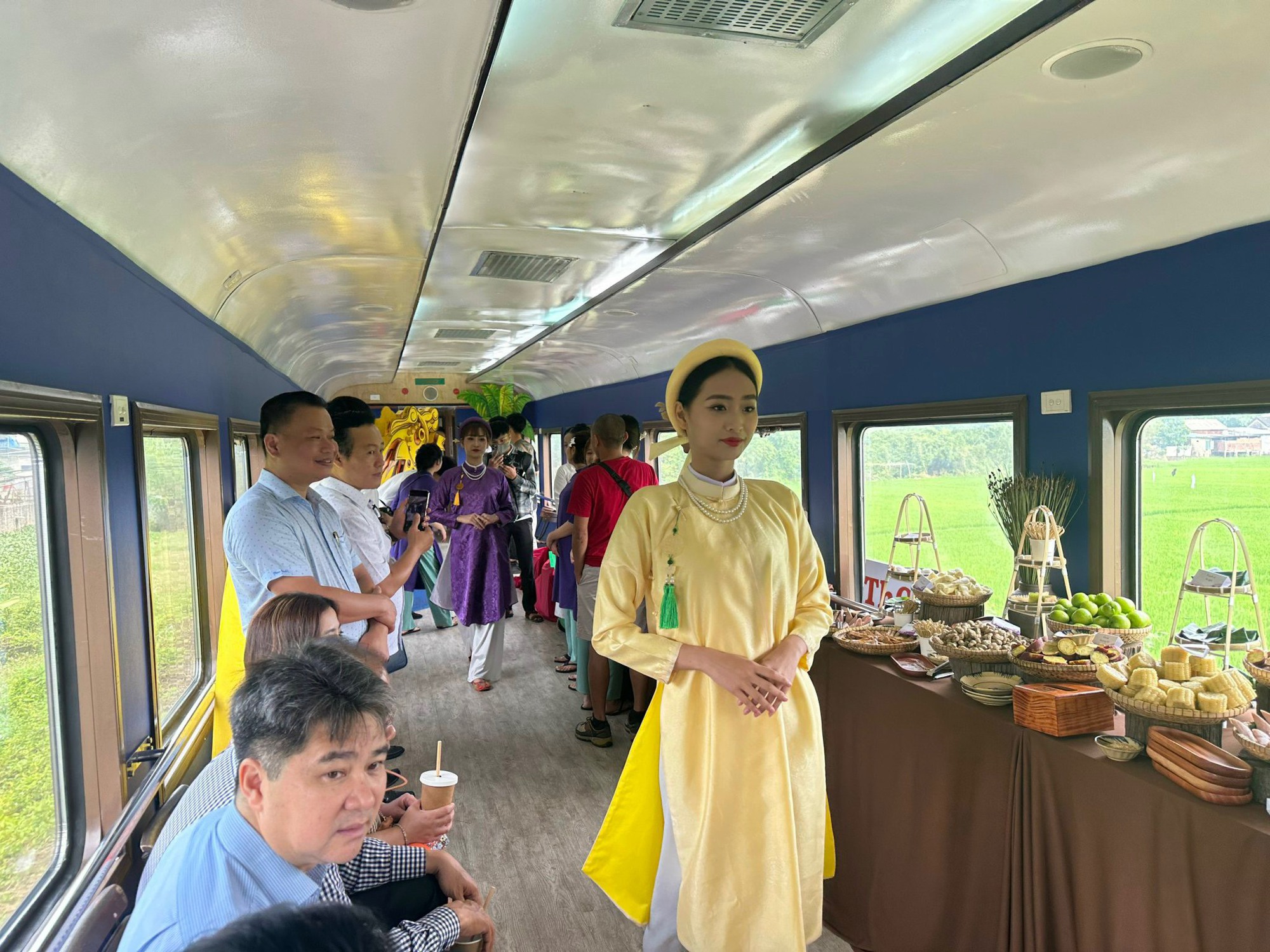
Tourists traveling on the Central Vietnam Heritage Connection train. NGOC NAM
“I love how they’ve arranged this room, and the exquisite wall painting depicting a Vietnamese countryside… Look, we’ve just passed rice fields and some small towns. I even saw a few buffaloes on the road,” Sarah said, surprised and delighted by the beautiful green scenery outside the window.
Following the successful launch of 5-star trains, which attracted significant tourist interest, the railway industry continues to diversify its services, such as inaugurating the Hue-Da Nang train and vice versa, named "Connecting Central Vietnam Heritage," a business model combining transportation with tourism services. While the Hue-Da Nang railway route has long been familiar to residents of both provinces, the newly launched "Connecting Central Vietnam Heritage" train continues to attract a large number of local visitors.
The Da Lat – Trai Mat night train, known as the “Da Lat Night Journey,” spanning 6.7 km, has quickly become a new tourist attraction in the misty city. With a journey time of approximately one hour (30 minutes going and 30 minutes returning) and a slow speed, during the day, visitors can relax and admire the romantic beauty of Da Lat; at night, the beauty of Da Lat becomes incredibly magical and unique.
![[Tàu di sản đêm Đà Lạt]_[LÂM VIÊN]].jpg](https://www.vietnam.vn/vinhphuc/wp-content/uploads/2024/07/1720496556_634_photo-1720456371652-17204563729552102402173.jpeg "[Da Lat Heritage Night Boat]_[LAM VIEN]].jpg")
Dalat Heritage Night Cruise. LAM VIEN
Having nurtured the idea of developing a unique train tourism product for many years, Chairman of the Board of Directors of Vietravel Corporation, Nguyen Quoc Ky, affirms that train tourism is becoming a new trend, attracting the attention of a large number of tourists. Train tourism is a journey to experience unique local culture, offering tourists unique experiences that are both relaxing and culturally enriching. In Vietnam, train tourism is experiencing positive development. According to data from the National Tourism Administration, in 2023, the number of domestic tourists traveling by train reached 10 million, an increase of 15% compared to 2022. The number of international tourists traveling by train reached 1.5 million, an increase of 20% compared to 2022.
“Vietnam has a railway system that has been in existence for 143 years, with a total length of 3,143 km, connecting most provinces and major cities nationwide. We have many beautiful natural landscapes and diverse cultures, offering tourists exciting experiences when traveling by train. In 2023, the railway industry was featured in Lonely Planet's Amazing Train Journeys – an publication compiling the world's greatest railway journeys. The Hanoi-Ho Chi Minh City railway line was voted the most beautiful and worthwhile railway route in the world. Not to mention, it is also an environmentally friendly option, in line with the trend of sustainable tourism development,” Mr. Nguyen Quoc Ky analyzed.
"Land" to bring railways back to their golden age.
According to the leaders of Vietnam Railways Corporation (VNR), until high-speed rail is completed, VNR intends to continue operating "hotel trains," developing in the high-end segment targeting high-income customers. High-end tourists prioritize "unique consumption," not focusing heavily on price but seeking unique and exclusive experiences. This is the fertile ground for reviving luxury tourist train carriages for the railway industry.
Supporting the utilization and promotion of railway value in tourism development, Dr. Khuat Viet Hung, Director of the Institute of Transport Development Strategy (Ministry of Transport), cited: Many studies show that the potential for promoting tourism development is closely linked to the development and characteristics of railways. For example, in Japan and Australia, the development of new railway lines in the mid-19th century opened up a new tourism industry, promoting group tourism and inter-regional tourism to remote areas.
This also presents an opportunity for existing, long-established railway lines in Vietnam, which serve as historical heritage sites. New tourism products on Vietnamese railways in recent years, or the phenomenon of "Railway Streets" in Hanoi, demonstrate the potential for developing attractive new transport-tourism products that appeal to tourists who enjoy nostalgic travel or want to recreate unique tourism identities with local communities along the railway lines.
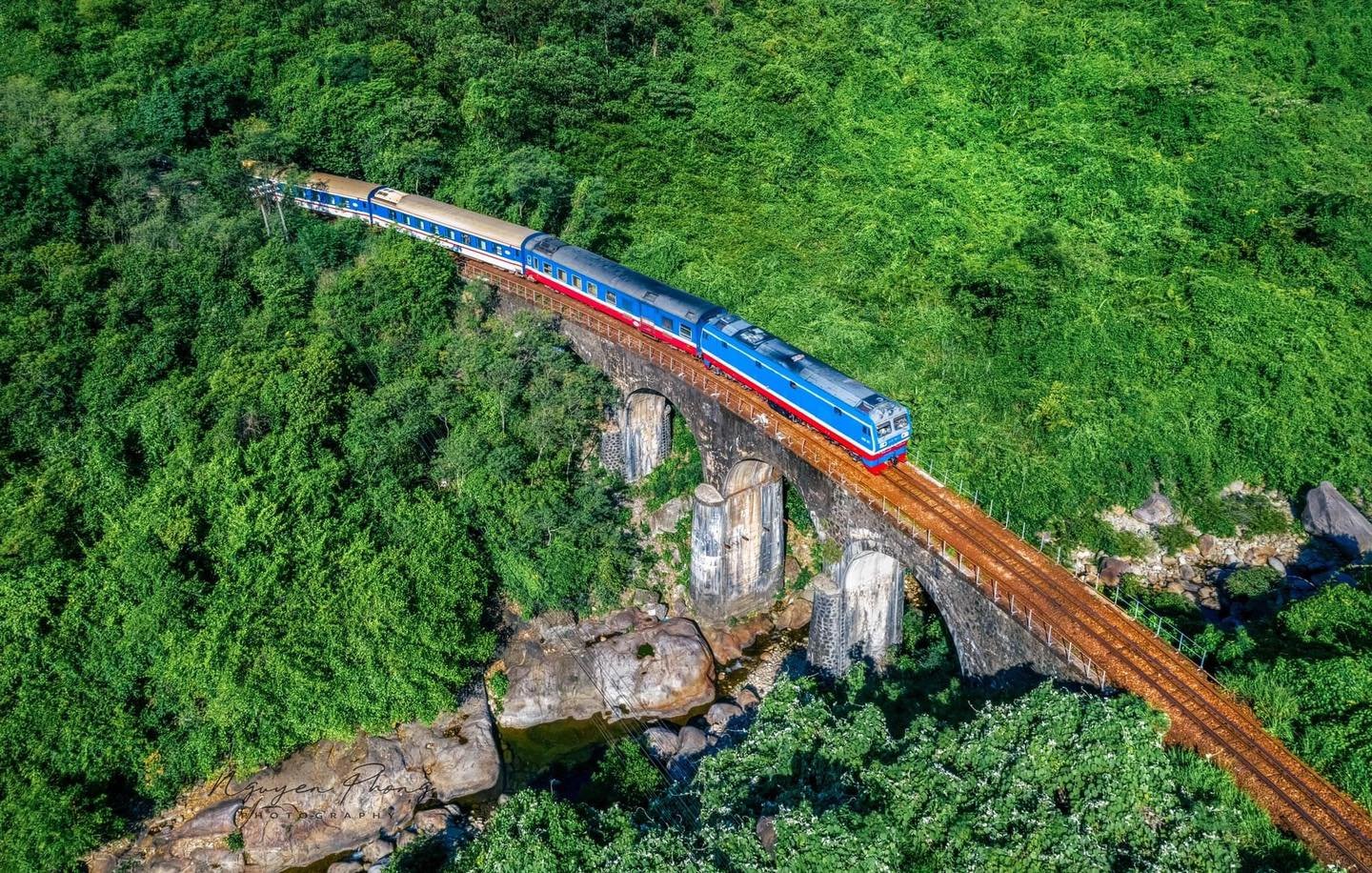
The Central Vietnam Heritage Connection train (the section through Hai Van Pass). NGUYEN PHONG
Dr. Khuat Viet Hung believes that improving the quality of railway transport services can strongly boost tourism. Several immediate actions can be taken, such as improving hygiene conditions on trains and at stations; making service staff friendlier; adding services and amenities for tourists; upgrading the exterior and interior of train carriages to meet tourist quality standards; improving train schedules and enhancing punctuality. Simultaneously, it is necessary to strengthen multimodal transport connections between rail and road, and with other modes such as air and water. It is crucial to ensure seamless bus service connections with train stations, guaranteeing the shortest and most convenient walking distance between buses and railways for tourists; and to offer integrated ticket sales for train passengers via smart applications or the internet.
“Developing transportation-tourism routes is a new trend in recent years. Research and planning of transportation networks connecting resources and tourist destinations to create a complete tourism package including sightseeing, experiences, food, accommodation, health and fitness activities, exploration… is increasingly attracting investment from many countries and localities. Combining transportation and tourism services in a single product not only provides a unique experience for tourists but also contributes to diversifying the tourism products of a destination,” Mr. Khuat Viet Hung emphasized.
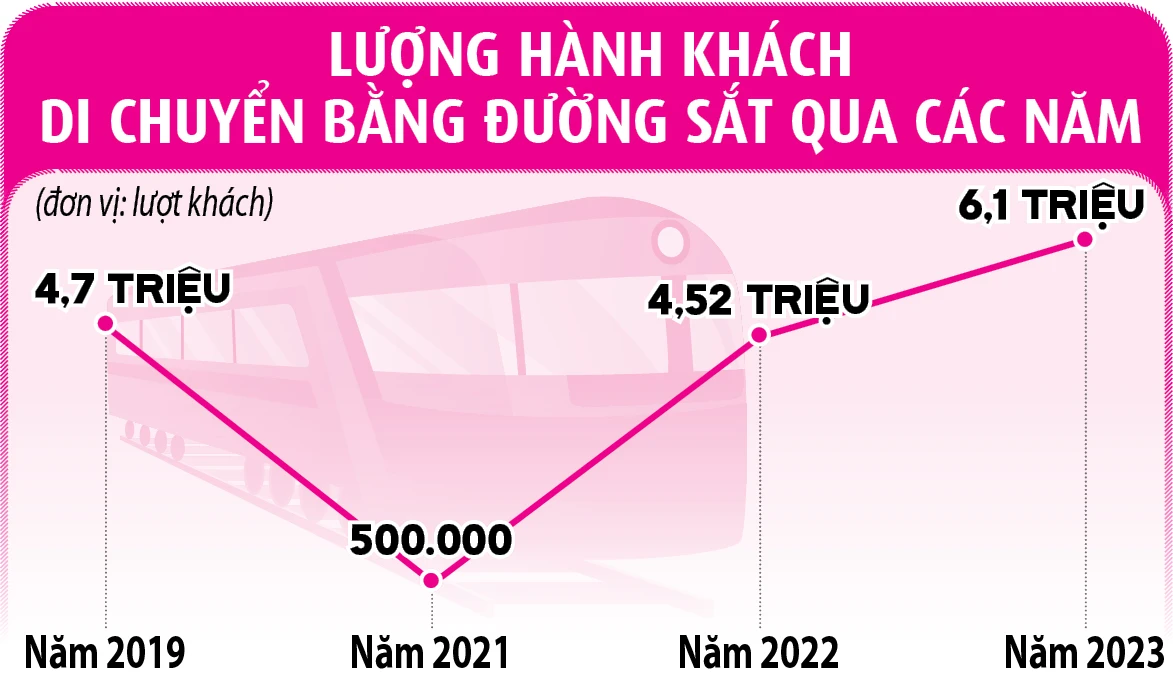
Number of passengers traveling by rail over the years. SOURCE: VNR – GRAPHICS: BAO NGUYEN
| Vietnam's railway system possesses many invaluable historical, cultural, and heritage assets, including strategically located central stations. It would be a great waste if we did not have a well-structured strategy to fully exploit and develop this enormous resource. Mr. Nguyen Quoc Ky, Chairman of the Board of Directors of Vietravel Corporation |
| Vietravel and VNR are collaborating on a 5-star Trans-Vietnam Train project, creating a new multimodal tourism model called “ONE TICKET ALL TRAILS”. This model not only offers convenience to customers with a comprehensive travel ticket but also expands travel opportunities through the combination of different modes of transportation, from air to rail, enhancing the overall travel experience. The two entities have committed to sustainable cooperation and will also partner with local authorities to promote local tourism throughout the journey with an integrated smart technology system: creating a multi-functional “ALL-IN TICKET” platform, providing a seamless travel experience, priority access to attractions, digital integration for real-time information updates, and a loyalty program. |
Source: https://thanhnien.vn/tang-toc-du-lich-tau-hoa-185240708233417206.htm

![[Photo] General Secretary and President To Lam receives Amazon's Senior Vice President David Zapolsky](https://vphoto.vietnam.vn/thumb/1200x675/vietnam/resource/IMAGE/2026/05/22/1779466547770_a1-bnd-3513-6601-jpg.webp)



































































Comment (0)