

This information was discussed by experts at the Forum on Credit Markets and Macroeconomic Issues, organized by the Institute for Brand and Competition Strategy in collaboration with relevant units on the morning of December 24th in Hanoi.
Credit and macroeconomic stability are inseparable 'problems'.
The forum took place against the backdrop of continued unpredictable fluctuations in the global and regional economies, slowing global growth, and increasing risks and uncertainties, posing numerous challenges to macroeconomic policy management, including the need for prudent and effective credit management, linking rapid growth with macroeconomic stability, and reforming the financial system.

Forum on Credit Markets and Macroeconomic Issues. Photo: Bank
Credit remains the primary source of capital for the Vietnamese economy and a crucial regulatory tool in macroeconomic management. Recent years have shown that credit has played a positive role in supporting economic recovery and growth. However, the expansion of credit has also revealed several issues related to the efficiency of capital allocation, the capacity of businesses to absorb capital, systemic risks in the financial and banking sector, and the need to maintain macroeconomic stability amidst significant policy adjustments.
The forum was organized to create a space for in-depth exchange, where policymakers, economic and financial experts, credit institutions, businesses, and investors could share perspectives and experiences, and discuss key issues in the current credit market. This would contribute to a more comprehensive understanding of the credit landscape in close relation to the goals of economic stability and growth.
Speaking at the forum, Dr. Vo Tri Thanh, Director of the Brand and Competition Strategy Research Institute (BCSI), stated that Vietnam is aiming for high economic growth in the coming years. However, growth needs to be not only rapid but also sustainable, green, and in harmony with the environment and society—that is, sustainable and inclusive development.
According to Dr. Vo Tri Thanh, the most important foundation for realizing this goal is maintaining macroeconomic stability. Macroeconomic stability is not limited to keeping inflation low, but also includes the soundness of the financial and banking system, the balance of payments, and other fundamental elements of the economy. This is an interconnected whole, requiring a comprehensive approach in policy planning and implementation.
In this context, the issue of credit has become a "hot" and crucial topic: what level of credit growth is appropriate, how should capital be allocated to maximize efficiency, what is the role of market mechanisms, and what is the extent of state intervention? Especially for developing countries like Vietnam, where the financial system still relies heavily on banks, credit continues to be a vital resource for growth.
Dr. Vo Tri Thanh emphasized the need for a flexible and cautious approach to meet immediate requirements, such as those in the 2025-2026 period, while also ensuring medium- and long-term goals, linked to the reform and restructuring of the financial and banking system.
You can't just look at the scale of credit.
From a more in-depth perspective, Dr. Can Van Luc, Chief Economist of BIDV and member of the Prime Minister's Policy Advisory Council, argues that Vietnam is pursuing a new development model, aiming to become a developing country with modern industry and upper-middle income by 2030, and a developed country with high income by 2045.

Dr. Can Van Luc, Chief Economist of BIDV and member of the Prime Minister's Policy Advisory Council, speaks at the forum. Photo: NH
According to Dr. Can Van Luc, the development model for the next phase needs to shift from relying heavily on capital and labor to relying more on science and technology, innovation, institutional reform, and productivity. Instead of following a sequential path from investment and capital injection to innovation, Vietnam needs to combine all three elements simultaneously to "leapfrog" ahead.
However, the economy is also facing a series of challenges: slowing global growth; high dependence on exports and foreign investment; low localization rates and participation in global value chains; lack of significant breakthroughs in competitiveness; risk of falling into the middle-income trap; increasingly evident impacts of climate change and environmental pollution; risks to energy security and supply chain security; rapid population aging; while the need to mobilize resources for development is enormous.
In this context, Dr. Can Van Luc argues that there is insufficient basis to assert that credit growth needs to double GDP growth, as the economy has many other channels for capital mobilization. Many international studies show that the scale of credit relative to GDP needs to be controlled at a reasonable level. Specifically, the study by Sy-Hoa Ho and Saadaoui (2022) recommends a credit/GDP threshold of approximately 96.5% for ASEAN during the period 1993-2019; some other studies suggest a range of 80-120% of GDP.
Notably, high credit growth amidst inflation exceeding 7% will reduce the effectiveness of growth promotion. This indicates that macroeconomic stability remains a prerequisite. According to Dr. Can Van Luc, the quality of growth largely depends on the credit structure and investment structure. Currently, about 80% of public investment capital is allocated to transportation infrastructure, while healthcare and education account for 15%, and science and technology only about 0.5%. Therefore, improving investment efficiency and adjusting the capital structure appropriately is more important than simply expanding the scale of credit.
Experts at the forum unanimously agreed that, to reduce pressure on bank credit and improve the quality of growth, it is necessary to accelerate reforms of financial institutions. The focus should be on developing a more balanced financial market, promoting the capital market, bond market, and derivatives market; diversifying financial institutions such as investment funds, pension funds, and REITs; and perfecting the legal framework for new financial models such as green finance, digital finance, carbon markets, and international financial centers.
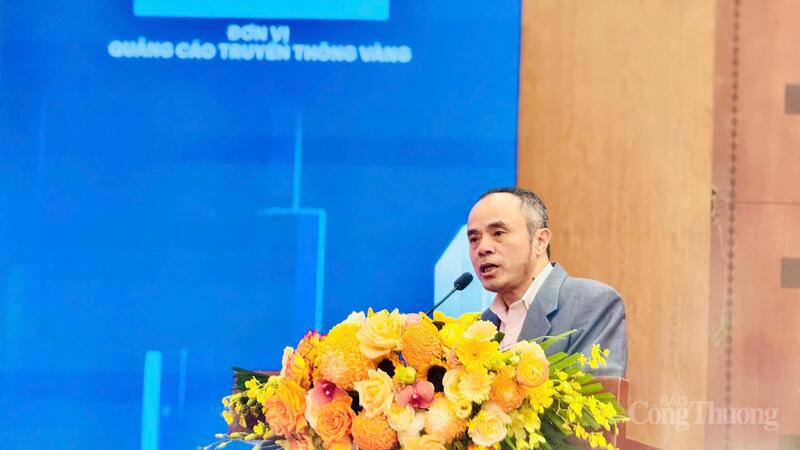
Dr. Le Xuan Sang, Deputy Director of the Vietnam and World Economics Institute. Photo: NH
Dr. Le Xuan Sang, Deputy Director of the Vietnam and World Economics Institute, believes that it is necessary to continue diversifying capital sources for the economy through the development of the stock market, especially bonds, and strengthening the role of credit rating agencies. Along with that, it is necessary to improve the health of the stock market, tightly control informal financial leverage and securities fintech activities.
Regarding investment, Dr. Le Xuan Sang proposed prioritizing sectors in which Vietnam has a high comparative advantage and is less likely to cause inflationary pressure, such as renewable energy, energy for digital transformation, domestic and cross-border e-commerce, and new technologies. At the same time, he suggested promoting the development of technology incubation systems, perfecting investment mechanisms to expedite investment linked to administrative reforms, and promptly completing national and local planning systems to create room for growth.
Dr. Vo Tri Thanh stated that the opinions and recommendations from the workshop will be compiled and reported to policy-making agencies, with the goal of contributing to promoting the development of the credit market in a stable, efficient, and sustainable direction, maintaining macroeconomic stability not only in 2026 but also for many years to come.
Source: https://congthuong.vn/tang-truong-tin-dung-den-dau-de-khong-danh-doi-on-dinh-vi-mo-436320.html


![[Image] Nearly 125,000 Hanoi students completed the Literature exam for the 10th grade entrance exam.](https://vphoto.vietnam.vn/thumb/1200x675/vietnam/resource/IMAGE/2026/05/30/1780117233041_ndo_br_thiet-ke-chua-co-ten-2-png.webp)






























![[Photo] Admire the coral "masterpiece" amidst the million-year-old heritage of Dak Lak province.](https://vphoto.vietnam.vn/thumb/1200x675/vietnam/resource/IMAGE/2026/05/30/1780107638639_y25-jpg.webp)









































































Comment (0)