

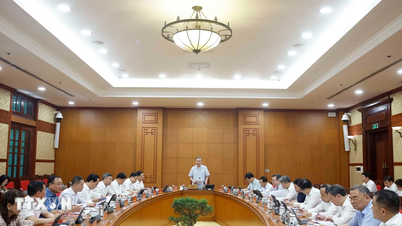
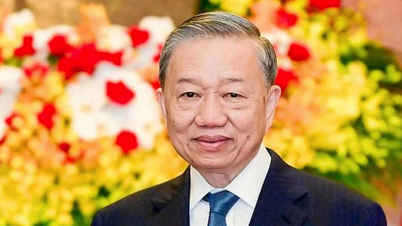
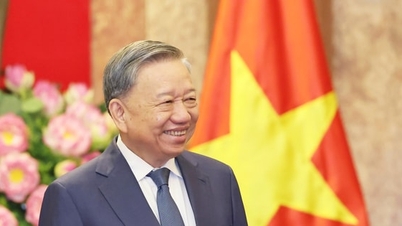
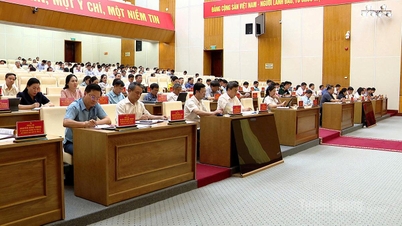
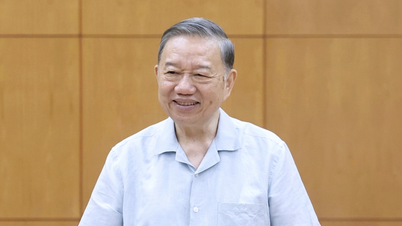
"It is impossible to represent the people if one cannot hear the true voice of the people and speak in a way the people do not understand." Perhaps this is the most thought-provoking statement at the 11th National Congress of the Vietnam Fatherland Front. Not only because of its frankness, but also because this statement by General Secretary and President To Lam at the Congress resonated with the growing expectations of today's society: to be listened to in a substantive way.
For nearly a century, the Fatherland Front has accompanied the nation, playing a crucial role in consolidating national unity, mobilizing social movements, caring for welfare, and supporting the poor and those affected by natural disasters and difficulties. These contributions are highly commendable. Along with the country's development, people's expectations of the Fatherland Front are also changing. Social media and the digital space create more opportunities for people to express their views, voice their concerns, and participate in community life more than ever before.
In such a society, people need more than just traditional forms of propaganda or advocacy. What they expect is a place where their voices are truly heard, their concerns are reflected, and their legitimate requests are followed through.
Perhaps that is why the messages at this Vietnam Fatherland Front Congress have created such a special resonance in society. When General Secretary and President To Lam emphasized that "Innovation is impossible if it is only the words in a resolution," people felt the spirit of opposing formalism.
When the General Secretary and President said, "It is impossible to represent the people without hearing their true voices," society sensed the need for genuine reform. And when the General Secretary and President affirmed, "Social consensus is not mere formal silence," many realized that the approach to democracy and national unity was undergoing a very significant shift.
People expect the Fatherland Front not only to organize mass mobilization, but also to become a "social sensor," capable of detecting early on shortcomings in practice, policies that are not in line with the people, and issues that are causing public concern.
That is why the requirement for "early and distant critique" was emphasized at this Congress. If critique only takes place after policies are finalized, it is often too late. But if critique is carried out right from the policy formulation process, many shortcomings can be identified early, many social conflicts can be resolved from the outset, and policies will have a better chance of being closer to real life. It is very noteworthy that this time, social critique is no longer being discussed in a general way.
The General Secretary and President demanded that criticism be "based on data, social surveys, and voices from the grassroots," while emphasizing that "legitimate opinions of the people must not be silenced." This is a very strong message. Because what makes people lose faith is not just difficulties or shortcomings, but the feeling that their voices are not being heard and that no one is pursuing their opinions to the end.
A strong system of governance is not one without dissenting opinions, but one that absorbs social feedback to improve itself. Perhaps that is why the statement "Social consensus is not formal silence" has garnered so much attention.
In a developed society, differences are natural. Sustainable consensus cannot be created by avoiding differences or making all voices sound the same. Consensus is only truly meaningful when it is built on a foundation of listening, dialogue, respect, harmoniously resolving conflicts of interest, and protecting the legitimate rights of the people.
And trust only emerges when people feel their voices are valued, their suggestions are pursued, their legitimate rights are protected, and the problems of their lives are not neglected. Perhaps that is why, at the end of his speech, the General Secretary and President sent a powerful and inspiring message: "Let democracy become a driving force."
"Let's make the people's trust the solid foundation of the nation." This is not just a message for the Front. It could also be a major suggestion for building social consensus in the new era of development: the strength of national unity lies not in slogans chanted in assembly halls, but in whether the people truly believe that their voices are heard.
Source: https://www.sggp.org.vn/tao-dong-thuan-bang-gan-dan-lang-nghe-va-hieu-dan-post852487.html
![[Image] Hanoi's urban life under the challenge of a "scorching hot" environment](https://vphoto.vietnam.vn/thumb/1200x675/vietnam/resource/IMAGE/2026/05/25/1779706979265_nang-nong-t5-2026-minh-duy-7-4636-jpg.webp)

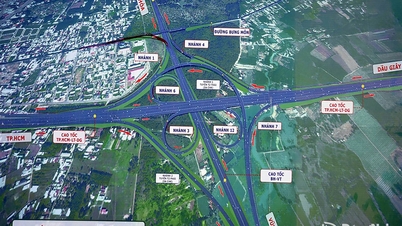
![[Image] Close-up view of the interchange connecting the two expressways and Long Thanh Airport.](https://vphoto.vietnam.vn/thumb/1200x675/vietnam/resource/IMAGE/2026/05/25/1779703378210_ndo_br_z7863716673926-224453a31600126cce10622af6290afd-4549-jpg.webp)






































































Comment (0)