


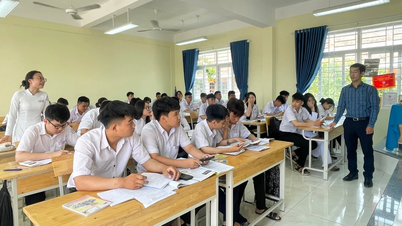
Van Du Primary School in Chi Dam commune is promoting digital transformation and applying information technology in teaching and learning, contributing to improving the overall quality of education .
Following the merger, Phu Tho province's education and training sector has achieved significant accomplishments in all three aspects: scale, quality, and effectiveness. Mechanisms and policies for educational development have been prioritized; the school network has been strengthened and expanded; infrastructure and teaching and learning equipment have received investment and are being gradually modernized; and the teaching staff and educational management personnel basically meet the requirements in terms of quantity and quality and are standardized. The plan aims to develop Phu Tho's education and training in a comprehensive, high-quality, effective, and sustainable manner; ensuring equity in access to education, in line with the local socio -economic development conditions. The province focuses on planning and streamlining the educational institution network for efficiency; improving the quality of teachers and management staff; promoting digital transformation, applying science and technology, and enhancing foreign language proficiency; using the actual quality of education and the learning outcomes of students as the main evaluation criteria. By 2030, the quality of mass and advanced education in the province will be among the leading localities nationwide; affirming its role as a center of education and training in the Northern Midlands and mountainous region; and with a vision to 2045, the quality of education and training will approach the advanced level of the region and internationally.
The specific targets for preschool education by 2030 include achieving universal education for children aged 3 to 5; ensuring 100% of 5-year-old children attend school; and striving for 99.5% of preschool children to attend two sessions per day. The quality of care, nurturing, and education for children will continue to improve, creating a foundation for their comprehensive development from their early years. The province will also focus on standardizing preschool teachers, developing non-public preschools rationally, and increasing the percentage of schools meeting national standards. At the general education level, the plan emphasizes improving the quality of comprehensive education, ensuring students develop harmoniously in knowledge, skills, and character. The province aims to maintain a high rate of students attending school at the appropriate age; 100% of primary school students will attend two sessions per day; the high school graduation rate will reach 99.8%; and students will win national, regional, and international awards. One of the highlights of the Project is the strategy for developing foreign languages and digital transformation in schools. Phu Tho aims to gradually make English the second language in schools; 100% of secondary school students will learn English according to the prescribed curriculum; and 55 bilingual schools will be established at all levels. Simultaneously, all management staff, teachers, and employees in the education sector will receive training in digital skills and the application of artificial intelligence in teaching and management. The province also pays special attention to developing specialized high schools: Vinh Phuc, Hung Vuong, and Hoang Van Thu into key high-quality schools of the province and the country, aiming to meet advanced regional standards and approach international standards; serving as centers for scientific research, innovation, and nurturing gifted and talented students. The project also focuses on developing high-quality general education institutions in areas with suitable conditions. Each key economic zone has at least one high-quality general education institution with synchronized infrastructure and modern equipment. The network of higher education and vocational education institutions is rationally organized and receives increased investment for upgrading; striving for 100% of higher education institutions and at least 80% of vocational education institutions managed by the province to meet national standards, and 20% to be equipped with modern facilities comparable to developed countries in Asia. The employment rate for graduates is over 90%, and 50% of those of post-secondary education age are pursuing higher education. The percentage of workers with college degrees or higher reaches 24%; the percentage of those studying basic sciences, engineering, and technology reaches at least 35%. Higher education institutions are elevated to truly become centers of research, innovation, and entrepreneurship for the nation and the regions. Ensure 100% of teachers meet the training standards according to the Vocational Education Law, with at least 40% of lecturers holding a master's degree or higher; the percentage of university lecturers with doctoral degrees reaches at least 35%, with a minimum of 10 associate professors; at least 90% of students find employment after graduation. Establish three key vocational education institutions in the Vinh Phuc, Phu Tho, and Hoa Binh (formerly) regions, including at least one vocational college meeting the criteria of a national key vocational college. Strive to establish a university zone/village integrated with urban areas in the Vinh Yen region according to the plan, attracting reputable higher education institutions and businesses to invest.
By 2035, Phu Tho province aims for 100% of teachers to meet standards, with at least 95% of preschool teachers exceeding standards and at least 40% of general education teachers exceeding standards; 100% of public schools to meet national standards, with over 40% reaching level 2; over 99.5% of preschool children attending two sessions per day; at least 95% of students after lower secondary school continuing on to upper secondary school or equivalent; at least 65% of upper secondary school graduates entering university; 100% of vocational education institutions achieving quality accreditation and establishing business partnerships; and the completion of universal upper secondary education and equivalent.
By 2045, the province's education and training system will be modern, equitable, and high-quality, approaching the advanced levels of the region and internationally, and ranking among the leading localities nationwide. The education index will contribute to the Human Development Index (HDI) at over 0.9. The province will have 3 specialized schools approaching international standards; 30% of general education schools will achieve advanced standards in the Asian region; 100% of public vocational education institutions will meet national standards; and English will be widely used as a second language. All citizens will have opportunities for lifelong learning, improving their skills and maximizing their personal potential; high-quality human resources and scientific and technological talents will become the driving force and competitive advantage of the province.
To realize the above objectives, Phu Tho province has proposed many synchronized solutions such as: strengthening the Party's leadership role in education; reforming specific mechanisms and policies; breakthroughs in the network of educational institutions, infrastructure, and mobilizing social resources; improving the quality of the teaching staff; promoting digital transformation and international integration; and strongly developing vocational and higher education. The project not only contributes to concretizing the Central Committee's resolutions on fundamental and comprehensive reform of education and training, but also creates a foundation for improving the quality of human resources, promoting socio-economic development, reducing regional disparities, and ensuring learning opportunities for all citizens.
With strong political determination and comprehensive solutions, Phu Tho expects to create a strong breakthrough in the development of education and training, building a high-quality workforce to meet the requirements of rapid and sustainable development in the new era.
Hanh Thuy
Source: https://baophutho.vn/tao-nbsp-dot-pha-phat-trien-nbsp-giao-nbsp-duc-va-nbsp-dao-nbsp-tao-255397.htm
![[Photo] First session of the 14th Congress of the Vietnam Trade Union](https://vphoto.vietnam.vn/thumb/1200x675/vietnam/resource/IMAGE/2026/06/03/1780465947883_ndo_br_img-3852-jpg.webp)




















![[Photo] Delegation attending the 14th Congress of the Vietnam Trade Union visits the Mausoleum of President Ho Chi Minh.](https://vphoto.vietnam.vn/thumb/1200x675/vietnam/resource/IMAGE/2026/06/03/1780451842301_ndo_br_img-3824-jpg.webp)





















































Comment (0)