

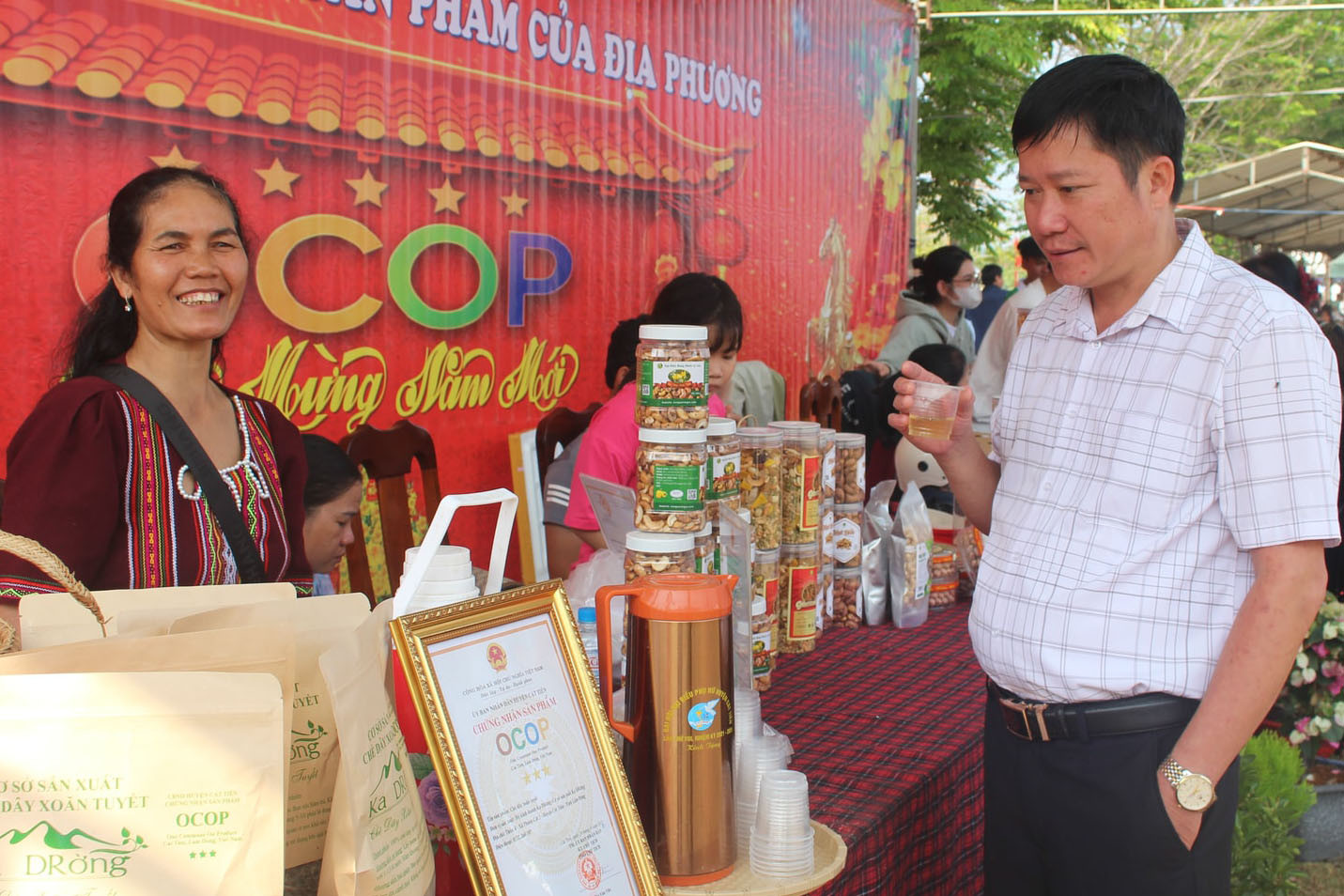
Traditional medicinal herbs of the Ma ethnic group become OCOP products.
Since childhood, Ka Drờng (born in 1973) has been given a drink made from the stems and leaves of climbing plants growing naturally in the forest by her parents; in the intense dry season sun of the Cat Tien basin, a bowl of this drink would quench her thirst and fatigue, leaving a sweet aftertaste.
For about the last five years, during her leisure time between farming seasons, she would go into the forest to harvest the leaves, dry them, and then sell them to people in her village, commune, and surrounding area. The small packets of tea were well-received because of their easy-to-drink, refreshing taste; the more you drink, the more you appreciate the subtle sweetness. As demand increased, she maintained a regular harvesting schedule, selecting only green vines with curled leaves that shimmer like snow. The name "snow-curled vine tea" also originates from this characteristic, as even after drying, it retains its light sheen.
Besides selling Gynostemma pentaphyllum tea, she also combines it with other forest products such as betel leaves, rattan shoots, sour tamarind, etc. She sells whatever is available depending on the season, but Gynostemma pentaphyllum tea remains the most sought-after item. In 2023, the Gynostemma pentaphyllum tea from Ka Drờng production facility was certified as a 3-star OCOP product, marking a shift from small-scale trading to production with clear labeling, name, and address.
Gynostemma pentaphyllum is a climbing plant that grows abundantly in the buffer zones of Cat Tien, Bu Dang, and Bu Dop forests (Binh Phuoc province, now Dong Nai province), often clinging to large trees. The Ma people in the region consider it a valuable folk medicine with effects such as cooling the body, detoxifying the liver, promoting urination, reducing blood fat, supporting sedation, and improving sleep. Thanks to its naturally sweet aftertaste, the tea is easy to drink even without adding any other ingredients.
To ensure a consistent supply, she buys fresh tea leaves from villagers who gather them from the forest, and processes them on the same day. The leaves are removed to remove any damaged ones, washed thoroughly, cut into small pieces, and then dried directly under the Cat Tien sun to preserve their natural flavor. The sun-dried tea has a silvery-brown color, and when brewed, it produces a clear, green liquid with a delicate aroma.
Bringing mountain and forest products to consumers.
Currently, the product is packaged in 500g portions, retailing at 100,000 VND, and can be used for about 6 months if stored in a dry place. Vine tea has helped stabilize the family's finances and also provided additional income for several other households involved in forest work. Since the product received OCOP certification, the number of customers has increased significantly. Through phone calls, the customer base is expanding daily, with many orders being shipped to Dong Nai, Ho Chi Minh City, Quang Ngai, and other northern provinces.
Mr. Nguyen Van Thuc, Secretary of the Party Committee and Chairman of the People's Council of Cat Tien 2 commune, commented that the Ka Drong snow-curled tea production facility contributes to enriching local products. Previously, the tea was only cut into small pieces and dried by people for family use. When standardized as an OCOP product, the value of the goods increased, and at the same time, it opened up a direction for development linked to rural tourism .
Cat Tien 2 commune is located near destinations such as the Cat Tien Archaeological Site, the Zone 6 Revolutionary Base, and Cat Tien National Park. Tourists come here not only to visit and learn about the history and ecosystem, but also to sample local specialties. Among them, the snow-curled vine tea is a choice that offers an experiential glimpse into the Ma people's traditional use of medicinal plants.
However, the complete exploitation of natural forests has resulted in an unstable supply of raw materials. Increased demand has led to many people entering the forests to harvest, causing the trees to become increasingly scarce. Local authorities have encouraged people to harvest selectively, avoiding cutting down trees at the roots or indiscriminate harvesting. Preserving the trees in the forest is also about preserving long-term livelihoods.
From a traditional family drink of the Ma people, snow vine tea has entered the market as a 3-star OCOP product. This shows that a folk medicinal herb can become a valuable commodity when properly preserved, processed, and infused with the dedication of its producers.
Source: https://baolamdong.vn/tao-san-pham-ocop-tu-cay-duoc-lieu-che-day-rung-427444.html






























![[Photo] Reception to welcome General Secretary and President To Lam and his wife on their State visit to the Philippines](https://vphoto.vietnam.vn/thumb/1200x675/vietnam/resource/IMAGE/2026/06/01/1780295488620_vna-potal-chieu-dai-chao-mung-tong-bi-thu-chu-tich-nuoc-to-lam-va-phu-nhan-tham-cap-nha-nuoc-toi-philippines-8798060-7855-jpg.webp)

































































Comment (0)