

Recently, foggy weather at night and in the early morning, along with high humidity, has created favorable conditions for the widespread outbreak of pests and diseases, especially rice blast disease. In response to this situation, the agricultural sector and local authorities are intensifying efforts to advise farmers on applying effective rice cultivation techniques and controlling rice blast disease.

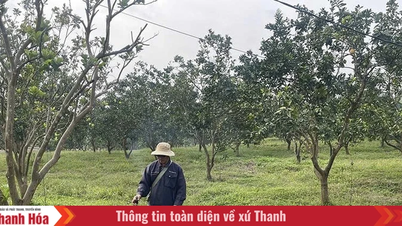
Farmers in Hai Lang district spray pesticides to control rice blast disease - Photo: LA
This year, Hai Lang district planted nearly 6,900 hectares of rice during the winter-spring season. Currently, the rice plants are in the tillering and heading stages. Since the Lunar New Year, the weather has been favorable for rice growth but also conducive to the development of certain pests and diseases. In particular, the cloudy and foggy conditions have created very favorable conditions for the severe development of rice blast disease.
Mr. Nguyen Nhu Bay, residing in Hamlet 4, Dien Sanh town, has 2 acres of rice planted with the BDR57 variety, currently in the heading stage. After discovering some patches of rice with leaf blight caused by blast disease, Mr. Bay purchased pesticides to spray the entire area according to the instructions of the technical staff. According to Mr. Bay, blast disease spreads very quickly, and if not treated promptly, it will lead to leaf blight. Furthermore, since the rice plants are currently heading, if the panicle blast is allowed to develop, the harvest yield will be significantly reduced. "Although it's only a small area affected, I have to spray immediately because if I don't spray and it rains, the disease will spread even more," Mr. Bay said.
According to Thai Thi Kim Tuyen, head of the Crop Production and Plant Protection Station of Hai Lang district, field inspections across the district have revealed nearly 400 hectares of rice infected with blast disease, with an average infection rate of 5-10%, reaching 30-50% in some areas, and even 50-70% in some fields. This is concentrated on rice varieties such as BDR57, HG244, HC95, and Du Huong 8, among others; particularly in fields with unbalanced fertilization, including excessive nitrogen application. Notably, this year the blast disease has severely affected the BDR57 rice variety, which is one of the district's main rice varieties, with over 1,300 hectares planted.
According to Ms. Tuyen, as soon as rice blast disease broke out and caused damage, the Plant Protection and Quarantine Station sent staff directly to the localities to organize propaganda and guidance on care and control measures. With these proactive measures, along with the initiative of farmers, rice blast disease in the district is now basically stable.
However, with the forecast indicating continued cold air and humid rain in the coming period, favorable conditions will continue for the development of rice blast disease, with a high risk of developing neck blast disease on susceptible varieties and in susceptible areas. In addition, small leaf-rolling caterpillars are appearing at an average density of 4-5 caterpillars/m2, and a new generation is predicted to damage rice during the heading stage in mid-March.
"Therefore, we advise farmers to absolutely not be complacent, to regularly inspect their fields, and closely monitor the pest and disease situation in order to take timely preventive measures according to the guidance of specialized agencies, in order to avoid losses at the end of the season," Ms. Tuyen emphasized.
This year, the entire province planted 25,600 hectares of rice during the winter-spring season. Currently, the rice plants are in the tillering and heading stage; the early rice varieties have already formed panicles, and the plants are developing well. However, the recent weather, with fog at night and in the early morning, and high humidity, has created favorable conditions for the widespread outbreak of pests and diseases, especially rice blast disease.
According to statistics from the Sub-Department of Plant Protection and Quarantine, more than 610 hectares of rice fields in the province are infected with rice blast disease, appearing in almost all rice-growing areas in the province.
Specifically, Hai Lang district has 395 hectares affected, Gio Linh 145 hectares, Vinh Linh 25 hectares... The disease prevalence rate ranges from 10-20%, with localized areas reaching over 40%. The disease mainly affects rice varieties such as BDR57, Bac Thom No. 7, HC95, IR38..., causing severe damage in densely sown fields and those with excessive nitrogen fertilization.
According to Bui Phuoc Trang, Head of the Plant Protection and Quarantine Sub-Department, the forecast for the coming period indicates continued cloudy weather, drizzle, high humidity, and fog in the evenings and early mornings. Combined with the current healthy rice growth, this will create very favorable conditions for rice blast disease to continue to develop, spread widely, cause severe damage, and burn on susceptible varieties and in fields with unbalanced fertilization, such as those with excess nitrogen, if not controlled promptly and thoroughly.
Therefore, to effectively control and prevent the spread of rice blast disease, farmers need to intensify inspections for rice blast on all varieties, especially susceptible varieties such as BDR57, IR38, Bac Thom No. 7, HC95...; on densely sown fields, fields with unbalanced fertilization, and promptly spray pesticides when the disease rate reaches approximately 5%.
In severely affected areas, a second spraying should be done 5-7 days after the first. Increase the water level and stop applying all fertilizers. After spraying, once the disease stops developing, then apply fertilizer to promote panicle development or supplement with foliar fertilizer. Spray to prevent rice blast disease 5-7 days before the rice heads, especially in areas already infected with leaf blast, outbreak areas, fields with excessive nitrogen fertilization, and areas where susceptible varieties such as BDR 57, IR38, VN10, Bac Thom 7, HC95... are used.
"We have also strengthened the deployment of technical staff to work closely with the grassroots, regularly visiting fields to inspect, detect, accurately predict and forecast pests and diseases, and guide farmers on timely and effective pest and disease control measures, especially for rice diseases," Mr. Trang added.
Le An
Source

























![[Photo] Reception to welcome General Secretary and President To Lam and his wife on their State visit to the Philippines](https://vphoto.vietnam.vn/thumb/1200x675/vietnam/resource/IMAGE/2026/06/01/1780295488620_vna-potal-chieu-dai-chao-mung-tong-bi-thu-chu-tich-nuoc-to-lam-va-phu-nhan-tham-cap-nha-nuoc-toi-philippines-8798060-7855-jpg.webp)


































































Comment (0)