

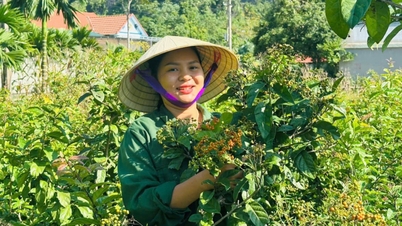
The green of my homeland (Photo: Do Anh Tuan). |
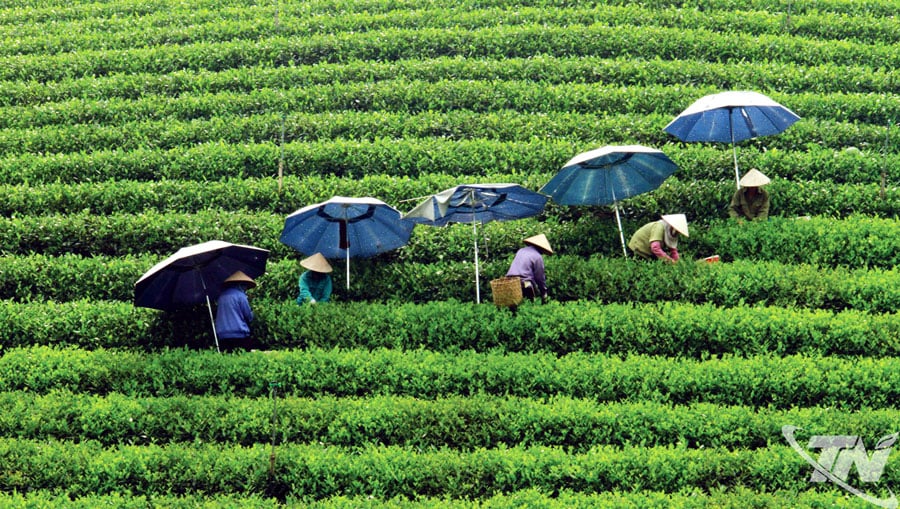
And indeed, the impression of Thai Nguyen remained vivid in my mind, especially since this time I was traveling with a group of tea connoisseurs. The host was, of course, a tea expert, but the dozen or so other guests accompanying me also spoke fluently about tea while traveling from Hanoi to Thai Nguyen.
Among them, I admire journalist Vinh Quyen the most. This journalist, formerly the Deputy Director General of the National Assembly Television, is famous for preparing (or rather, recreating) delicious Hanoi dishes, both for eating and drinking. Her specialty in drinks is lotus seed sweet soup. Once, a friend asked her to send me nearly a hundred lotus seeds for sweet soup, almost forcing me to buy an extra refrigerator to store them. After a while, I thought of a solution, though it was a bit painful: I gave some away to friends.
Ah! The part about giving and receiving gifts from friends is quite complicated. I live in Pleiku, the land of coffee. Most of my friends there, when friends from other places visit and they want to give them a small gift, the simplest thing to do is... coffee. Sending gifts back home is the same. And conversely, anyone from the North visiting or sending gifts mainly brings tea.
I'm different, because I know that not everyone can drink or enjoy tea or coffee. You have to ask them, just out of politeness, if they want coffee, then offer it to them; if not, offer something else. I've seen my friend's house full of... moldy tea. He doesn't drink it, but he often receives it as a gift. And tea that's left for too long gets moldy, at least it loses its aroma. So you have to know the customs of enjoying different regions. In the North, it's tea, of course; in the South, it's coffee, very simple, except for... exceptional cases, which of course are becoming much less common now...
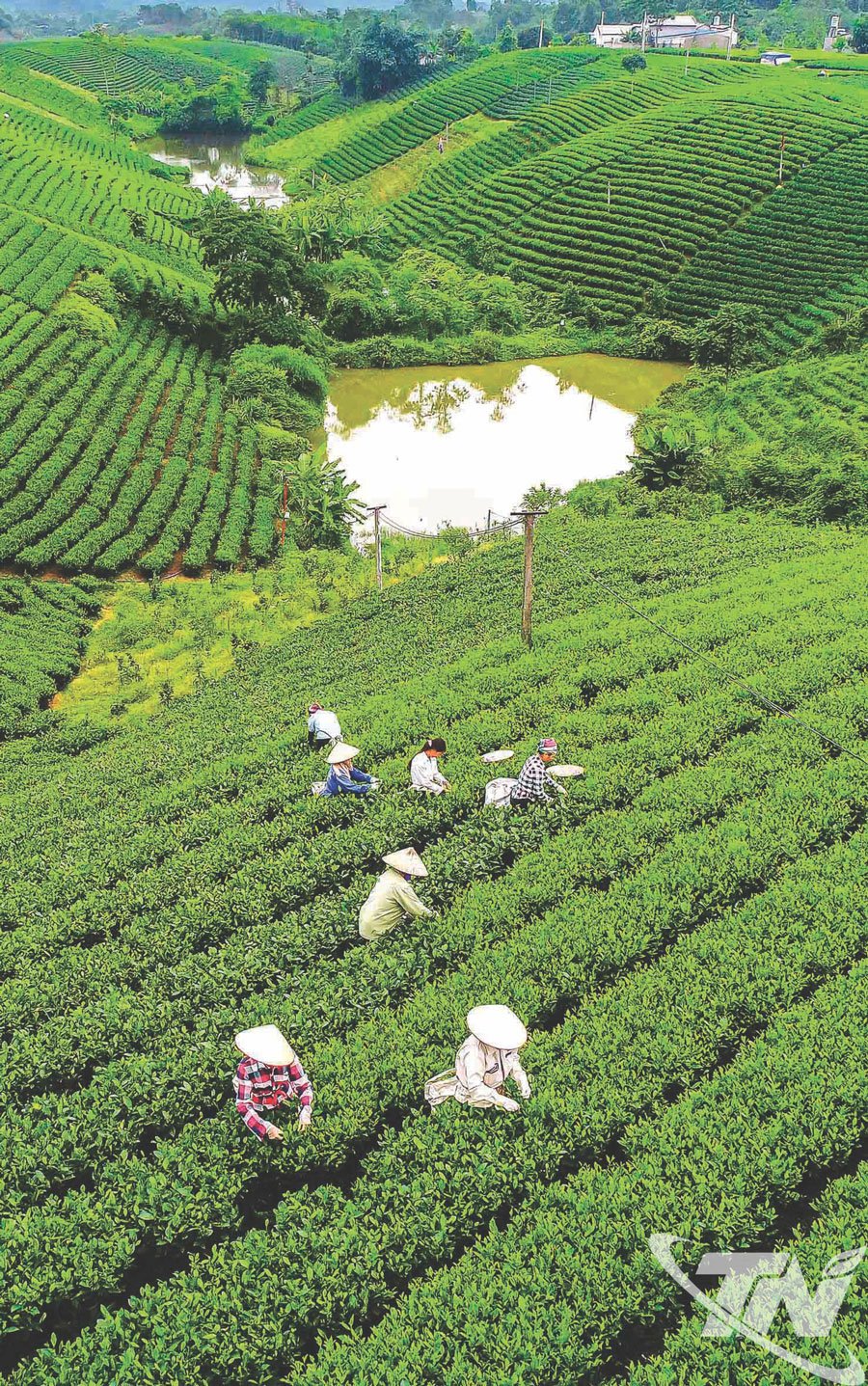
As for Ms. Vinh Quyen, on her very first morning "stumbling" into the world of tea, she exclaimed in admiration: "I've made a lot of lotus-infused tea before, but this is the first time I've witnessed tea so abundant, beautiful, and boundless. And it's also the first time I've truly understood the names of the 'four great famous teas of Thai Nguyen': Tan Cuong, La Bang, Trai Cai, and Khe Coc."
Let's savor some tea again. The North does differentiate, but not as strictly as the South, although the quality of tea in the South is far inferior to that of the North. I was born and lived in Thanh Hoa throughout the war, trudging along with my parents' workplace during evacuations, mostly staying with villagers in the villages along the major rivers Ma and Chu..., where there was plenty of green tea. My mother had a standard packet of tea for guests, the kind that cost three hào a packet, and most of it was moldy by the time it reached the drinker. My mother's colleagues called it "nine hào three" tea, which sounds like nine hào a packet, but it really was nine hào three a packet. My mother didn't drink it, and she didn't have any guests to entertain—no guest would cycle a hundred kilometers to the constantly moving evacuation location of her workplace, and there were no means of communication like today. So my mother gave that tea to her colleagues; they cherished it, only brewing it occasionally, mostly drinking fresh tea. Just to remember, they always called it tea, both green tea and dried tea, which means processed tea.
Hoang Nong tea (Photo: Ngoc Hai). |
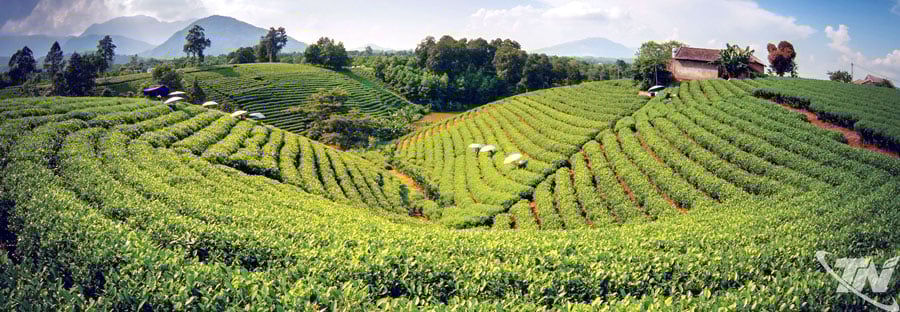
In the South, there's a clear distinction: tea and tea. And the thing I've been living amidst, the one that's been infused with its fragrance, the one that always carries that scent of roasted rice, is tea. And those lush green hills, even though they undulate into those valleys, still stretching as far as the eye can see, are tea plantations.
And it turns out that it's only here that things become clear: that Thai Nguyen tea, it was transplanted from Phu Tho. I remember last year, Minister Le Minh Hoan, now Vice Chairman of the National Assembly, invited me and some writers to visit Thai Binh (rice) and Bac Giang (lychee). That's how I learned more about how the lychee tree, now a famous specialty of Luc Ngan, Bac Giang, was actually brought from Hai Duong, from the equally famous Thanh Ha region. But now, when people mention lychee, they think of Bac Giang. The same goes for Thai tea. It came from Phu Tho and became famous here, becoming a saying passed down orally and now spread through all media: Thai tea, Tuyen Quang girls. Regarding Tuyen Quang, the talented writer Hoang Phu Ngoc Tuong, one of the best essayists in Vietnam, wrote a masterpiece titled "Land of Beautiful Girls," to the point that now, anyone who mentions Tuyen Quang always includes "land of beautiful girls," even though Tuyen Quang is only two words long. Adding "land of beautiful girls" makes it five words, and if you leave out Tuyen Quang and just say "land of beautiful girls," everyone still knows it's still three words. In this era of frugality, where even place names in our country are almost always numbered, this is a unique and special tribute... to the region.
Thai tea is now a brand, not just domestically. Two years ago, when I went to Taiwan, some senior writers (living in Hanoi, meaning tea addicts) instructed me from afar, from home: Try Taiwanese Oolong tea, then buy some to take home. I replied, "Are you guys going to try it?" They said, "No, we're used to drinking Thai tea." Then they said, "Oh, so am I."
I also live in a tea-growing region. When the country was still divided, the South had two famous tea-growing areas: one was Bao Loc (Lam Dong province), known for its B'lao tea, and the other was Gia Lai province, with two famous brands: Bau Can tea and Bien Ho tea. B'lao tea was extremely famous. I remember, right after reunification, in early 1976, when I returned to my hometown in Hue, all my relatives had B'lao tea plants to welcome my three children. At that time, nobody drank tea. But they insisted on having B'lao tea to welcome my uncle from the North.
These tea-growing regions were all discovered and cultivated by the French. In 1981, after graduating from university and taking up a job in Gia Lai, Bau Can tea was still distributed according to food ration coupons. There were several grades, 1, 2, 3, and so on.
But later, when trade resumed, after the days when even carrying a few ounces of Thai tea required permits and inspections, goods circulated freely, Thai Nguyen tea flooded the South, and tea brands like B'lao, Bau Can, and Bien Ho gradually disappeared.
I still vividly remember that afternoon nearly twenty years ago in Saigon. An older writer from Hanoi arrived, and the first thing he said upon checking into his room was: "Oh no!" I was surprised: "What's wrong?" "I forgot to bring... tea." "There are tea bags in the room, and I also brought some Bau Can tea." "No, I only want Thai Nguyen tea, and only that kind. Let's go buy some. I have the address of a distributor here."
I also want to mention this detail: many places display signs selling "Thai tea," but whether it's actually Thai tea is another matter. Most recently, while we were in Thai Nguyen, the Thai Nguyen police cracked a case involving fake Thai Nguyen tea. A husband and wife were found to have counterfeited 9.2 tons of Thai tea, but it's not certain that it was... genuine.

































































Comment (0)