

08:35, 28/05/2023
The Ba Bai base (the local name for the Can Tho Provincial Party Committee base during the resistance war against the US) is currently located in Phuong Quoi hamlet, Phuong Binh commune, Phung Hiep district, Hau Giang province. This was the place where the leadership directed the political and armed struggle activities of the people and army of Can Tho before the complete liberation of South Vietnam, from 1972 to 1975.
Today, to visit the Can Tho Provincial Party Committee Base historical site, tourists follow National Highway 61 towards Vi Thanh (Hau Giang), passing through Cai Tac town for about 20 km, then at the Cau Mong intersection turn onto Provincial Road 927 for about 8 km to reach the site. What was once a fierce battlefield, with abandoned fields and gardens, and constant artillery bombardment, is now a lush green area with vast sugarcane fields; the road leading to the base is paved, wide, and lined with tall eucalyptus trees providing cool shade.
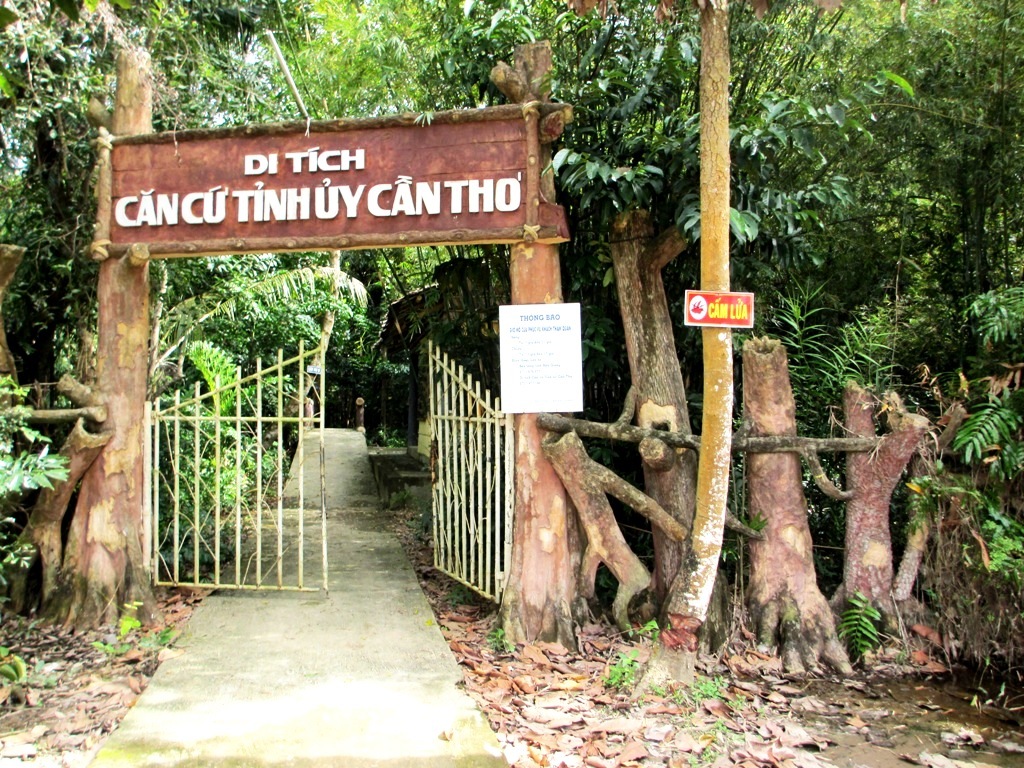 |
| Entrance to the Can Tho Provincial Party Committee Base Historical Site. |
The Can Tho Provincial Party Committee's base was built on the land of "Mrs. Bai" - a landlord during the French colonial period. The entire base was constructed on a garden area of more than 6 hectares, surrounded by canals that acted as natural trenches: Xang Canal, Lai Hieu Canal, Ca Cuong Canal, Cu Canal, and Ba Bai Canal.
This base was where the Can Tho Party Committee commanded the armed forces' offensive against Can Tho, Vi Thanh, and other key targets during the Spring 1975 General Offensive and Uprising to liberate the South and unify the country.
This area was once heavily attacked by the enemy, especially after the signing of the 1973 Paris Agreement. The enemy launched numerous large-scale sweep operations with various units (9th, 21st, and 7th Divisions, special forces, armored units, and local troops from Phong Dinh, Chuong Thien, Soc Trang, and Bac Lieu provinces) from multiple directions, supported by 105mm and 155mm artillery batteries stationed in Long My, Cai Tac, and Phung Hiep, along with hundreds of bombing raids by enemy fighter planes. The most intense fighting occurred in June 1973, when the enemy mobilized 75 battalions in the Phung Hiep - Long My battlefield. In the Lai Hieu area of Phuong Binh commune alone, dozens of battalions were concentrated for a fierce sweep, aiming to dislodge the Can Tho Provincial Party Committee from the area. But the Can Tho Provincial Party Committee remained steadfast in its base, continuing to lead the local army and people in defeating and breaking many enemy sweeps, encroachments, and forced withdrawals, destroying many enemy units and outposts, destroying and confiscating much military equipment and supplies, and regaining and expanding the liberated zone. All the enemy's efforts proved futile and resulted in disastrous defeats. They were forced to retreat, regroup, and passively defend until the day they surrendered to the revolution (April 30, 1975).
 |
| A monument commemorating the founding of the Tay Do Battalion. |
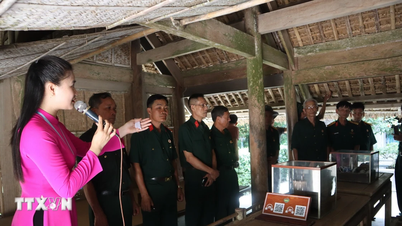
The Can Tho Provincial Party Committee Base historical site has been restored and many items have been recreated. The meeting hall is a rectangular building with a thatched roof, approximately 150 square meters in size, where important conferences of the Can Tho Provincial Party Committee took place. The building was constructed from materials readily available at the base such as melaleuca, betel nut, coconut, bamboo, cassava, and water hyacinth leaves. In addition, the base still contains many huts and bunkers of subordinate agencies and departments such as: Propaganda, Cryptography, Radio, Civil Affairs, Military Medical, Civilian Medical, and some youth and women's organizations, the Party School... However, these huts and remnants are no longer in their original form due to the unstable construction materials, which quickly deteriorate over time and due to weather conditions. The exhibition house still displays quite a few artifacts and memorabilia from the base such as typewriters, transistor radios, household items, and weapons of the units...
In Phuong Binh commune, besides the Can Tho Provincial Party Committee Base historical site, visitors can also visit the historical and cultural site of the founding of the Tay Do Battalion, with a commemorative monument vividly and powerfully depicting the image of a mother bidding farewell to her son, a liberation army soldier, as he goes off to fight. The Tay Do Battalion, with its oath "Going out means victory, fighting means annihilation," is a unit that has twice been awarded the prestigious title of Hero of the People's Armed Forces by the Party and the State.
Hoang Tham
Source link
![[Photo] General Secretary and President To Lam presides over the meeting to approve the draft report on the results of the second inspection by the Politburo of the Standing Committee of the Hanoi City Party Committee.](https://vphoto.vietnam.vn/thumb/1200x675/vietnam/resource/IMAGE/2026/05/26/1779789811432_a2-bnd-4430-9620-jpg.webp)






















































Comment (0)