

A U.S. federal judge has blocked billionaire Elon Musk and the Department of Government Effectiveness (DOGE) from proceeding with the closure of the U.S. Agency for International Development (USAID), saying the action could be unconstitutional.
In a preliminary ruling issued on March 18, U.S. federal judge Theodore Chuang in Maryland ordered Elon Musk, a key adviser to President Donald Trump, and the agency he leads to restore access to USAID's computer systems for agency employees and contract workers, including thousands who had been furloughed, according to Reuters.
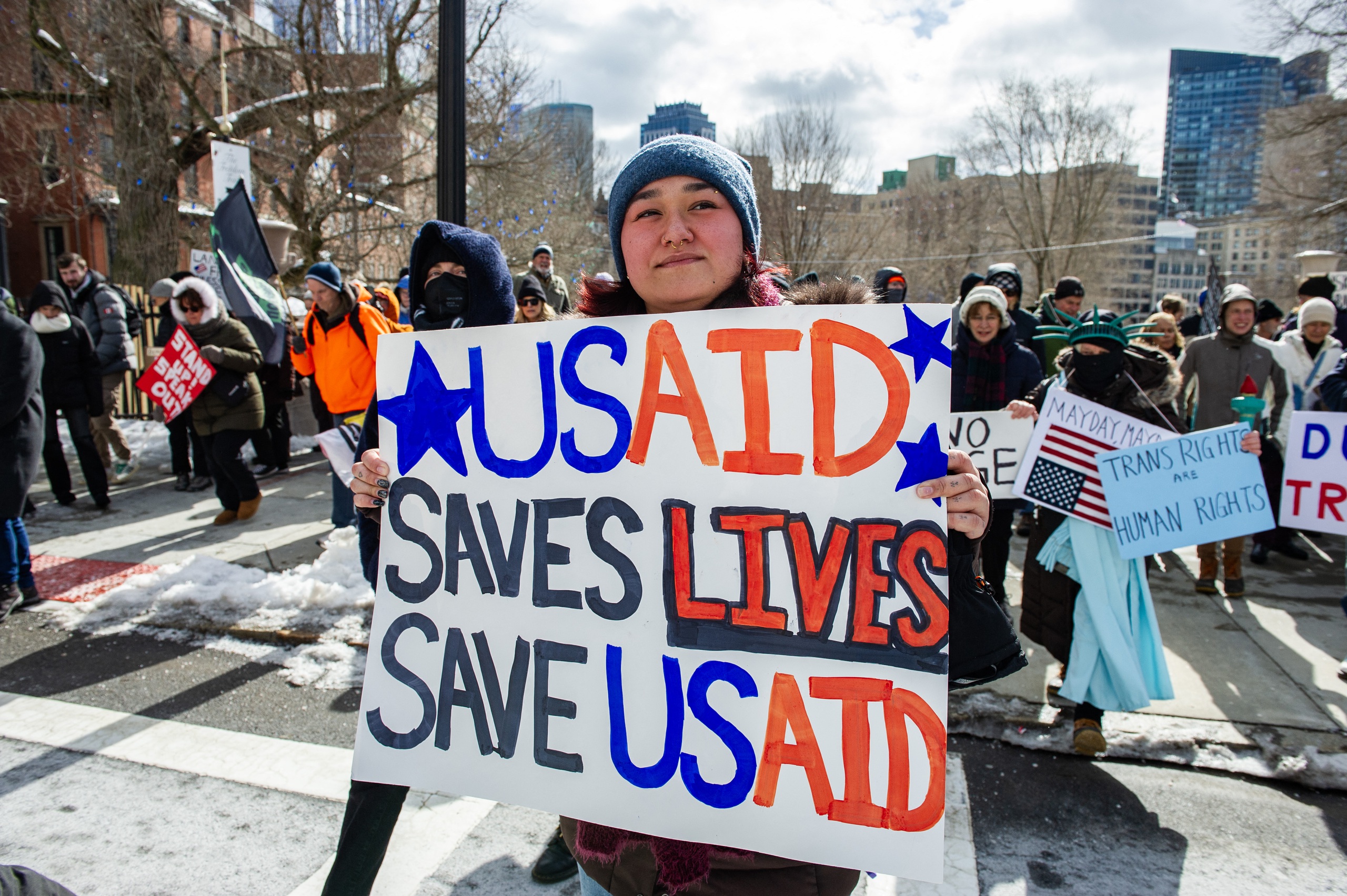
A protester in support of USAID in Boston in February.
This decision comes after a lawsuit filed by current and former USAID employees, one of several pending lawsuits related to the rapid closure of the leading U.S. humanitarian aid agency.
"Today's decision is a major victory against Elon Musk and his DOGE attack on USAID, the U.S. government, and the Constitution," said Norm Eisen, executive chairman of the State Defense Democracy Foundation, a lawyer representing 26 anonymous plaintiffs in the lawsuit.
President Trump told Fox News that his administration would appeal the ruling. "I assure you we will appeal. We have rebellious judges who are destroying our country," Trump said.
On his first day back in the White House, President Trump ordered a 90-day freeze on all U.S. foreign aid and a review of whether aid programs were consistent with his administration's policy.
Shortly afterward, Musk and DOGE gained access to USAID's payment and email systems, freezing numerous agency payments and notifying most employees that they would be furloughed. On February 3rd, Musk wrote on social media that he had "spent the weekend putting USAID into a wood chipper."
In the lawsuit filed on February 13, the plaintiffs alleged that Musk seized control of USAID and effectively acted as a U.S. official, violating the constitutional requirement that such officials must be nominated by the president and confirmed by the Senate.
They argue that Musk and DOGE have overstepped the executive branch's authority, undermining an agency established by Congress in 1961. Last week, U.S. Secretary of State Marco Rubio announced that 83% of USAID programs had been canceled.
Judge Chuang agreed that Musk and DOGE "may have violated the U.S. Constitution in multiple ways, and these actions have harmed not only the plaintiffs but also the public interest."
Musk and DOGE argued in court filings that Musk's role was merely that of an advisor to President Trump, and that USAID officials, not DOGE, were responsible for the actions the plaintiffs complained about. Judge Chuang concluded that Musk and DOGE effectively controlled the agency.
In addition to demanding the restoration of computer access for employees, Mr. Chuang also prohibited the defendant from disclosing any sensitive employee information.
Mr. Chuang did not prohibit the mass dismissals of USAID contract employees and staff. He argued that while these dismissals may have violated the constitution, they were approved by government officials who were not named in the lawsuit.
Source: https://thanhnien.vn/tham-phan-my-ngan-ti-phu-elon-musk-dong-cua-usaid-185250319085643814.htm

![[Photo] Prime Minister Pham Minh Chinh presides over a meeting on private sector economic development.](/_next/image?url=https%3A%2F%2Fvphoto.vietnam.vn%2Fthumb%2F1200x675%2Fvietnam%2Fresource%2FIMAGE%2F2025%2F12%2F20%2F1766237501876_thiet-ke-chua-co-ten-40-png.webp&w=3840&q=75)

















































































Comment (0)