

In Hau Giang, many traditional dishes from the pioneering days of the countryside are now present in restaurants, showcasing their natural colors, sparkling with the value of delicious and unique delicacies, and reflecting the vibrant spirit of "One Village, One Product (OCOP)...".
One similarity between Italian villages and the places where we live is that they share vivid, timeless stories.
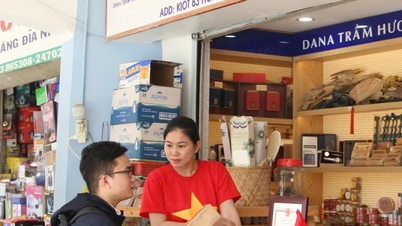
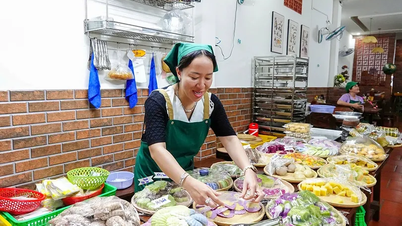
Tien Tho is a restaurant specializing in exquisite folk dishes steeped in customs, traditions, etiquette, and the refined tastes of leisure time... From a treasure trove of traditional cakes, such as the "husband and wife" cakes, the stylized banh tet with mixed fillings and three-colored sticky rice, the sweet cakes with pineapple jam, to the "Nang Hai" snakehead fish sausage... these are proof of the creativity of someone who cherishes the dream of enriching local resources, transforming inspiration into delicious dishes, confident that no matter where they go, customers will eventually turn back to their homeland.
The idea behind establishing a rest stop to welcome tourists and promote a product line featuring 100 savory and sweet dishes that are close to nature, deeply rooted in the Mekong Delta, rustic in character, and refined with culinary artistry... Ms. Vo Thi Tho believes that the delicious folk dishes here will remind diners of the Western Hau River region, help them understand the dedication of those who diligently create these diverse delicacies, making them worthy souvenirs.
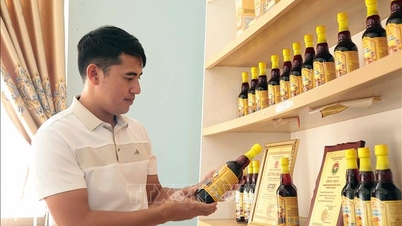
Similarly, Ms. Vo Thi Phuong Trang, co-founder, is promoting the traditional Ut Tay rice wine and UT massage oil brands, reminiscent of the legendary Xa No canal, which opened up the vast rice-growing region west of the Hau River.
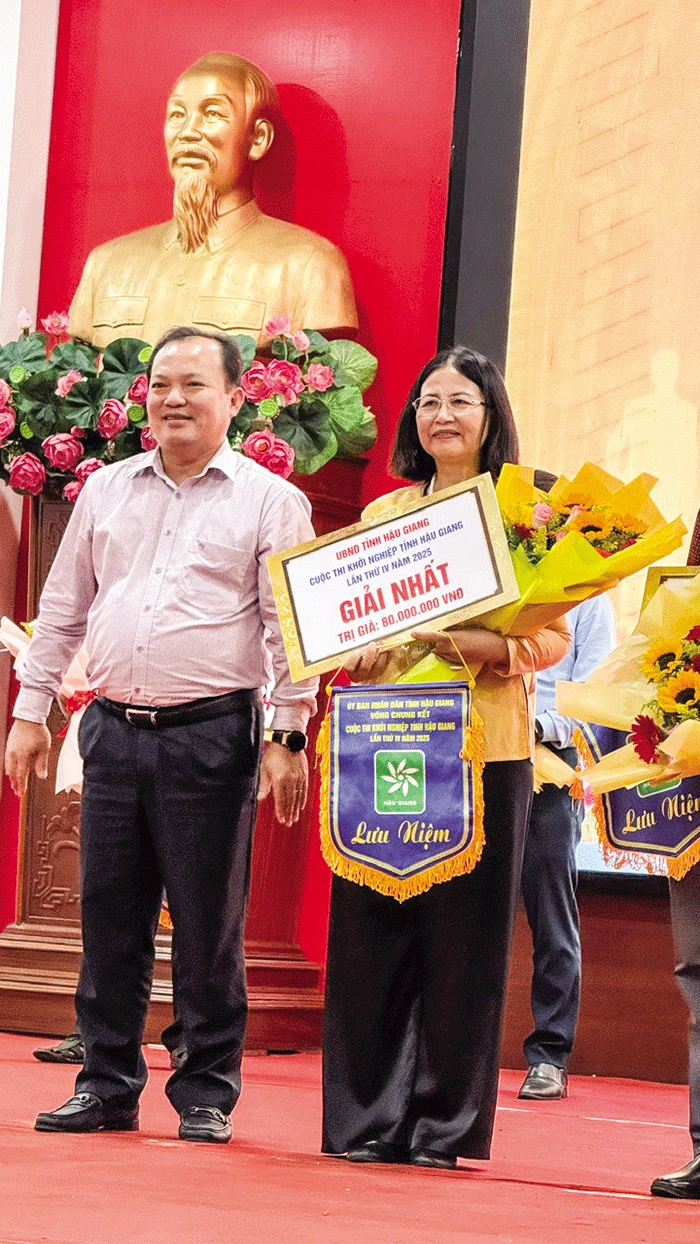
Mr. Nguyen Van Hoa, Standing Vice Chairman of the People's Committee of Hau Giang province (formerly), presented the first prize of the 4th Hau Giang Provincial Startup Competition to Ms. Vo Thi Phuong Trang, owner of Ut Tay Traditional Wine Production Facility.
The 4th Hau Giang Province Startup Competition, characterized by stories of innovative entrepreneurship and the integration of the OCOP program – with the final round on June 18, 2025 – aims to encourage entrepreneurs to strive for sustainable development, starting with self-told stories filled with diverse emotions. Ms. Phuong Trang won first prize with her story of a descendant of pioneers who brewed and processed traditional family remedies into health care products (for bone and joint health) – a way of connecting family heritage with societal needs, enhancing the symbolic image of her community for customers everywhere.
The story of Ut Tay is the journey of a micro-establishment striving to create a brand identity, cherishing joy, filtering out genuine anxieties, interwoven with deep, authentic emotions, and adapting to traditional product lines while innovating to comply with alcohol content regulations. Utilizing broken rice from the rice processing of the Mekong Delta region, Ut Tay (Quang Anh and Phuong Trang) applied techniques to separate harmful substances from alcohol and independently researched and practiced making various types of "intoxicating friendship" liquors. From this, the liquor and the healing formula from their family's traditional martial arts school have resulted in a new product that alleviates pain from injuries and joint problems.
To date, Ut Tay establishment has 7 product lines, including: Wines (various types of tonic wines) and UT herbal massage oils (2 types). Of these, 4 products have achieved the OCOP (One Commune One Product) certification for the Mekong Delta. On January 17, 2025, Ut Tay's Lao Tuu Cordyceps Wine and Snor's Wine received the 5-star OCOP certification at the national level.
Sometimes it's just an urgent order call – "Send quickly…", even if it's just one box, from nearly 200 kilometers away or more, but it's a joy – showing the trust of the customer, showing the meaning of the impetus that helps a micro-business connect with the large flow of goods. From there, products from Hau Giang reach Saigon, the Central Highlands, Hanoi or anywhere else according to orders. "There's still much to be done in shortening geographical distances, connecting tradition and modernity, connecting the past and present, connecting products and the community towards customers at duty-free shops…", Ms. Phuong Trang said about the small but very encouraging "joy of vitality," which spurred the idea of innovating products with spiced wine and "S'Nor specialty" cocktail mixes in the future.
Duong Hien, a girl from Northern Vietnam living in Hau Giang, has demonstrated her determination to enrich the often overlooked value of pineapple peels by approaching the "Happy Queen" Pineapple Tea project. She is enthusiastically realizing her idea of processing pineapple fibers into tea bags and pineapple pulp into jam, leading the story of 2,800 hectares of pineapple plantations in acidic soil. Initially, it was a challenging area for pineapple cultivation, but later, it was about overcoming obstacles and achieving happiness. This multifaceted message will be written by the leaders of the Happy Cooperative.
Students from the Faculty of Rural Development, Can Tho University, listened attentively to messages from Duong Thi Hien at the competition, imagining pineapple tea with honey from Tran Nim (in Hau Giang), combined with Tien Tho's pineapple-filled pastry combo… who knows, perhaps the art of adaptation and combination to enhance the taste will create a simple, light, yet memorable tea party.
Young people made it to the top of the selection process, with 20 entries out of a total of 140 submissions. Truong An, one of two girls in their late teens or early twenties, confidently spoke about her family's eco- tourism resort, featuring seasonal delicacies and utilizing the expanded area of the commune after the administrative merger… Similarly, Ton Phuoc Nguyen returned to Hau Giang to apply IoT and AI technology to cultivate and promote heat-resistant strawberries.
Ideas closely related to the Barringtonia acutangula tree by Bé Em, the hibiscus plant by Hồng Bích, mushroom cultivation by Vân Anh, the surprising mushroom-based pork sausage by Thanh Thủy; raising black snails by Ngọc Hương, raising ducks using biological bedding and methods for clean soil preparation, or growing sprouts linked to a green consumer product chain by Nguyễn Văn Thẳng… A new picture is emerging with symbiotic ideas from local resources connected with technology, leveraging AI and Chat GPT to locate personalized ingredient combinations, building customer data, and traceability – showing many solutions that optimize activities not only to facilitate product trade but also to deeply regenerate the environment, maintain and develop the microbial community…
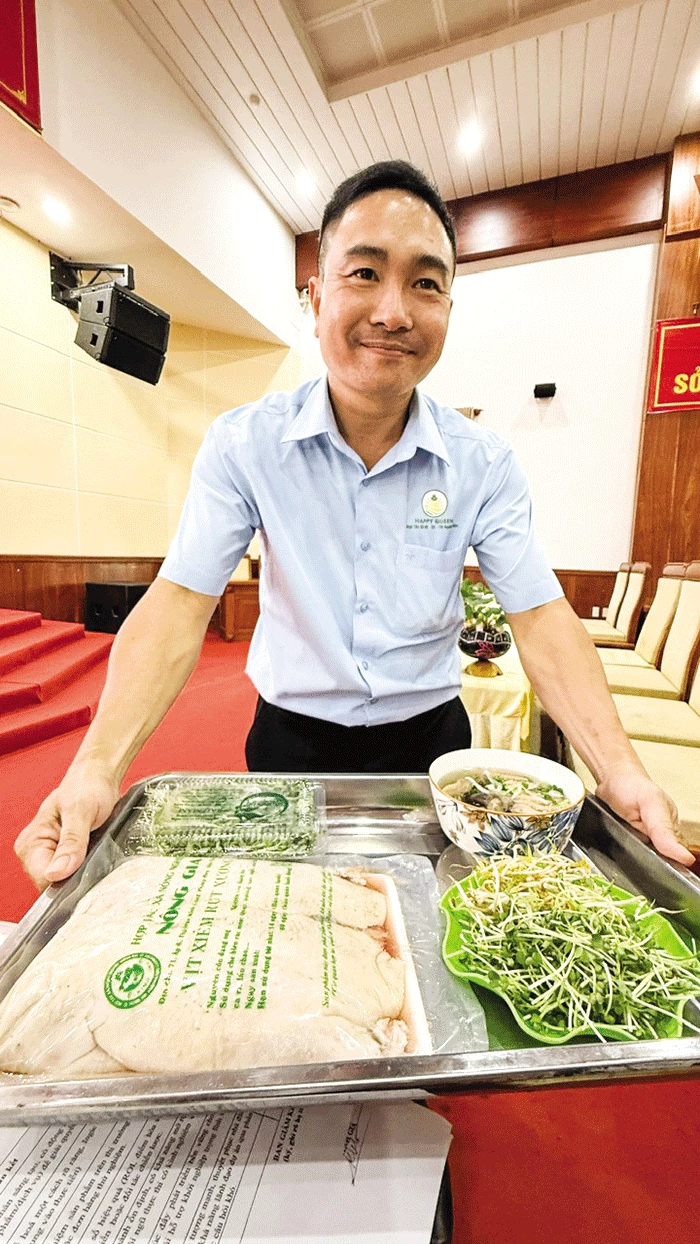
The entry submitted by Mr. Nguyen Van Thang is a realized project (Enhancing the value of Muscovy ducks - raising ducks with biological bedding - combined with sprout production).
One can envision positive signals from clearly articulated, practical, and creative thinking, an entrepreneurial spirit, an awareness of resource regeneration from villages, respect for natural products, a clear desire to create jobs, bring about change, and revitalize the place where they live… Ultimately, the solution to these difficult problems lies in utilization and satisfaction.
These stories may have flaws, limitations in financial calculations, market vision, and rudimentary packaging, but they reveal a consciousness and aspiration—without age boundaries or barriers to creative thinking—to enrich the value of resources, find ways to process them more deeply, and integrate into the fields of food development, food substitutes, and cosmetics.
A new landscape is emerging as educated young people return to their hometowns to start businesses, integrating into the OCOP program alongside older generations who share stories of the past and present. Hopefully, the future will be different.
No one mentions Professor Morihiko Hiramatshu, who initiated and developed the OVOP (One Village One Product) concept in Oita Prefecture in 1979 – which later spread to many other countries. And we are learning from and applying what Professor Morihiko Hiramatshu has done.
Thailand is one of the countries that has successfully embraced the OVOP spirit of Professor Morihiko Hiramatshu by practicing the principles of self-reliance, proactive innovation based on local resources and culture; local action - global thinking; attracting young, well-trained human resources to rural areas to create jobs, improve livelihoods, and increase welfare… In just 15 years, from 2001 to 2015, Thailand developed 208,860 OVOP products and directed this product line towards the global market.
Mr. Vo Minh Luan, a specialist at the Office for Coordinating National Target Programs in Hau Giang province, who persistently supports OCOP (One Commune One Product) entities in participating in capacity-building training courses for market participation, said: To date, Hau Giang province has recognized 363 products. Of these, 110 products are 4-star (accounting for 30.30%); 250 products are 3-star (accounting for 68.87%), and 3 products have achieved 5-star national level (0.83%). There are 164 participating entities, including 24 companies (accounting for 14.63%); 46 cooperatives (accounting for 28.05%); and 94 establishments and business households (accounting for 57.32%).
Hau Giang has extensive experience in coordinating with relevant departments, establishing strategic goals, building a rich and diverse OCOP product structure, and taking focused action to create a transformation in creativity and innovation. Many products still need improvement despite achieving 3-star standards, but the leading products have proactively upgraded, becoming large enough for lavish feasts linked to stories with origins dating back to the pioneering era up to June 2025.
The 20 stories selected for the final round from 140 promising entries also show that the rest need support. There is enormous potential for creative thinking in nurturing and supporting future endeavors, so that before long, many more individuals will join this dynamic and innovative team.
June brought sudden rains… Extreme changes were mentioned in the OCOP stories, concerns arose about humans exploiting nature beyond its self-healing and regenerative capacity… But from this, environmentally friendly solutions emerged, perhaps just small sparks, but Hau Giang has built a team consciously connecting, sharing thoughts, harmoniously linking different values, kindling big dreams from small projects, ready to connect villages in a new space spanning over 6,360 square kilometers, with a population of 4.19 million people.
In rural areas, spreading new ideas and attracting local human resources to create new value is seen as a practical and effective way to inspire and reduce the number of people migrating to cities and leaving their villages behind.
There, the workforce, harboring a desire to further enrich natural resources, preserve cultural identity, and revitalize the rural economy, has more or less learned vital lessons from the past and knows how to move forward.
Text and photos: CHAU LAN
Source: https://baocantho.com.vn/thang-6-dau-an-khong-the-nao-quen-o-hau-giang-a188039.html

![[Photo] Delegation attending the 14th Congress of the Vietnam Trade Union visits the Mausoleum of President Ho Chi Minh.](https://vphoto.vietnam.vn/thumb/1200x675/vietnam/resource/IMAGE/2026/06/03/1780451842301_ndo_br_img-3824-jpg.webp)



























































Comment (0)