

May experienced the hottest weather in the past five years.
According to the National Center for Meteorological and Hydrological Forecasting, in May, Northern and Central Vietnam experienced two widespread heatwaves on May 13-17 and May 23-28, with maximum temperatures commonly ranging from 36-39 degrees Celsius, and exceeding 40 degrees Celsius in some areas. By May 29, the heatwave had subsided and was mainly concentrated in the area from Nghe An to Hue and the South Central coastal region.
In Southern Vietnam, May saw three widespread heatwaves on May 1-3, May 7-17, and May 22-26, with maximum temperatures commonly reaching 35-38 degrees Celsius. Some meteorological stations recorded absolute daily temperatures exceeding historical records for the same period.
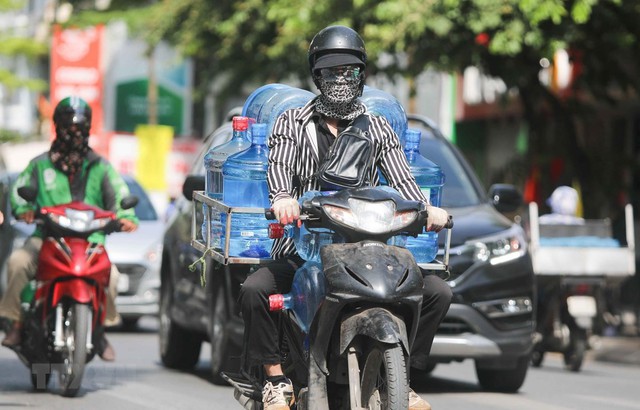
June will see 1-2 periods of intense heat.
According to meteorological agencies, the heatwave at the end of May was the most intense and exceptionally severe heatwave of its kind for the same period in May since 2021. Notably, the sunshine lasted unusually long, with many areas experiencing sunshine from around 9 am until 7 pm. Nighttime temperatures remained at 30-31 degrees Celsius, creating a persistent feeling of oppressive heat throughout the day and night.
The cause has been identified as the strong development and expansion of a hot low-pressure area in the west towards the southeast, combined with a strong Foehn effect in Central Vietnam, resulting in widespread high temperatures for several consecutive days. Under the influence of this heatwave, 11 meteorological stations recorded daily highest temperatures in May that reached or exceeded historical values for the same period.
Bac Ninh recorded the highest temperature in the country with 40.5 degrees Celsius on May 25th, equaling the May record set in 2020. Hiep Hoa (Bac Giang) reached 39.7 degrees Celsius, 0.7 degrees Celsius higher than the previous record; Bac Giang station reached 39.4 degrees Celsius, exceeding the previous historical record by 0.3 degrees Celsius. In Quang Ninh, Uong Bi station recorded 39.7 degrees Celsius, 2.2 degrees Celsius higher than the previous record set in 2013 - the largest record breach during this heatwave. Quang Ha station recorded 35 degrees Celsius, exceeding the historical value by 0.4 degrees Celsius.
The Hai Phong area also recorded several unusually high temperatures. The Duong Kinh station reached 39.8 degrees Celsius, 0.2 degrees Celsius higher than the previous record. Coastal and island stations such as Co To and Bach Long Vi recorded 34.5 degrees Celsius and 35.5 degrees Celsius respectively, both exceeding historical values for the same period. In addition, the Cat Tien station (Lam Dong) recorded 38.1 degrees Celsius, surpassing the previous record by 0.1 degrees Celsius; Phan Rang reached 38.3 degrees Celsius, equaling the highest temperature ever recorded in May.
Where is the hottest place in the country in June?
According to the National Center for Meteorological and Hydrological Forecasting, in June, the Northern region and Thanh Hoa - Nghe An provinces are forecast to have rainfall 5-10% higher than the multi-year average, but hot weather is likely to persist due to generally high temperatures. In other areas of the country, total rainfall is expected to be 10-25% lower than the multi-year average.
The forecast for average temperatures in June in Hanoi is 30-31 degrees Celsius, Nghe An 31-32 degrees Celsius, Hue 30-31 degrees Celsius, and Quy Nhon 30.5-31.5 degrees Celsius. These are all areas at significant risk of being affected by heatwaves in the coming period.
The meteorological agency forecasts that June will see 1-2 more widespread heatwaves. The highest temperatures during these periods will generally range from 36-39 degrees Celsius, with some areas exceeding 40 degrees Celsius, concentrated in the western mountainous regions from Thanh Hoa to Hue. The overall trend indicates that the average monthly temperature nationwide will continue to be 0.5 to 1 degree Celsius higher than the multi-year average.
During the first 10 days of the month, rainfall fluctuates between 40-70 mm, then increases to 50-100 mm in the middle and end of the month. Lao Cai has an average temperature of 30.5-31.5 degrees Celsius, among the highest in the northern mountainous region, with a total rainfall of approximately 150-300 mm distributed fairly evenly throughout the month.
Central Vietnam continues to be the hottest region in the country. In Vinh, the average monthly temperature is forecast to be 31-32 degrees Celsius, the highest among all representative meteorological stations nationwide. Rainfall is only about 70-140 mm, significantly lower than many other areas, indicating that hot and dry weather remains the dominant weather pattern. Meanwhile, the Central Highlands maintain an average temperature of 26-27 degrees Celsius. The Buon Ma Thuot station forecasts 150-300 mm of rainfall, gradually increasing towards the end of the month as the Southwest monsoon becomes stronger.
In Southern Vietnam, the average monthly temperature in Ho Chi Minh City ranges from 29-30 degrees Celsius, with rainfall of approximately 150-300 mm. Can Tho has a common temperature of 28-29 degrees Celsius, with rainfall of 140-270 mm. Thunderstorms are forecast to increase from mid-month, but localized heat waves may still occur before the rain appears in the evening.
The meteorological agency warns that prolonged intense heat could significantly impact people's health, electricity demand, and production activities. People need to be wary of the risk of fires and explosions in residential areas due to increased electricity demand, and should limit outdoor work during periods of extreme temperatures.
Inland, the monsoon trough and the Southwest monsoon in the South may cause showers and thunderstorms, posing a risk of dangerous weather phenomena such as tornadoes, lightning, hail, and strong gusts of wind. In addition, strong winds due to localized thunderstorms, the Southwest monsoon, or tropical cyclones in the East Sea should be anticipated, posing a danger to shipping. In the Northern and Central regions, hot and intensely hot weather is significantly affecting people's lives and production.
In the context of climate change, weather and climate patterns are becoming increasingly complex with many dangerous and extreme modes. Therefore, it is recommended that all levels of government and the public regularly update and integrate meteorological and hydrological forecasts and warnings into short-term bulletins (1-3 days) to promptly adjust production plans and response measures to ensure the safety of production activities and people's lives.
Source: https://suckhoedoisong.vn/thang-6-se-co-bao-nhieu-dot-nang-nong-gay-gat-169260601144534958.htm






































![[Photo] Reception to welcome General Secretary and President To Lam and his wife on their State visit to the Philippines](https://vphoto.vietnam.vn/thumb/1200x675/vietnam/resource/IMAGE/2026/06/01/1780295488620_vna-potal-chieu-dai-chao-mung-tong-bi-thu-chu-tich-nuoc-to-lam-va-phu-nhan-tham-cap-nha-nuoc-toi-philippines-8798060-7855-jpg.webp)









































































Comment (0)