

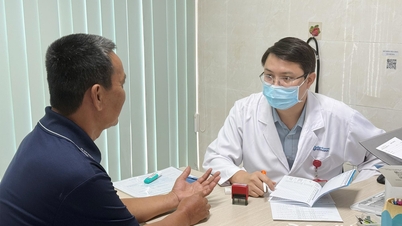
The patient, Mr. Nguyen K. (77 years old, residing in Tam Anh commune, Da Nang city), was admitted to the hospital with persistent chest pain and progressively worsening shortness of breath during exertion. Examination revealed severe aortic valve stenosis accompanied by heart failure. Given his advanced age, thin physique, history of hypertension, and co-existing conditions including benign prostatic hyperplasia and renal cysts, the risks associated with open-heart surgery were assessed as high.

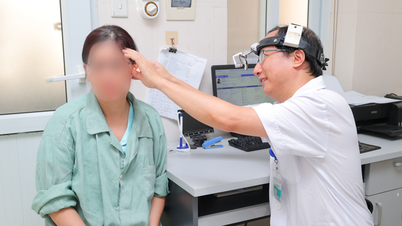
The patient recovered well after the procedure. Photo: Provided by the hospital.
On May 5th, after consultation, the team unanimously chose the transcatheter aortic valve replacement (TAVR) method. This is a minimally invasive intervention technique, suitable for elderly patients with multiple underlying conditions. The hospital had prepared contingency plans to ensure the safety of the procedure, including equipment and personnel for open-heart surgery, ECMO, echocardiography, pacemaker, blood, and platelets before performing the procedure.
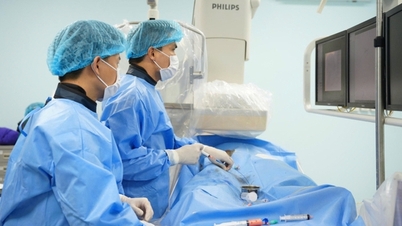
The intervention was performed in the cardiovascular intervention room under the guidance of Prof. Dr. Pham Manh Hung, Director of the Cardiovascular Institute, 19-8 Hospital, President of the Vietnam National Cardiology Association, along with a team of doctors from Hanoi Medical University Hospital and Vietnam-Korea Hospital in Da Nang.
Instead of open-chest surgery, the doctor makes only a small puncture in the femoral artery. From this location, the artificial valve system is guided up to the heart via a catheter, precisely positioned, and replaces the narrowed valve.
The entire procedure was completed in a short time. Immediately after the intervention, the new valve functioned effectively, and the patient's ultrasound and hemodynamic parameters stabilized. The patient no longer experienced shortness of breath or chest pain and was able to walk two days after the procedure.
According to Dr. Phan Tan Quang, Deputy Director of Viet Han Hospital in Da Nang and Head of the Cardiology Department, transcatheter aortic valve replacement (TAVR) is a highly advanced technique requiring close coordination among multiple specialties, from diagnostic imaging and anesthesia to interventional cardiology and open-heart surgery.
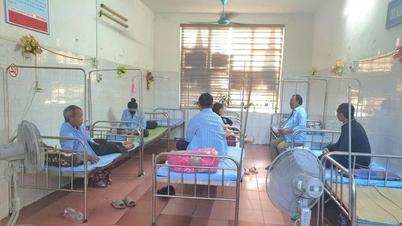
"The advantages of this method are that it is minimally invasive, reduces pain, minimizes blood loss, and shortens recovery time, making it particularly suitable for elderly patients or those at high risk for surgery," Dr. Quang shared. After one day of monitoring in the Cardiac Intensive Care Unit, Department of Cardiovascular and Thoracic Surgery, the patient was transferred to the Cardiology Department for continued treatment. Currently, three days after the intervention, as of May 8th, the patient is recovering well.
Dr. Nguyen Luong Tan, head of the Department of Cardiovascular and Thoracic Surgery, said: "In TAVI intervention, the role of the Department of Cardiovascular and Thoracic Surgery is to ensure maximum safety for the patient, and to be ready to provide surgical support when complications occur such as bleeding, valve ring rupture, valve displacement, or embolism. In addition, the vascular surgery team helps ensure vascular access for instruments used in the procedure in cases of severe stenosis, occlusion, or calcification of the femoral or iliac arteries. When necessary, we can expose other access routes such as the subclavian artery, carotid artery, or aorta to support the safe placement of the valve into the heart."
Dr. Nguyen Dinh Hung, Director of Viet Han Da Nang Hospital, said: "To successfully perform transcatheter aortic valve replacement (TAVI), the hospital has developed a strategy for human resource training, invested in equipment, and successfully implemented open-heart surgery as a foundation for deploying difficult and complex cardiac intervention techniques, with patient safety being the top priority."
The successful implementation of the first transcatheter aortic valve replacement (TAVI) procedure marks a significant advancement in professional capabilities and opens up more treatment options for valvular heart disease patients in the Central region. People can now access this advanced technique locally, reducing costs and travel time.
Source: https://suckhoedoisong.vn/thay-van-tim-khong-can-mo-ho-cho-benh-nhan-co-nhieu-benh-nen-169260508173133076.htm
![[Image] Hanoi's urban life under the challenge of a "scorching hot" environment](https://vphoto.vietnam.vn/thumb/1200x675/vietnam/resource/IMAGE/2026/05/25/1779706979265_nang-nong-t5-2026-minh-duy-7-4636-jpg.webp)
































































































Comment (0)