

Technological tensions between the US and China are escalating, with the vast network of undersea cables being predicted to become a new source of conflict.
 |
| The submarine cable war will continue for years to come as the US and China vie for influence in the digital age. (Source: Adobe Stock) |
Underwater cables came under scrutiny earlier this year – after four of 15 crucial cables in the Red Sea were cut amid Houthi rebels in Yemen attacking US and British ships.
Concerns about undersea cables have increased, and these cable networks are predicted to become a new source of tension in international relations, especially in the context of escalating geopolitical engagements between the US and China.
The "backbone" of the global Internet.
According to telecommunications market research firm TeleGeometry, a total of hundreds of giant telecommunications cables, stretching nearly 1.4 million kilometers, are laid under the sea.
The number of undersea cables around the world is expected to increase in the coming years, reflecting the growing demand for data traffic driven by the popularity of video streaming services.
As of early 2024, TeleGeometry reported that its data had tracked 574 active and soon-to-be-active undersea cables.
Underwater cables are the "backbone" of the global internet, carrying 99% of the world's intercontinental data traffic.
Andy Champagne, Chief Technology Officer of Akamai Labs, stated: “If you’ve ever sent an email, texted, or video chatted with someone on another continent, you’ve used submarine cable. Installing submarine cables is incredibly complex. And when something goes wrong, repairs are extremely complicated.”
Meanwhile, Joe Vaccaro, Vice President and General Manager of Cisco-owned internet monitoring company ThousandEyes, argues that what makes submarine cables important is their impact when disrupted.
"When a cable is broken, service providers will reroute traffic to other routes, and this will inevitably cause some degree of congestion. In particular, there will be a domino effect affecting the terrestrial cable network," he emphasized.
China no longer holds the top position.
The world's second-largest economy was once considered the hub of future undersea cable networks and a key driver of international data flow.
China has emerged as an economic superpower competing with the US and now generates and consumes vast amounts of data. More than 15 undersea cables, totaling over 1,000 km in length, all operational since 1994, connect China to the rest of the world.
China Mobile and other state-owned enterprises in the country have spearheaded trans-Pacific and other projects, sometimes co-funding projects by American companies.
The situation began to change around 2020, when then-President Donald Trump launched the "clean network" initiative to exclude Chinese companies from telecommunications infrastructure projects.
Since then, Washington has maintained a tough stance toward Beijing, citing the need to ensure data security.
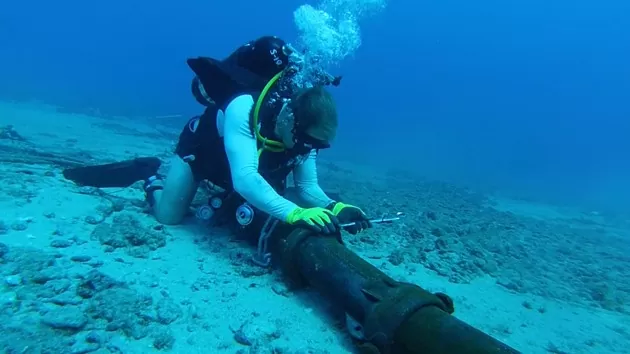 |
| A cold war is brewing underwater between the US and China. (Illustrative image - Source: AFP) |
In 2020, the U.S. Department of Justice urged Google and Meta to reconsider their plans to install a 13,000-kilometer undersea cable between Los Angeles and Hong Kong. The project was in its final stages, but the two tech giants quickly decided to remove the Chinese destination and halt the cable route in Taiwan (China) and the Philippines.
Furthermore, a World Bank-led submarine cable project for South Pacific island nations also "rejected" Chinese companies to appease policymakers in Washington.
China's presence on undersea cable systems is also rapidly fading. Three international cable routes connecting the country to Hong Kong (China) are expected to be completed in 2025.
After 2026, Beijing has no plans to install any new underwater cables.
Meanwhile, demand for data traffic between the US and Asia remains generally strong, with four cable routes to Japan and seven to Singapore planned for completion after 2024.
In addition, nine more cables will be built connecting the US island of Guam with Southeast Asia. This brings the total number of submarine fiber optic cables being constructed between the US and Southeast Asia to 16.
A Cold War at sea?
Previously, underwater cables were owned and operated by telecommunications companies.
Recently, American tech giants including Meta, Google, Microsoft, and Amazon have invested significant sums of money in installing their own cabling systems.
Citing anonymous sources within the U.S. State Department, the Wall Street Journal reported in May that undersea cables in the Pacific Ocean could be vulnerable to surveillance by Chinese ships.
According to the newspaper, SB Submarine Systems, a Chinese state-controlled company specializing in repairing international cables, appears to be concealing the location of its ships from radio and satellite tracking systems.
According to CNBC, the US government's concerns are not new.
Estonia says it suspects a Chinese ship cut two underwater cables, and the world's second-largest economy has yet to respond to a request from six months ago to investigate the matter.
Furthermore, many international undersea cable projects are reportedly seeking to avoid China due to concerns about data security and Beijing's geopolitical influence.
Experts assert that, given China's increasing data consumption, new submarine cable projects are gradually declining. This reflects the rivalry between the world's two largest economies in the technology sector.
Alan Mauldin, research director at TeleGeography, told Nikkei Asia : "There will be a cold war at sea between the US and China."
Veteran writer NC Bipindra, specializing in geopolitics, defense, and diplomacy for The EurAsian Times, also affirmed: "The submarine cable war will continue for years to come as the two superpowers vie for influence in the digital age."
As the internet becomes an increasingly important tool for everything from commerce to security, controlling underwater cable routes is likely to become even more crucial.
Source: https://baoquocte.vn/them-mat-tran-moi-trong-cuoc-chien-cong-nghe-my-trung-quoc-bac-kinh-dang-dan-lep-ve-278983.html


![[Photo] Prime Minister Pham Minh Chinh attends the Conference on the Implementation of Tasks for 2026 of the Industry and Trade Sector](/_next/image?url=https%3A%2F%2Fvphoto.vietnam.vn%2Fthumb%2F1200x675%2Fvietnam%2Fresource%2FIMAGE%2F2025%2F12%2F19%2F1766159500458_ndo_br_shared31-jpg.webp&w=3840&q=75)



















































































Comment (0)