

According to information gathered by historical researchers, the diary belongs to a Vietnamese volunteer soldier who died in Laos. His name may have been Ly Ngoc Thinh.
In the notebook, there was a page with different handwriting, probably recorded by his comrades: "Born in 1946. Cao Lan ethnic group. Father was a Party member... Tuyen Quang . Very kind. His fighting motivations were very correct. Pure soul. High revolutionary enthusiasm. Trusted and loved by officers and soldiers. Brave in battle. Died while conferring with the platoon deputy during an extremely difficult situation..."
This page is from the diary. |
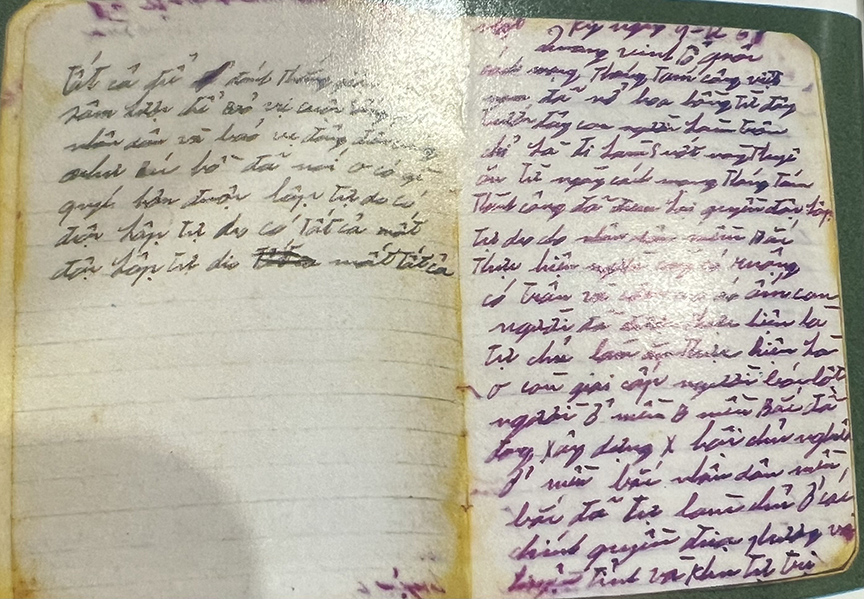
Reading the diary, we can feel the sense of responsibility and honor of the revolutionary soldier when the country is in danger, ready to sacrifice himself to protect the independence and freedom of the Fatherland and the happiness of the people: "A communist party member must know how to choose a path that is worthy of living and worthy of dying. Even if one only lives 20 years, it is better than living a hundred years in vain. To live a great life, to die gloriously. My life and my existence have been spent directly taking up arms to kill the enemy to protect the independence and freedom of the Fatherland and the territorial sovereignty of the Democratic Republic of Vietnam. Therefore, as a young man living in the army, I must determine my ideology, have a high fighting spirit, have a firm ideological stance, and be ready to accept heavy tasks and sacrifice for the Fatherland."
Besides entries expressing faith in the leadership of the Party and President Ho Chi Minh during the all-out, nationwide resistance war, and showing heartfelt affection for the people of the South being trampled by the enemy, the diary also contains pages expressing pure international sentiments.
On December 13, 1968, his platoon set off on a mission in Laos. He wrote: "We have begun our march to fight in Laos. Before going, I had already determined my mindset and high fighting spirit. Specifically, the march will be full of hardships, carrying heavy loads, marching day and night, and traveling long distances. But I think my life must be filled with honor and pride as a heroic Vietnamese person. I must stand firm against the enemy and push forward to repay the kindness of our beloved Uncle Ho and the Vietnamese people. Therefore, I must follow the Party to the last drop of blood. The Vietnamese people and the Laotian people are one."
The Vietnamese revolution and the Laotian revolution are one. Our homeland and our friend's are one, so I am very enthusiastic about going on international missions. I don't calculate sacrifice or reward, even if I sacrifice myself in Laos, it is for the people, for the homeland, for the common revolution of the Vietnamese and Laotian nations. The people of Laos and Vietnam must unite to fight the Americans to liberate their nations and for the progress of humanity... "Over the four days of December 25, 26, 27, and 28, 1968, I fought at Pha Thi. Bombs and bullets shook the earth, but my determination, even if it meant sacrificing my life in battle, was to remain wholeheartedly loyal to the people of Laos and Vietnam. It's better to die at Pha Thi than to be enslaved. Pha Thi is an important area of the Laotian battlefield, so the enemy also attacked to use Pha Thi as a springboard to attack Laos." That place is also very important, so even if we have to fight and sacrifice ourselves, we will not let Pha Thi be lost."
![[Photo] The heat at the fireworks display site on the opening night of the Da Nang International Fireworks Festival 2026](https://vphoto.vietnam.vn/thumb/1200x675/vietnam/resource/IMAGE/2026/05/27/1779889741485_ndo_br_z7872039145157-fecaba5112f39e8352544099d7ef4738-5140-jpg.webp)











![[Photo] Standing Committee member of the Party Central Committee Tran Cam Tu working with the Central Inspection Committee](https://vphoto.vietnam.vn/thumb/1200x675/vietnam/resource/IMAGE/2026/05/28/1779969579668_ndo_br_bnd-2495-jpg.webp)
















































Comment (0)