

When history moves beyond the pages of a book.
In recent years, instead of choosing modern amusement parks or shopping malls, many families have taken their children to historical sites during summer vacation. The trend of tourism combined with historical education is gaining increasing attention.
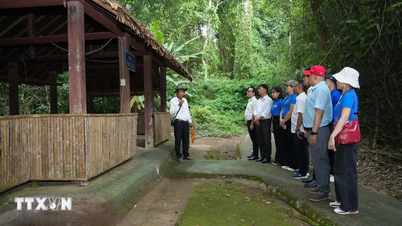
One early summer morning, with mist still lingering on the mountain slopes of the Định Hóa ATK ( Thai Nguyen ) region, convoys of vehicles made their way into the historical site. The chirping of forest birds mingled with the laughter and chatter of families, creating an atmosphere that was both solemn and intimate.
The family of 43-year-old Nguyen Van Hung (Ha Dong, Hanoi ), comprising three generations, participated in a trip to the historical site of ATK Dinh Hoa. Mr. Hung explained that his children enjoy watching cartoons and using electronic devices. Therefore, the family wanted to create an opportunity for them to engage with history in a more visual way.
"At school, the children learn history, but often they only remember the events. When they see with their own eyes President Ho Chi Minh's working hut, the bomb shelters, and the forest paths that revolutionary cadres once traveled, they truly understand the sacrifices of the previous generation. That's something that textbooks can't fully convey," he said.
This is a strategic area located in the heart of Viet Bac, considered the "heart" of the revolutionary base during the resistance war against French colonialism (1946-1954).
Historically, this area has been known by various names such as the Safe Zone, the Dinh Hoa ATK Historical Relic Area, or the Central Safe Zone – all associated with the years of activity and work of President Ho Chi Minh, the Central Party Committee, and the Government of the Democratic Republic of Vietnam. Each location is linked to important decisions that changed the destiny of the country.

Amidst the lush greenery of the mountains and forests, history is no longer just dry numbers but becomes a vibrant tapestry of stories. Children, accustomed to their phone screens, eagerly ask questions about the lives of revolutionary cadres during the resistance years. Many parents said this was the most surprising and delightful aspect of the trip.
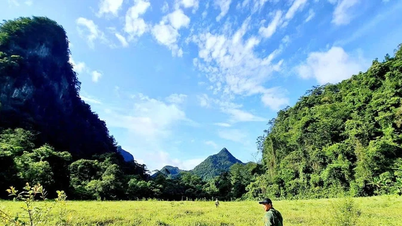
Leaving the Định Hóa Revolutionary Base Area, families and tourists continue their journey to the Chợ Đồn Revolutionary Base Area (Thái Nguyên), one of the centers of the Việt Bắc base area during the resistance war against French colonialism. The road leading to the historical site winds through towering mountain ranges.
The Tay and Nung villages appear peaceful on the mountain slopes. It's hard to imagine that this was once an important war zone, providing security for many key revolutionary organizations. These include: the Pu Co Hill historical site, the Vo Nguyen Giap Memorial House, Khuoi Khit, the Trieu Phu Duong house historical site, Na Pa, Lsao Lso Do (Khe Nua), Ban Ca, Khuoi Dam...
The simple stilt houses are still preserved as historical witnesses. Standing in front of the stilt house where officials once lived and worked, Tran Thu Ha, 36, a tourist from Hai Phong, could not hide her emotion.
"I've taken my children to the beach and amusement parks many times before. But this trip brought a very different feeling. The children got to see firsthand the places where their ancestors lived and fought. The lessons about patriotism became much more real," Ms. Ha shared.
According to her, the most valuable thing is that her children have begun to ask questions about the nation's history, about life during the war, and about the sacrifices of those who fell for independence and freedom. "That's exactly what I hoped for when I brought my children here," she said.
Along the way, many families choose to stay at community homestays, enjoy traditional local dishes, and listen to stories about the revolutionary land.
Not only children but also adults have the opportunity to look back at the glorious history of the nation. Mr. Nguyen Van Duc, 68 years old, a veteran from Ninh Binh, said that the trip brought back stories his father used to tell him about the resistance war.
"Before, I only heard stories about Viet Bac and the ATK (Resistance Zone). Today, seeing it with my own eyes, I understand even more why this place is called the Capital of Resistance. Every mountain, every stream holds proud historical stories," he shared.
Gratitude from summer trips
During their journey back to the roots, visitors can visit the National Historical Monument of July 27th in Thai Nguyen. In the spacious, cool grounds of the historical site stands a cylindrical white marble slab inscribed with: “Here, on July 27th, 1947, 300 cadres, soldiers, and representatives of various social strata of the local people gathered to hear the announcement of President Ho Chi Minh's letter, marking the establishment of the Day of War Invalids and Martyrs in our country.”
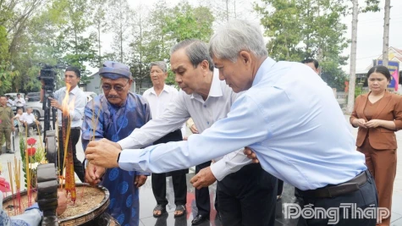
Nestled amidst the tranquil mountain scenery, the historical site possesses a simple yet profoundly meaningful beauty. During the summer months, many families bring their children here to light incense and pay respects to the fallen heroes. Fresh flowers and fragrant incense sticks are offered with utmost reverence.
Nguyen Khanh Linh, a 9th-grade student from Bac Ninh, stood silently for quite a while in front of the memorial. “I’ve heard my grandfather tell stories about the war, but I’ve never felt it as strongly as today. I feel I need to study harder to be worthy of those who sacrificed their lives,” she said. Many parents believe that trips like this have a much deeper educational significance than theoretical lectures.
What's special about this journey is that there are no thrill rides or exciting entertainment activities. Instead, there are moments of tranquility amidst nature and history.
The leisurely strolls along tree-lined paths, the stories told by the guides, and the simple artifacts preserved over time all create vivid lessons about national traditions.
Tourism experts believe that heritage tourism is becoming increasingly attractive to families due to the demand for combining relaxation with life values education for children. Visiting historical sites not only helps the younger generation learn more about the nation's history but also contributes to fostering love for their homeland and a sense of responsibility towards the community.
Amidst the hustle and bustle of modern life, the "historical sites" in the vast forests of Northern Vietnam quietly tell stories of patriotism, the will for independence, and the spirit of sacrifice of our ancestors. And every summer, these stories continue to be passed down through the footsteps of families on their journey back to their roots, so that history is not just in books but lives on in the hearts of future generations.
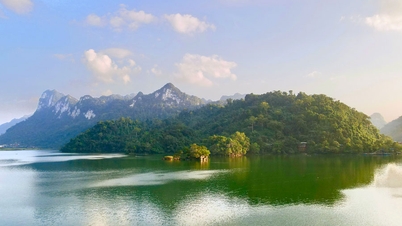
According to Mr. Nguyen Chu Thu, Deputy Director of the Department of Culture, Sports and Tourism of Thai Nguyen province, Thai Nguyen currently has 399 ranked historical and cultural relics and scenic spots (including 3 special national relics: Dinh Hoa Revolutionary Base, Cho Don Revolutionary Base, and Ba Be Lake; 67 national relics; and 329 provincial relics). It also has 1 intangible cultural heritage of humanity (the Then ritual practices of the Tay, Nung, and Thai people) and 45 national intangible heritages.
From being the "Capital of Resistance" during the glorious years of the nation, the Dinh Hoa Safe Zone today is undergoing a strong transformation – both preserving its sacred historical values and unleashing its potential for cultural tourism development.
Following the Prime Minister's directive to "transform heritage into assets," Thai Nguyen province is striving to transform this "red address" into an attractive destination for historical tourism, where a glorious past blends with modern life, creating momentum for sustainable development in this revolutionary land.
In the first five months of this year, the total number of tourists visiting Thai Nguyen is estimated at over 4.3 million, an increase of 39% compared to the same period in 2025. Total revenue from tourism is estimated at 6,050 billion VND, an increase of 63%.
Source: https://baophapluat.vn/theo-dau-chan-lich-su-giua-dai-ngan-viet-bac.html
![[Image] Hanoi Police officially crowned champions of V-League 2025/2026](https://vphoto.vietnam.vn/thumb/1200x675/vietnam/resource/IMAGE/2026/05/31/1780244769054_ndo_br_039d561b692be875b13a-jpg.webp)

![[Photo] Admire the coral "masterpiece" amidst the million-year-old heritage of Dak Lak province.](https://vphoto.vietnam.vn/thumb/1200x675/vietnam/resource/IMAGE/2026/05/31/1780221235105_anh-man-hinh-2026-05-31-luc-16-53-27.png)
![[Photo] Solemn bathing ceremony and Buddha procession in Hue](https://vphoto.vietnam.vn/thumb/1200x675/vietnam/resource/IMAGE/2026/05/31/1780228263543_1-jpg.webp)

![[Photo] The General Secretary, President and his wife begin their state visit to the Philippines.](https://vphoto.vietnam.vn/thumb/1200x675/vietnam/resource/IMAGE/2026/05/31/1780230559452_anh-man-hinh-2026-05-31-luc-19-28-11.png)















![[Video] Sunset at Lap An Lagoon – Where the sun sets over the fishing nets](https://vphoto.vietnam.vn/thumb/340x192/vietnam/resource/IMAGE/2026/05/31/1780192137701_beach-landscape-sea-water-nature-grass-745871-pxhere-com.jpeg)































![[Photo] Admire the coral "masterpiece" amidst the million-year-old heritage of Dak Lak province.](https://vphoto.vietnam.vn/thumb/402x226/vietnam/resource/IMAGE/2026/05/31/1780221235105_anh-man-hinh-2026-05-31-luc-16-53-27.png)




























Comment (0)