

Many experts believe that, given AI's becoming a foundational technology with profound impacts on all aspects of economic and social life and shaping the future of humanity, introducing AI into primary and secondary schools, starting with first-grade students, is a suitable approach. However, when introducing AI into schools, a humane approach is needed, with pilot programs following a suitable roadmap, and avoiding uncontrolled AI applications within schools.
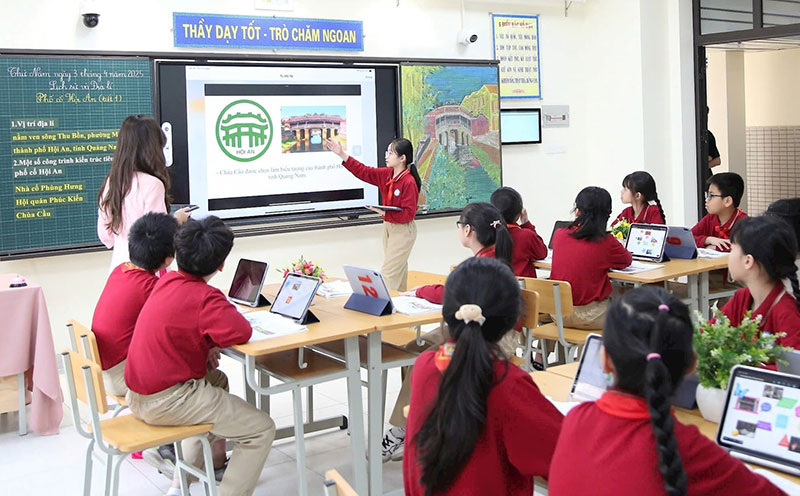
Helping students develop digital skills and AI skills.
The AI education framework is designed to correspond to two educational stages: the basic education stage, comprising primary school (starting from grade 1) and lower secondary school; and the career-oriented education stage, which is upper secondary school. At the primary school level, students initially experience simple AI applications, forming initial concepts and recognizing the role of AI in life. They are educated about protecting personal data and respecting copyright. At the lower secondary school level, students learn how to use AI tools to create digital products, are equipped with foundational knowledge about the operating principles of AI, and begin to develop an awareness of ethics and civic responsibility in the digital society. At the upper secondary school level, students are encouraged to explore, design, and improve simple AI tools through science projects.
The program focuses on developing problem-solving skills, creativity, and mastery of AI tools, helping students apply AI to create products that serve the community and guide their career paths. The AI education framework for students is built on the competency-based perspective of the 2018 General Education Program and is consistent with the General Education Program for Informatics.
The Ministry of Education and Training stated that implementing AI education for high school students is necessary and urgent, fulfilling the tasks outlined in the Party and State's policies and directives on education and training in the new context. Implementing AI education in general education aims to help students develop digital skills, scientific and technological capabilities, creative thinking, learning skills, and self-reliance; equipping students with foundational knowledge, basic application skills in AI, and the necessary qualities for using AI in learning and life.
Dr. Do Viet Tuan, from the Faculty of Information Technology and Communications at the Academy of Educational Management, also believes that introducing AI education into primary and secondary schools, starting from grade 1, is entirely feasible. At this age, complex academic knowledge isn't necessary; what's important is helping students recognize the role of AI in daily life. Early preparation not only helps students proactively apply this technology to their studies effectively and ethically, but also lays the foundation for algorithmic thinking. Specifically, at the primary school level, students focus on recognizing, differentiating, and understanding the applications of AI; at the lower secondary level, they develop fundamental algorithmic thinking skills to adapt to learning about AI; and at the upper secondary level, they are trained in programming languages, AI gen tools, and also approach ethical and legal issues in AI.
Carefully prepare resources to ensure implementation is appropriate to the practical situation.
Many teachers and education administrators believe that the Ministry of Education and Training's issuance of the pilot framework for AI education for high school students is a correct step to help students access AI early, develop digital skills, creative thinking, and problem-solving skills, and prepare them for future careers. However, the implementation of AI in schools needs to follow a roadmap, applying it first in areas that meet the necessary conditions; ensuring student data security; and providing clear legal and governance guidelines to prevent uncontrolled AI applications in schools.
From an expert perspective, Professor Nguyen Thanh Thuy, President of the Vietnam Informatics Association, assessed that incorporating AI content into general education is a breakthrough, reflecting a vision for education and training, and aligning with current contexts and trends. To implement it effectively, Professor Nguyen Thanh Thuy noted that the introduction of AI into general schools must be carried out alongside other educational technologies and activities such as STEM education and Informatics.
Sharing this view, Mr. Bach Dang Khoa, Deputy Director of the Bac Ninh Department of Education and Training, also emphasized the approach of integrating AI content into existing subjects rather than establishing it as a separate subject. He also suggested that the Ministry of Education and Training should soon issue a framework for teachers on the application of AI in teaching and learning at the secondary level, so that localities have a basis for training and developing their staff on this topic.
Mr. Le Huy Hoang, Deputy Director of the Education Department, Central Propaganda and Mass Mobilization Committee, stated that AI education in general education is necessary, especially in training high-skilled human resources. However, Mr. Le Huy Hoang also noted that the development and implementation need careful review and preparation of resources, especially regarding the capacity of the teaching staff and infrastructure; AI education in general education must be piloted, reviewed, and controlled.
Mr. Thai Van Tai, Director of the Department of General Education, Ministry of Education and Training, stated that the implementation of AI education for general education students will be carried out according to a roadmap and stages, in line with practical realities and under control. Therefore, the pilot implementation of AI education in general education serves as a basis for research, evaluation, and proposals for implementation suitable for each level of general education in subsequent school years. Based on this, the Ministry of Education and Training will also develop appropriate solutions to ensure that all students, regardless of their region or socio-economic conditions, have the opportunity to access AI education.
Source: https://cand.com.vn/giao-duc/thi-diem-theo-lo-trinh-tranh-viec-ung-dung-ai-khong-kiem-soat-trong-truong-hoc-i791416/

![[Image] Central Party Office summarizes work in 2025](/_next/image?url=https%3A%2F%2Fvphoto.vietnam.vn%2Fthumb%2F1200x675%2Fvietnam%2Fresource%2FIMAGE%2F2025%2F12%2F18%2F1766065572073_vptw-hoi-nghi-tong-ket-89-1204-jpg.webp&w=3840&q=75)














































































Comment (0)