


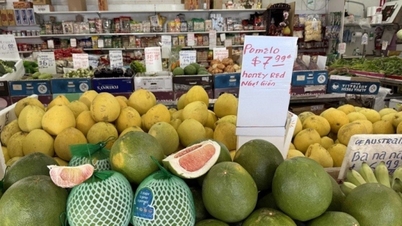
The family of Ms. Trinh Yen Nhi, residing in Hamlet No. 6, Cang Long Commune, cultivates 120 green pomelo trees on an area of approximately 6,000 m2, yielding an average annual output of about 10 tons. Recognizing the high demand and price during Tet (Lunar New Year), she proactively managed the trees to bear fruit precisely during the Tet season, achieving a harvest of approximately 3 tons of commercial pomelos.
Ms. Nhi said that traders had already placed deposits to buy the entire harvest for Tet (Lunar New Year) two months in advance, at prices ranging from 27,000 to 30,000 VND/kg, about 10,000 to 15,000 VND/kg higher than usual. The peak harvest period is from the 23rd to the 26th of the 12th lunar month, and traders come directly to the orchard to buy the fruit, so sales are quite favorable. “To have beautiful pomelos to sell for Tet, you have to prepare very early. The pomelos are carefully cared for and monitored at each stage to ensure appearance, quality, and uniformity,” Ms. Nhi shared.
Notably, the entire pomelo orchard of Ms. Nhi's family is cared for using safe practices, prioritizing the use of organic fertilizers and pesticides. Each year, the investment cost is approximately 30 million VND, which helps prevent soil degradation, maintain soil fertility, produce high-quality pomelos, and protect consumer health.
According to Mrs. Nhi's family's experience, pomelo trees yield fruit throughout the year, with an average production of 500-600 kg per month. During Tet (Lunar New Year), applying the right techniques for concentrated fruit harvesting can lead to higher yields and better prices. This season, her family's pomelo orchard produced over 800 kg more than the previous Tet, providing them with a substantial income and enough resources for a prosperous Tet celebration.
Sharing the joy of a bountiful harvest and good prices for pomelos during Tet (Lunar New Year), Ms. Doan Thi Su from An Truong commune said that her family has over 2,000 square meters of green pomelo orchards planted on alluvial soil. Combined with annual mud dredging and earthworm composting, the pomelos have a rich, sweet flavor and consistent quality, making them well-known and favored by many traders. This year, Ms. Su's orchard is expected to yield about 1.5 tons of fruit for Tet. Since the 10th day of the 12th lunar month, traders have come to her orchard to place deposits and buy the entire harvest at 25,000 VND/kg, about 10,000 VND/kg higher than usual.

According to Ms. Su, to have pomelos ready for sale during Tet (Lunar New Year), her family proactively started treating the trees to encourage concentrated fruiting as early as April of the lunar calendar. The pomelo orchard is cultivated organically, using self-composted earthworm compost to fertilize the trees. This helps the pomelos have a beautiful green color, firm flesh, and promotes healthy tree growth, extending the orchard's lifespan compared to using chemical fertilizers. "Although this method is more labor-intensive, the pomelos are safer and protect consumer health, making them very popular in the market, especially during Tet," Ms. Su shared.
Vinh Long province currently has 18,720 hectares dedicated to growing green-skinned pomelos, yielding nearly 234,000 tons per year. This is one of the province's key fruit crops. According to calculations by the provincial agricultural sector, farmers earn an average profit of nearly 200 million VND per hectare of pomelo cultivation.
Recently, the Project Management Board for the Development of Climate-Smart Agricultural Value Chains in Tra Vinh (CSAT Tra Vinh), in coordination with the Department of Agriculture and Environment of Vinh Long province, implemented a plan to upgrade climate-adaptive value chains; in which, green pomelo is one of the eight agricultural products selected for upgrading.
According to Mr. Le Van Dong, Deputy Director of the Department of Agriculture and Environment of Vinh Long province, green pomelo in the province is mainly produced on a household scale, with limited linkages, and the deep processing and concentrated consumption stages have not developed proportionally to their potential. Given the increasingly high demands of the market for quality, food safety, and traceability, Vinh Long province has identified upgrading the green pomelo value chain towards clean, sustainable production and adaptation to climate change.
According to the plan, the province will maintain and expand the area of green pomelo cultivation meeting VietGAP, GlobalGAP, and OCOP standards, moving towards organic production, while simultaneously improving the brand, design, logo, and packaging of the product. Along with this, it will encourage farmers to convert inefficient rice fields and renovate mixed orchards to green pomelo cultivation; replicate high-tech application models, water-saving irrigation, and increase the use of organic fertilizers and biological pesticides to reduce input costs and improve economic efficiency.
The province will focus on supporting the development of green pomelo cooperatives based on a centralized supply-consumption model, improving management and business capabilities; supporting cooperatives and businesses in adopting and applying technological processes to produce value-added products from pomelo by-products and waste. Simultaneously, it will promote the establishment of planting area codes and traceability systems. The agricultural sector and the Department of Industry and Trade will support cooperatives with standardized products to participate in e-commerce platforms, linking with businesses for consumption and export, thereby enhancing the value chain, increasing sustainable income for pomelo growers, and affirming the position of Vinh Long green pomelo in the market.
In contrast to the joy of a bountiful harvest and high prices for pomelo growers in Vinh Long province, dragon fruit growers in Dong Thap province are less pleased as dragon fruit prices plummet near Tet (Lunar New Year). These days, the price of red-fleshed dragon fruit has unexpectedly dropped sharply, causing many growers of off-season dragon fruit to worry as profits fall short of initial expectations.
According to observations in communes specializing in dragon fruit cultivation such as Luong Hoa Lac, Tan Thuan Binh, My Tinh An, etc., the price of red-fleshed dragon fruit continues to fall compared to previous days. While a few days ago, bulk red-fleshed dragon fruit was priced at around 22,000 - 25,000 VND/kg, it is now only around 18,000 VND/kg.
Mr. Nguyen Van Ut, from Linh Dong hamlet, Tan Thuan Binh commune, Dong Thap province, who cultivates 4,000 m2 of red-fleshed dragon fruit, said that the current price is only commonly 17,000-18,000 VND/kg, a decrease of 5,000-7,000 VND/kg compared to last week. Lower prices range from 12,000 VND/kg, and even substandard fruit is only 1,000-2,000 VND/kg.
In Tan Thuan Binh commune, Mr. Nguyen Thanh Nhan is harvesting the last crop of red-fleshed dragon fruit for the Tet holiday on his 1,000 m2 plot. According to Mr. Nhan, his family sold the first batch for 30,000 VND/kg, the second for 27,000 VND/kg, but this time the price has dropped to only 17,000 VND/kg for grade 3. "With the high cost of off-season cultivation, the current price only yields a very small profit," Mr. Nhan expressed.
Mr. Tran Hai Nguyen, a dragon fruit trader in Tan Thuan Binh commune, Dong Thap province, said that this year's dragon fruit yield for Tet (Lunar New Year) is higher than last year, while many warehouses have already purchased enough stock for Tet, causing prices to drop rapidly. At the current price, farmers are still making a profit, but it's not significant.

According to some traders, the drop in the price of red-fleshed dragon fruit in the area is also due to the influence of export market factors, including certain barriers in the import and export of agricultural products during the period leading up to Tet (Lunar New Year).
Dragon fruit has long been hailed as a "money-making crop" for many farmers in Dong Thap province. However, to avoid the recurring cycle of "bumper harvests leading to falling prices," local authorities need to implement comprehensive solutions to support farmers, including cultivation techniques, production scale, branding, market access, and processing.
According to the Department of Agriculture and Environment of Dong Thap province, the locality has developed a specialized dragon fruit cultivation area for export of nearly 9,400 hectares, with an annual harvest of over 236,000 tons of fruit, concentrated in the eastern communes of the province located in the Go Cong freshwater zone, including Cho Gao, An Thanh Thuy, My Tinh An, Dong Son, Vinh Binh, and Go Cong communes.
To date, Dong Thap province has over 2,300 hectares of dragon fruit certified under GAP standards, along with 33 planting area codes for export to the Chinese market (5,493 hectares) and 92 planting area codes for export to Japan, the United States, South Korea, and Australia (1,271 hectares).
According to Le Ha Luan, Director of the Department of Agriculture and Environment of Dong Thap province, the province aims to develop over 135,000 hectares of various fruit trees in 2026, with a production of over 2.5 million tons. To date, the province has 1,846 registered planting areas covering 185,469 hectares. In addition, 1,500 planting areas (3,449 registered codes) for export purposes have been approved in the province, covering 99,878 hectares, along with 462 registered packaging facilities.
Source: https://baotintuc.vn/kinh-te/thi-truong-nong-san-tet-vui-buon-dan-xen-20260211160310056.htm
![[Photo] Ba Lang An Lighthouse - the "eye of the sea" amidst the "rock museum" of Quang Ngai province.](https://vphoto.vietnam.vn/thumb/1200x675/vietnam/resource/IMAGE/2026/05/29/1780038698840_anh-man-hinh-2026-05-29-luc-14-10-42.png)
![[Image] Pleasant weather helps students enter the 10th grade entrance exam with confidence.](https://vphoto.vietnam.vn/thumb/1200x675/vietnam/resource/IMAGE/2026/05/29/1780034401612_ngay-1-thi-lop-10-minh-duy-8-5009-jpg.webp)




















































































Comment (0)