

The moment a meteor exploded at 10:33 PM on May 25th (local time) attracted widespread attention. This cosmic rock exploded, creating a "fireball" above the erupting Mayon volcano in Albay province, Luzon Island, Philippines.
Initial reports suggested the meteorite may have struck the flank of the Mayon volcano. However, experts have confirmed this did not actually happen.
Two live streams tracking the eruption of Mount Mayon captured a blinding flash of light lasting over a second from a meteor. According to the Smithsonian Institution's Global Volcanology Program, Mount Mayon, 2,463 meters above sea level, began erupting in early January. Black-and-white video from the Philippine Institute of Volcanology and Seismology (PHIVOLCS) shows a bright streak near the summit, illuminated by glowing red lava. Another video on afarTV reveals the red glow of flowing lava and the green glow of a meteor.
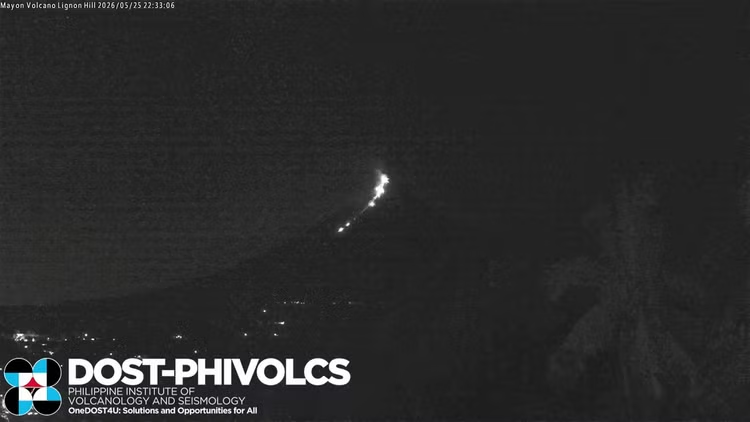
After reviewing seismic data, infrasound, and additional imagery from multiple cameras around the volcano, PHIVOLCS concluded that the meteorite broke apart in the atmosphere and did not fall onto the slopes of Mount Mayon.
The Philippine Information Agency has offered several estimates. Among them, if the meteorite had struck Mount Mayon shortly after erupting, it could have generated an impact force equivalent to 7,500 tons of explosives. If this is accurate, it could have led to massive rockfalls, detected by seismic sensors around the volcano. Even without a collision, the meteorite exploding above the erupting Mount Mayon would be an incredible coincidence, creating an unbelievable spectacle.
The meteor that glows as a fireball is the result of an asteroid passing through Earth's atmosphere and burning up due to friction with the air. The Philippine Space Agency explains that as meteors hurtle through the atmosphere at extremely high speeds, friction causes them to heat up to the point of vaporization. The high temperature also ionizes the surrounding air molecules, creating a brilliant streak of light similar to a shooting star, usually occurring at altitudes of 60-100 km above the Earth's surface. Similar observations previously suggested that the green color of the fireballs may be due to the high nickel content in the asteroid.
Some of the larger fragments of exploding space rocks in the sky may survive and fall to Earth, becoming meteorites, helping scientists learn more about the formation of the Solar System. In some extremely rare cases, fragments of meteorites can fall into people's homes.
Source: https://khoahocdoisong.vn/thien-thach-sang-choi-no-tren-nui-lua-mayon-phun-trao-post2149101984.html




![[Photo] Standing Committee member of the Party Central Committee Tran Cam Tu working with the Central Inspection Committee](https://vphoto.vietnam.vn/thumb/1200x675/vietnam/resource/IMAGE/2026/05/28/1779969579668_ndo_br_bnd-2495-jpg.webp)








![[GALLERY] A "billion-dollar" game that hasn't even been released yet is already driving gamers crazy.](https://vphoto.vietnam.vn/thumb/402x226/vietnam/resource/IMAGE/2026/05/28/1779977371733_goi-3-png.webp)





![[GALLERY] Japan's ambition for the largest "super battleship" in history.](https://vphoto.vietnam.vn/thumb/402x226/vietnam/resource/IMAGE/2026/05/28/1779975571048_nhat-tung-muon-dong-quai-vat-bien-500000-tan-manh-hon-ca-mot-ham-doi-jpg.webp)
![[GALLERY] Surviving power outages in hot weather is still possible thanks to these batteries.](https://vphoto.vietnam.vn/thumb/402x226/vietnam/resource/IMAGE/2026/05/28/1779975574934_du-1-png.webp)

![[GALLERY] Facebook and Instagram users need to take note of this](https://vphoto.vietnam.vn/thumb/402x226/vietnam/resource/IMAGE/2026/05/28/1779954873247_ig-1-png.webp)

![[GALLERY] LG makes a breakthrough with the first 1000Hz FHD gaming monitor.](https://vphoto.vietnam.vn/thumb/402x226/vietnam/resource/IMAGE/2026/05/28/1779942265656_ultragear-1000hz-monitor-jpg.webp)













































































Comment (0)