

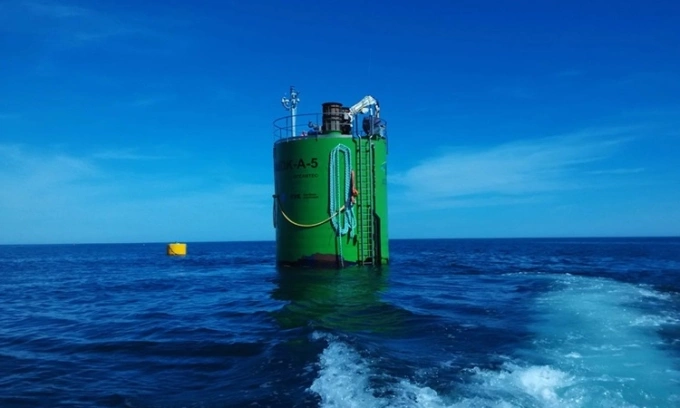
According to Renewable Energy World, the Marmok Atlantic project has successfully deployed a prototype floating wave energy converter (WEC) at the Biscay Marine Energy Platform (BiMEP) test site off the coast of Bilbao, Spain. The prototype, named Marmok-A-5 and developed by Idom, is the first WEC to connect to the grid via a floating buoy. This is one of three wave energy projects under the European Union's EuropeWave research program.
Marmok's main structure is a buoy containing a cylindrical column of water inside. The entire device is 42 meters high, with a 5-meter-long, 5-meter-diameter section protruding above the water and anchored to the seabed at a depth of nearly 90 meters. During operation, ocean waves push against the buoy, causing the water column inside to move relative to the buoy. This movement acts like a piston, compressing and expanding the air chamber at the top of the buoy. The oscillating airflow rotates a turbine, generating electricity that is transmitted to shore via an underwater cable.
Previous versions of the Marmok have been deployed since 2016. The latest version boasts an intelligent control system, adjustable propellers, and an integrated battery pack, aiming to demonstrate its potential for offshore power generation under real-world conditions.
According to New Atlas, Marmok-A-5 can only produce a maximum of 30 kW of electricity, enough to power 15-20 households in the US. After Marmok-A-5 is successfully installed and connected to the grid, the next task is to bring it into full operation. Data collected from testing will help plan the next phase of refining the technology before commercialization and widespread deployment. In the coming weeks, Idom will test Marmok-A-5's power take-off (PTO) system and enhance its operation to achieve higher efficiency.
This isn't the only wave energy conversion device at sea. In 2024, the University of Western Australia also tested a massive WEC design consisting of a steel frame mounted on four floating buoys. The major challenge for researchers is to build a system that is scalable, withstands harsh offshore conditions, is easy to maintain, cost-effective, and minimizes impact on the marine ecosystem.
( According to vnexpress.net )
Source: https://baodongthap.vn/thiet-bi-noi-chuyen-doi-song-bien-thanh-dien-a241130.html

![[Image] Close-up view of the interchange connecting the two expressways and Long Thanh Airport.](https://vphoto.vietnam.vn/thumb/1200x675/vietnam/resource/IMAGE/2026/05/25/1779703378210_ndo_br_z7863716673926-224453a31600126cce10622af6290afd-4549-jpg.webp)
![[Image] Hanoi's urban life under the challenge of a "scorching hot" environment](https://vphoto.vietnam.vn/thumb/1200x675/vietnam/resource/IMAGE/2026/05/25/1779706979265_nang-nong-t5-2026-minh-duy-7-4636-jpg.webp)











































































Comment (0)