

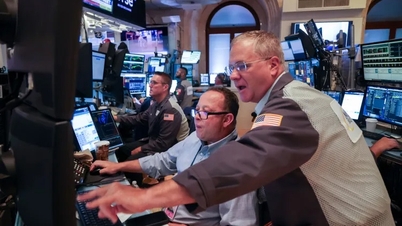
While the collaboration between Ho Chi Minh City and Nasdaq contributes to strengthening management capacity, connecting Vietnam's capital market with the international market, and facilitating the attraction of high-quality capital flows into the finance, technology, and innovation sectors, the collaboration between UEH and NYIF aims at practical training in finance and investment, developing global financial human resources. Importantly, the ultimate goal is to serve the development of the Vietnam International Finance Center in Ho Chi Minh City (IFC-HCM). The early realization of Ho Chi Minh City leaders' commitments to building a dynamic, transparent, and sustainable International Finance Center seems very much in line with Vietnam's development vision until 2030.
From the history of its formation and development, its leading global position in stock exchanges, and its practical financial training, to the five points of cooperation agreed upon with Ho Chi Minh City, the city's approach to building IFC-HCM is evident. This includes, for example, providing technological and technical support and other services for the construction and operation of IFC-HCM, particularly the development of technological infrastructure and a specialized trading floor, the application of Nasdaq's trading, payment, monitoring, and advanced technologies; or training human resources for IFC-HCM, especially in the fields of securities, bonds, derivatives, digital assets, and carbon credit markets.
Clearly, in laying the foundation for IFC-HCM, the first bricks have been prepared and designed according to international standards, not only in terms of technology and infrastructure but also in terms of the legal framework (with efforts to draft and adjust it as appropriately as possible) and personnel. Regarding this, at the meeting of the Steering Committee for the Construction and Development of the Vietnam International Finance Center in Ho Chi Minh City, the Secretary of the Ho Chi Minh City Party Committee, Tran Luu Quang, concluded that the preparation steps should focus on three points: infrastructure and technology, personnel, and institutions. The requirement for "the participation of multidisciplinary experts, international experts, those knowledgeable in finance, and fluent in English" was considered a necessary and fundamental condition.
Broadly speaking, the global integration of academic, policy, and practical approaches that Ho Chi Minh City is pursuing reflects the technocratic spirit in the city's leadership and operation. Placed within the new development context, with its expanding geographical, economic , and social space, Ho Chi Minh City needs to be re-planned, restructured, and operated in a way that is commensurate, with a longer-term, more sustainable perspective. In simpler terms, it needs to be fundamentally renewed from the outset (within the overall framework after the merger), rather than being merely a patchwork solution. The use and emphasis on deep professional expertise and high technical skills in the approach and consultation process will ensure that decisions are made based on practical foundations and with the open participation of all stakeholders, achieving high persuasiveness. From there, the formation of concrete results will only be a matter of time.
This is also the method to demonstrate what is called "knowing how to do" in the process of formulating policies, programs, and projects of the expanded Ho Chi Minh City, as emphasized by City Party Secretary Tran Luu Quang. That is, before "doing," one must "know" – know the expertise; know how to assess the market, potential, and human resources; know how to prepare to respond to unforeseen events and risks… Returning to the IFC-HCM story, we are starting a race, and we need the right starting steps along with calculations of wind direction, distance, and internal resources… to ensure a safe race, smooth acceleration, and an early finish.
Source: https://www.sggp.org.vn/thiet-lap-nen-mong-can-co-cho-ifc-hcm-post818916.html



















































































Comment (0)