

 |
 |
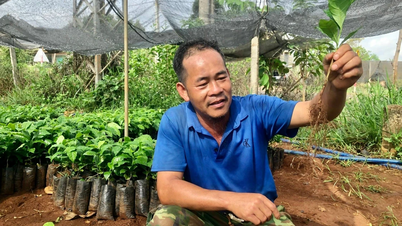
| Mr. Trinh Cao Khai with his family's nearly 2-hectare durian orchard in Phu My neighborhood, Xuan Lap ward. Photo: Doan Phu |
Economic development through crop cultivation.
During his childhood, Trinh Cao Khai's garden was filled with fruit grown by his parents for family consumption. It wasn't until 1980, when he married Tran Thi Ngoc Suong, that he began to think about developing his family's economy through agriculture . With all the capital they had accumulated after their wedding, they bought 2.4 hectares of land along a stream to start their business.
Coffee was the first perennial crop that Mr. Khai and his wife chose to plant, alongside other crops like corn, beans, and rice, to generate short-term income while waiting for the coffee to ripen. From the day they bought the land and dug holes to plant the coffee, Mr. Khai and Mrs. Suong's hope was to endure the rain and sun while waiting for the coffee harvest.
After two successful coffee harvests with a slight surplus, Mr. Khai and Mrs. Suong were delighted to have a very successful coffee harvest in 1987, yielding 3 tons of green coffee beans (at that time, 6 kg of green coffee beans was worth about one tael of gold).
Coffee cultivation enabled Mr. and Mrs. Khai to acquire nearly 2 hectares of new land, bringing their total coffee plantation area to 4.2 hectares. However, coffee prices then began to fall sharply, becoming unattractive to growers, with the worst period being 2001-2005 (prices as low as 2,000-4,000 VND/kg of green coffee beans).
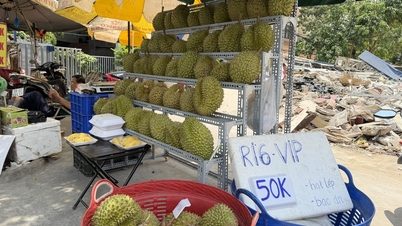
Although they couldn't avoid losses from their coffee plantation investment, Mr. and Mrs. Khai, being shrewd, gradually converted a portion of their coffee plantation to fruit trees such as rambutan, mangosteen, jackfruit, and durian, adopting a multi-cropping approach. The durian varieties that Mr. and Mrs. Khai and many local farmers planted at that time had very unusual names, such as "Chin Hoa" (from the Mekong Delta), or even the growers themselves didn't know what variety it was because they were grown from seeds (they bought the fruit, found it delicious, and then planted the seeds). These weren't the varieties like Dona, Ri6, Monthong, or Musangking, which are considered "billion-dollar" crops by farmers in Xuan Lap ward today.


![[Photo] General Secretary and President To Lam presides over the meeting to approve the draft report on the results of the second inspection by the Politburo of the Standing Committee of the Hanoi City Party Committee.](https://vphoto.vietnam.vn/thumb/1200x675/vietnam/resource/IMAGE/2026/05/26/1779789811432_a2-bnd-4430-9620-jpg.webp)




























































Comment (0)