

Following in Uncle Ho's footsteps in Thailand
One thing that impressed us about Thailand was that, whether walking through modern Bangkok with its elevated train lines spanning the bustling financial districts, or heading to the Northeast where a large Vietnamese community lives, we easily encountered feelings of closeness and affection for Vietnam. In the stories of many overseas Vietnamese, the word "homeland" was always mentioned with very natural emotion.
Located in Lane 2 on Srisuk Road, Vietnam Town stands out with its red and yellow archway in the heart of modern Udon Thani province. The neighborhood originated from the Vietnamese market in the city center, where almost all residents are of Vietnamese origin, having lived for generations. Vietnamese signs, the red flag with a yellow star, and the sounds of children learning their mother tongue make this place feel like a corner of home in the land of temples.
For the past few days, Thai media and the Vietnamese community in the area have been eagerly anticipating the visit of General Secretary and President To Lam. Many overseas Vietnamese from Sakon Nakhon province traveled 160km to arrive in Udon Thani early in the morning to welcome the delegation. The presence of General Secretary and President To Lam, his wife, and the high-ranking Vietnamese delegation in the late afternoon at the Nam Nueng Cultural Center brought warm and sincere moments.
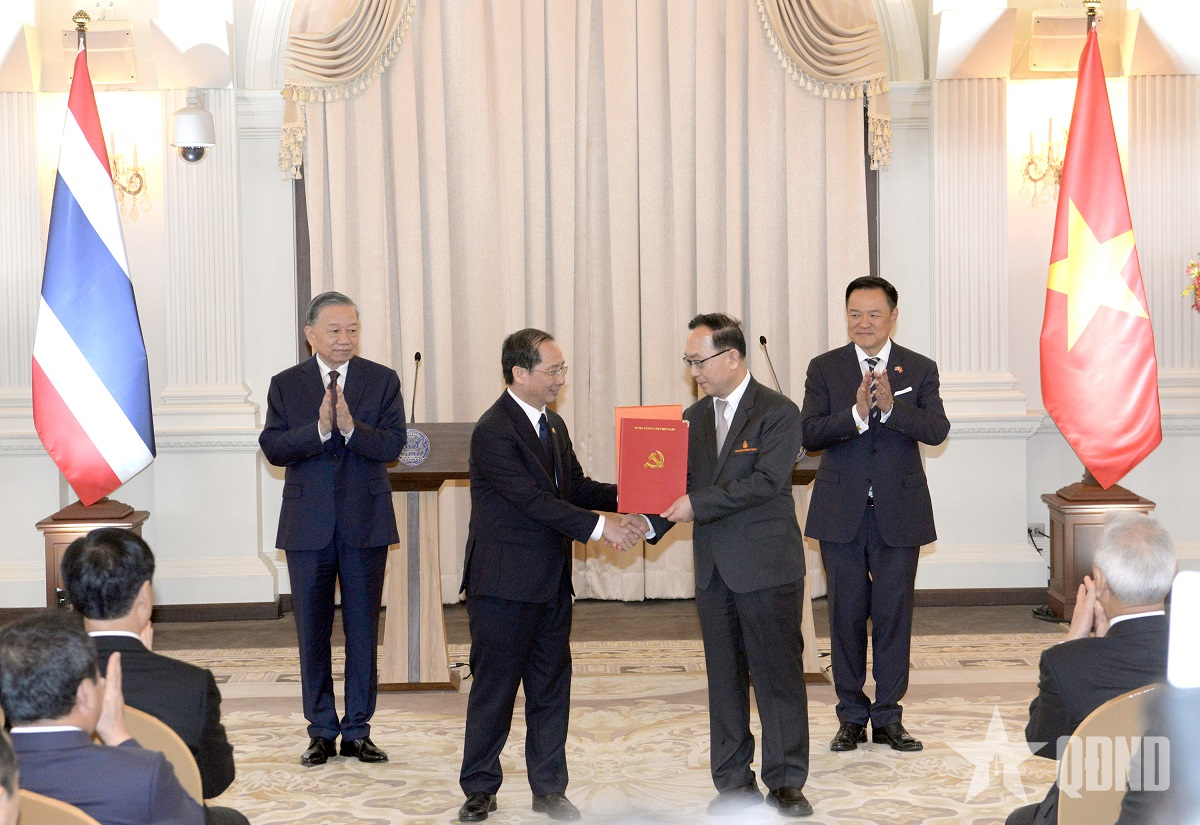 |
| General Secretary and President To Lam and Prime Minister of Thailand Anutin Charnvirakul witnessed the signing ceremony of cooperation documents. |
Listening to the General Secretary and President share about the changes in the country and the aspirations for development in the new era, many overseas Vietnamese felt a surge of pride and confidence. Vietnamese Ambassador to Thailand Pham Viet Hung happily reported to the General Secretary and President that the Vietnamese and people of Vietnamese origin in Thailand currently number around 100,000. They not only preserve their national identity but also serve as a bridge promoting friendly relations between Vietnam and Thailand, and especially demonstrate their deep respect and love for President Ho Chi Minh across generations.
Despite his busy schedule, during his recent state visits, General Secretary and President To Lam always made time to revisit places associated with President Ho Chi Minh and the history of the Vietnamese revolution. This is not only an expression of gratitude but also demonstrates the profound affection and loyalty of Vietnam to its international friends today. Perhaps that is why the stories about President Ho Chi Minh's revolutionary activities—under the pseudonym "Thau Chin"—in Udon Thani made General Secretary and President To Lam's visit to the Ho Chi Minh Memorial Site that afternoon last longer than expected.
Stopping for quite a while by the well where Uncle Ho used to draw water for daily use with the villagers, and gazing at the small wooden house and simple bed where he lived years ago, the General Secretary and President repeatedly expressed his emotion as he inquired about the life, living conditions, and affection that the Vietnamese expatriates and local people had for Uncle Ho during his revolutionary years. Amidst this simple setting, memories of a difficult period in the history of the Vietnamese revolution still seemed to linger.
During his time living in Udon Thani from 1928, Uncle Ho often advised Vietnamese expatriates to work diligently, unite, abide by the law, and maintain good relations with the local people. He also encouraged them to learn Thai and understand Thai culture in order to live together harmoniously. The diplomatic philosophy of "making more friends and fewer enemies" and the spirit of good neighborliness that he left behind have become a guiding principle for subsequent generations to continuously cultivate friendship.
In his guestbook, General Secretary and President To Lam expressed his emotion upon visiting the historical site, which is not only a sacred historical and cultural landmark for Vietnamese expatriates in Thailand, but also a vivid symbol of the close relationship between the Vietnamese and Thai peoples.
Nearly a century has passed, yet the "seeds of friendship" sown during those years continue to flourish in Vietnam-Thailand relations today. From the establishment of diplomatic relations in 1976, to the upgrading to a strategic partnership in 2013, and especially to officially becoming a comprehensive strategic partnership in 2025, Thailand is now one of Vietnam's leading economic partners.
Promoting the "Three Connections" Strategy
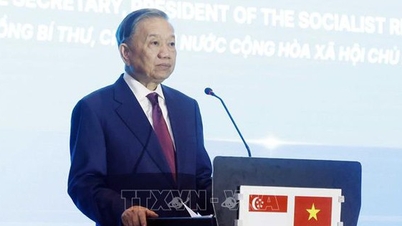
General Secretary and President To Lam had two days of packed activities with urgency and efficiency. What was clearly felt was the sincere, open, and trusting atmosphere between the leaders of the two countries. From high-level talks and meetings to business gatherings, both sides not only emphasized traditional friendship and achievements but also clearly demonstrated their determination to move bilateral relations to a more substantive, effective, and closely integrated stage of cooperation within the new development space of ASEAN.
This year's Vietnam-Thailand Business Forum has a very thought-provoking theme: Developing Together. In a world fragmented by strategic competition, supply chain disruptions, and growth pressures, "going together" is becoming an increasingly important need for ASEAN economies.
The presence of General Secretary and President To Lam made the forum more vibrant and practical. The message emphasized by the General Secretary and President was the need to move Vietnam-Thailand relations to a deeper and more sustainable stage of integration. This was clearly demonstrated through the direction of promoting the effective implementation of the "Three Connections" Strategy, which includes connecting supply chains, connecting businesses and localities, and connecting in the goal of sustainable development.
A positive development on the sidelines of the General Secretary and President's meetings with businesses in Thailand is that in the first four months of 2026 alone, Vietnam's exports of computers, electronic products, and components to Thailand exceeded US$1 billion, a 29.2% increase. Conversely, high-tech Thai products such as household appliances and automotive parts remain popular with Vietnamese consumers. This demonstrates the increasingly deep integration of the two economies within the regional supply chain.
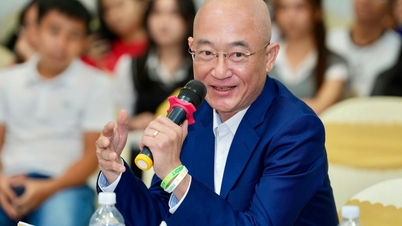
This spirit was once again emphasized by General Secretary and President To Lam during his meeting with the Chairman and CEO of TCC Group and ThaiBev Group (Thailand), when he affirmed that Vietnam is continuing to improve its investment and business environment; prioritizing the attraction of high-quality projects with high scientific and technological content and modern management; and requesting the Group to participate more deeply in the supply chain.
General Secretary and President To Lam stated that one side possesses strong dynamism, while the other is rich in experience and depth. If these two advantages are connected with a new vision, Vietnam and Thailand can jointly form supply chains, production and distribution centers, trade and service platforms, and new growth drivers for both countries as well as for ASEAN.
With over $15 billion in investment, bilateral trade exceeding $22 billion, and nearly 20 pairs of localities having established cooperation, the Vietnam-Thailand relationship today has far surpassed the framework of a conventional partnership. However, General Secretary and President To Lam believes there are still many untapped opportunities. The current issue is not just about expanding the scale but also about increasing the depth of connectivity and tangible effectiveness. It is necessary to further promote connections between businesses, localities, logistics, and supply chains; and to translate strategic commitments into concrete cooperation programs, creating real value for both economies.
It is clear that during this visit, the leaders of the two countries not only promoted the expansion of bilateral relations but also set out a larger vision: strengthening linkages among ASEAN countries to jointly enhance the competitiveness, adaptability, and position of the region in a rapidly changing world. This demonstrates that Vietnam-Thailand relations are entering a phase of deeper and more substantive integration.
Looking back at the long history of Vietnam-Thailand relations, this visit by General Secretary and President To Lam marks a milestone, opening a new chapter of cooperation between the two countries. From the bridges built on people-to-people ties to the expanding strategic linkages today, Vietnam-Thailand relations are increasingly showing the clear shape of a dynamic, substantive cooperation model, all oriented towards the sustainable development of the ASEAN region.
Text and photos: PHAM KIEN (from Bangkok, Thailand)
Source: https://www.qdnd.vn/chinh-polit/cac-van-de/thong-diep-ket-noi-tu-xu-so-chua-vang-1041797

![[Photo] Ba Lang An Lighthouse - the "eye of the sea" amidst the "rock museum" of Quang Ngai province.](https://vphoto.vietnam.vn/thumb/1200x675/vietnam/resource/IMAGE/2026/05/29/1780038698840_anh-man-hinh-2026-05-29-luc-14-10-42.png)
![[Image] Pleasant weather helps students enter the 10th grade entrance exam with confidence.](https://vphoto.vietnam.vn/thumb/1200x675/vietnam/resource/IMAGE/2026/05/29/1780034401612_ngay-1-thi-lop-10-minh-duy-8-5009-jpg.webp)


















































Comment (0)