

The digital economy is growing rapidly but has yet to generate traction.
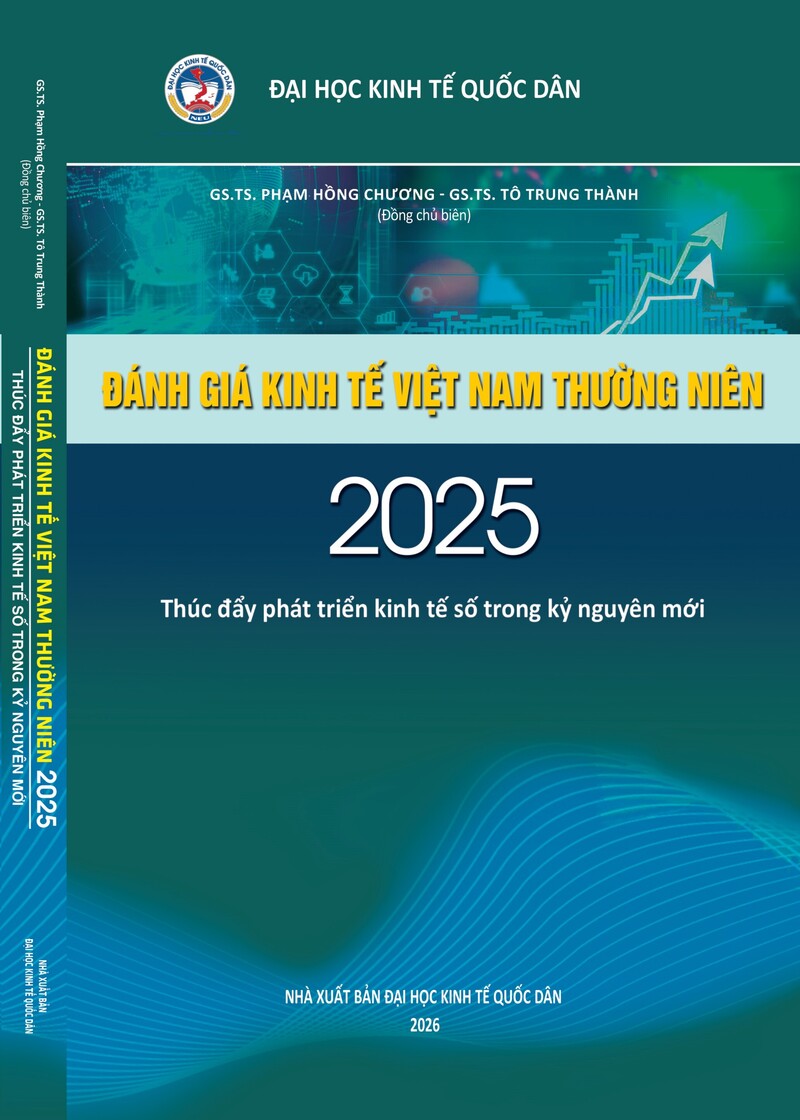
On the morning of April 24th, the National Economics University organized the national scientific conference "Vietnam's Economy in 2025 and Prospects for 2026: Promoting Digital Economic Development in the New Era," and simultaneously announced the annual Vietnam Economic Assessment 2025 publication.

Press conference announcing the annual Vietnam Economic Review 2025. Photo: Nguyen Hanh
Presenting the report, Professor To Trung Thanh from the National Economics University stated that the digital economy should be understood as the process of developing an economic model based on data, digital technology , and innovation, and as a comprehensive restructuring of the economy in the digital age.
This year's report adopts a structural perspective, thereby quantifying more clearly the impact of the digital economy on growth, employment, income, and economic sectors. Notably, the research team used the latest updated inter-industry (IO) balance sheet, combining macro, sectoral, and micro-level analysis at the enterprise level.
According to assessments, amidst global economic uncertainties, Vietnam's economy is expected to grow by approximately 8.02% in 2025, reaching an estimated size of $515 billion, ranking 33rd in the world. Per capita income is projected to reach around $5,000, further narrowing the gap with other countries in the region.
The main drivers of economic growth come from the industrial sector, especially processing and manufacturing, thanks to the recovery of export orders, along with improvements in the service sector due to tourism and consumption. However, these drivers still carry risks as they depend on external developments.
From the demand side, growth was primarily driven by consumption and investment, with investment increasing by approximately 12%. However, the investment structure continued to be skewed towards the state sector, while the domestic private sector, considered a long-term driver, faced numerous challenges.
Notably, growth remains heavily reliant on bank credit, with credit projected to increase by nearly 19% in 2025, bringing the total credit volume to approximately 150% of GDP. This reflects the underdeveloped capital market and poses potential risks to macroeconomic stability.
From the perspective of growth quality, the contribution of total factor productivity (TFP) has turned negative, indicating that growth still relies primarily on capital expansion, while long-term factors such as technology, innovation, and human resource quality remain limited.
Entering 2026, the target of approximately 10% growth is considered very challenging in the context of slowing global economic growth and increasing risks. To achieve this goal, the two main drivers identified are industry and construction, and services, with manufacturing playing a central role, while services shift towards high-value sectors such as finance, logistics, and tourism.
However, the report emphasizes that the core issue is not just whether growth is fast or slow, but what model of growth it follows. In this context, the digital economy is identified as the central solution. Currently, the digital economy accounts for approximately 14.02% of GDP, with an average growth rate of 10% per year. Despite these positive results, the development process still faces many limitations.
Firstly , the digital economy structure is unbalanced, with the core (ICT) sector accounting for up to 60% of the value, while the level of digitalization spreading to other sectors remains low.
Secondly , development is uneven across regions and sectors. High-tech manufacturing centers are concentrated in a few northern localities, while major cities play a service and innovation role. Many sectors such as agriculture, construction, and finance still have low levels of digitalization.
Thirdly , the quality of growth remains limited. The intermediate cost ratio of the core digital economy reaches 70–80%, while the value-added ratio is only about 20–25%, significantly lower than the overall average for the economy.
This reflects the reality that Vietnam mainly participates in processing and assembly stages in the global value chain, while high-value stages such as design, R&D, and technology mastery remain limited.
Furthermore, the spillover effect of the digital economy to the national economy remains weak and has not yet become a common technological foundation. Notably, the spillover effect to imports is much higher than the value added domestically, indicating that the development model still depends on external inputs.
Shifting from “digitalization” to “economic restructuring”
Based on the above analysis, the report suggests that the key to developing the digital economy is shifting from a "digitalization" mindset to a "restructuring of the economy based on digitalization".
This orientation needs to be implemented on three pillars: developing a core digital economy focused on mastering technology; promoting digitalization and restructuring industries; and building a data-driven digital governance system.
Based on that, the report proposes key solution groups, including improving the institutional and legal framework for the digital economy; developing core technologies and attracting high-quality FDI; restructuring industry to increase the localization rate; promoting widespread digital transformation; and enhancing the technology absorption capacity of businesses.
According to experts, Vietnam is facing a great opportunity amidst the restructuring of global value chains and the emergence of new growth drivers in the digital age. If this period is well-utilized, the economy can achieve a strong breakthrough; conversely, if it is missed, it will significantly impact growth prospects, especially in the medium and long term.
Therefore, the issue is not just about fast or slow growth, but about choosing the right development model for the next 10 years—a model based on productivity, technology, and innovation, rather than continuing to rely on capital expansion as before.
In terms of scale, Vietnam's digital economy currently accounts for approximately 14.02% of GDP, with an average growth rate of about 10% per year. This is a remarkable achievement, demonstrating the positive development trend of this sector in recent years.
Source: https://congthuong.vn/thuc-day-kinh-te-so-chia-khoa-doi-chat-tang-truong-453648.html

![[Image] Close-up view of the interchange connecting the two expressways and Long Thanh Airport.](https://vphoto.vietnam.vn/thumb/1200x675/vietnam/resource/IMAGE/2026/05/25/1779703378210_ndo_br_z7863716673926-224453a31600126cce10622af6290afd-4549-jpg.webp)
![[Image] Hanoi's urban life under the challenge of a "scorching hot" environment](https://vphoto.vietnam.vn/thumb/1200x675/vietnam/resource/IMAGE/2026/05/25/1779706979265_nang-nong-t5-2026-minh-duy-7-4636-jpg.webp)

































































































Comment (0)